Mechanics instead of chemistry — what this actually means
Most cosmetology treatments work chemically or thermally: acid exfoliates the epidermis, a laser heats the tissue, an ampoule delivers an active ingredient. Endermolift is based on an entirely different principle — a mechanical stimulus. The device's specialised handpiece grips a fold of skin and sets it into controlled, rhythmic motion: lifting, folding, rotating, stretching it.
It sounds simple, but the consequences run deeper than they seem. Skin — and fibroblasts in particular, the cells that produce collagen and elastin — evolved over millions of years in an environment full of movement and tension. Muscles beneath it work, tissues stretch, gravity pulls down. Fibroblasts need these mechanical signals to function properly. When skin stops being sufficiently "moved" — for the face, this includes a loss of elasticity that everyday facial expression can't compensate for — fibroblasts start producing less collagen and elastin. Endermolift aims to restore that signal.
What the handpiece looks like and what it does to the skin
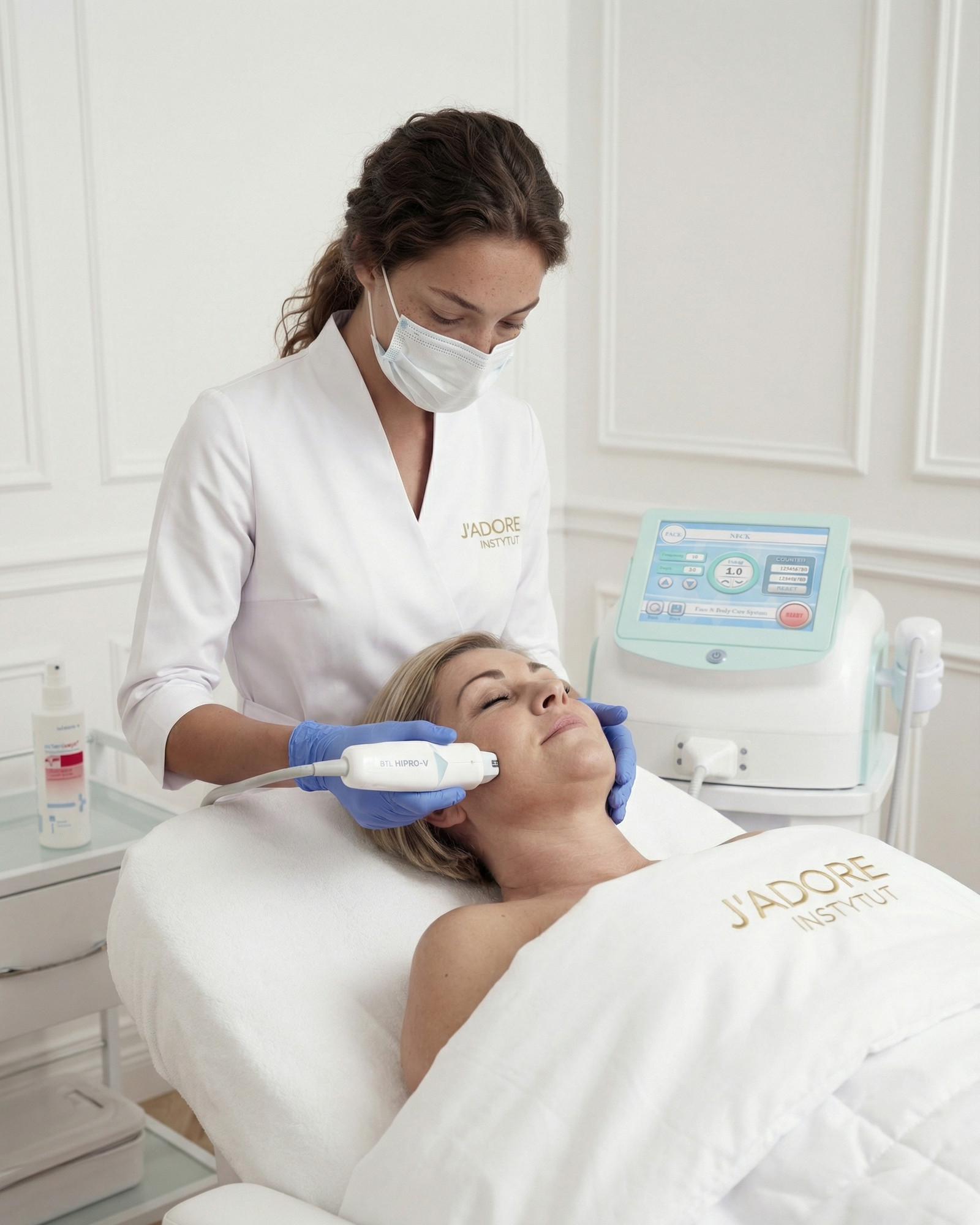
The endermolift handpiece is fundamentally different from the one used on the body — it's smaller, more precise and designed for the delicate, thin skin of the face, neck and décolletage. It works using a system of two motorised rollers and suction: the rollers gently grip a fold of skin, suction "draws it in", and the rollers then set it in motion in whatever direction and rhythm the specialist chooses.
- 01
Suction lifts the fold
The handpiece draws the skin in without mechanical pressure from the specialist's hand — gently, in a controlled way, with no pinching. The epidermis isn't pressed from outside; it's lifted from below.
- 02
The rollers set it in motion
Two moving rollers inside the handpiece get to work: folding the skin, unfolding it, rotating it. Direction, speed and amplitude are all set by the specialist for the specific area of the face.
- 03
The signal reaches the fibroblasts
The movement stretches the fibres of the dermis, where fibroblasts live. The cells pick up the mechanical signal and can respond with increased metabolic activity.
- 04
Drainage and microcirculation
The rhythmic movement of the tissue supports lymphatic drainage and improves circulation in small blood vessels. Often, even after the first session, the face looks better nourished and less puffy.
The entire treatment is performed through a special stocking placed over the face — a thin, close-fitting fabric that reduces friction, protects the skin and lets the handpiece glide smoothly. This keeps the skin free from irritation, and the treatment remains pain-free and non-invasive.
Four processes triggered by movement
Endermolift doesn't do one thing — it does several at once. That's why its effects are often hard to attribute to a single mechanism. Here are the four main processes triggered by mechanical facial massage:
- Fibroblast stimulation. A mechanical stimulus can trigger fibroblasts to increase collagen and elastin production. In many people, skin becomes denser after a series of sessions, and its elasticity noticeably improves — particularly where natural firmness has weakened.
- Improved microcirculation. The rhythmic movement of the tissue "pumps" blood through small vessels and supports cell oxygenation. The result is often a change in skin tone — grey, tired-looking skin starts to look more alive after just a few sessions.
- Lymphatic drainage. Unlike blood, lymph has no pump of its own — it moves through muscle contractions and pressure on tissue. Endermolift provides an ideal rhythmic stimulus for this: it supports the removal of excess fluid and reduces the tendency towards swelling and puffiness, particularly visible in the morning around the eyelids and cheeks.
- Relaxation of the facial muscles. Faces work — all day long. Stress, tension, jaw clenching, frowning. Rhythmic endermology massage can release this chronic tension and restore the face to a neutral, "rested" expression.
Endermolift versus classic massage — what it does differently
Since we're talking about mechanical facial massage, a natural question arises: isn't this just the same as a good massage from a beautician? The similarity is superficial — the mechanism of action is fundamentally different.
Manual facial massage
works on the surface and muscles
- Pressure and stroking on the skin and subcutaneous tissue
- Relaxation of facial muscles and fascia
- Improved circulation through the warmth and movement of the hands
- Draining effect dependent on the therapist's technique
Endermolift (endermology massage)
works directly on the dermis
- The handpiece grips and folds the dermis in a controlled way
- The mechanical signal reaches fibroblasts directly
- Repeatability and precision of settings — the same depth every session
- Suction + movement = simultaneous drainage and stimulation
The key difference lies in the repeatability and precision of the stimulus. Even a very experienced masseur's hands can't reproduce exactly the same force, rhythm and direction every time. Endermolift, as a device, is calibrated: the parameters can be set and repeated session after session. This isn't an argument against manual massage — it's an argument that the two work on different principles and often work best together.
Who endermolift makes sense for
Endermolift isn't a treatment for one narrow problem. Its mechanism of action means it can bring benefits for several different needs — which is why such a wide range of people come to the salon for it.
- Loss of firmness and facial contour. When the jawline loses its definition, cheeks start to sag and skin "slides" — endermolift is often the first treatment people reach for when looking for a lifting effect without medical intervention.
- Puffiness and a tendency to retain water. People who wake up with swollen faces, dark circles and a "tired" look often respond to endermolift quickly and noticeably. Lymphatic drainage tends to be the fastest visible effect here.
- Grey, lacklustre skin. When skin has lost its glow and looks visually "flat", lacking depth of tone — the improved microcirculation that endermolift offers can be a simpler, less invasive solution than aggressive peels.
- Prevention and slowing the signs of ageing. Regular endermolift as a maintenance treatment — particularly past your thirties, when collagen production naturally starts to slow — can be part of a preventive strategy. Fibroblast stimulation makes sense before a problem becomes clearly visible.
- Works well alongside other treatments. Endermolift doesn't compete with aesthetic medicine — it often complements it well. After hyaluronic acid treatments, biostimulators or mesotherapy, it can support circulation and drainage in the treatment area and reinforce the effect of the primary treatment.

Series or single session — what to choose
It's worth being honest here: as a single session, endermolift most often delivers improved radiance, a refreshed look and a slight release of tension — something worth doing before an important event. But its real potential — fibroblast stimulation, improved skin density, lasting change in firmness — requires a series and consistency.
Fibroblasts don't change their activity after a single stimulus. They need repeated signals at the right rhythm — a bit like physical training. One gym session doesn't change your physique; only regular, planned sessions produce a lasting effect. The same applies here. The optimal frequency and length of a series is individual — and that's exactly what you discuss with a cosmetologist, who will assess your skin's condition and plan the treatment protocol.
Endermolift as part of a broader strategy
Treatments are increasingly less often treated as an "either–or" choice. Endermolift is by nature compatible with other methods — because it works at a level most treatments bypass. It doesn't deliver a substance, doesn't heat, doesn't exfoliate. It stimulates through movement — and that's exactly what allows it to support or complement almost any other protocol.
Biostimulators (Sculptra, Radiesse)
Endermolift after biostimulators supports microcirculation in the treatment area and can help create optimal conditions for new collagen formation.
Needle mesotherapy / hydrating cocktails
A series of endermolift sessions can improve absorption of active ingredients by boosting circulation and drainage — the treatments work synergistically.
Lifting threads
Endermolift as a maintenance treatment after threads helps sustain the lifting effect, supporting the tissue and drainage without interfering with how the threads work.
HIFU / RF
While HIFU and RF work with heat in deeper layers, endermolift complements them with a mechanical stimulus in the dermis — different depths, different mechanisms, one shared direction.
Everyday home care
Endermolift doesn't replace home care — but by improving microcirculation, it can create better conditions for absorbing the active ingredients in the serums and creams you use at home.
Which combination makes sense specifically for you depends on your skin's condition, your priorities and your treatment history. The best protocols are always planned individually — there's no single formula for everyone. That's the main purpose of the initial consultation — not to sell a treatment, but to match the treatment logic to your particular face.