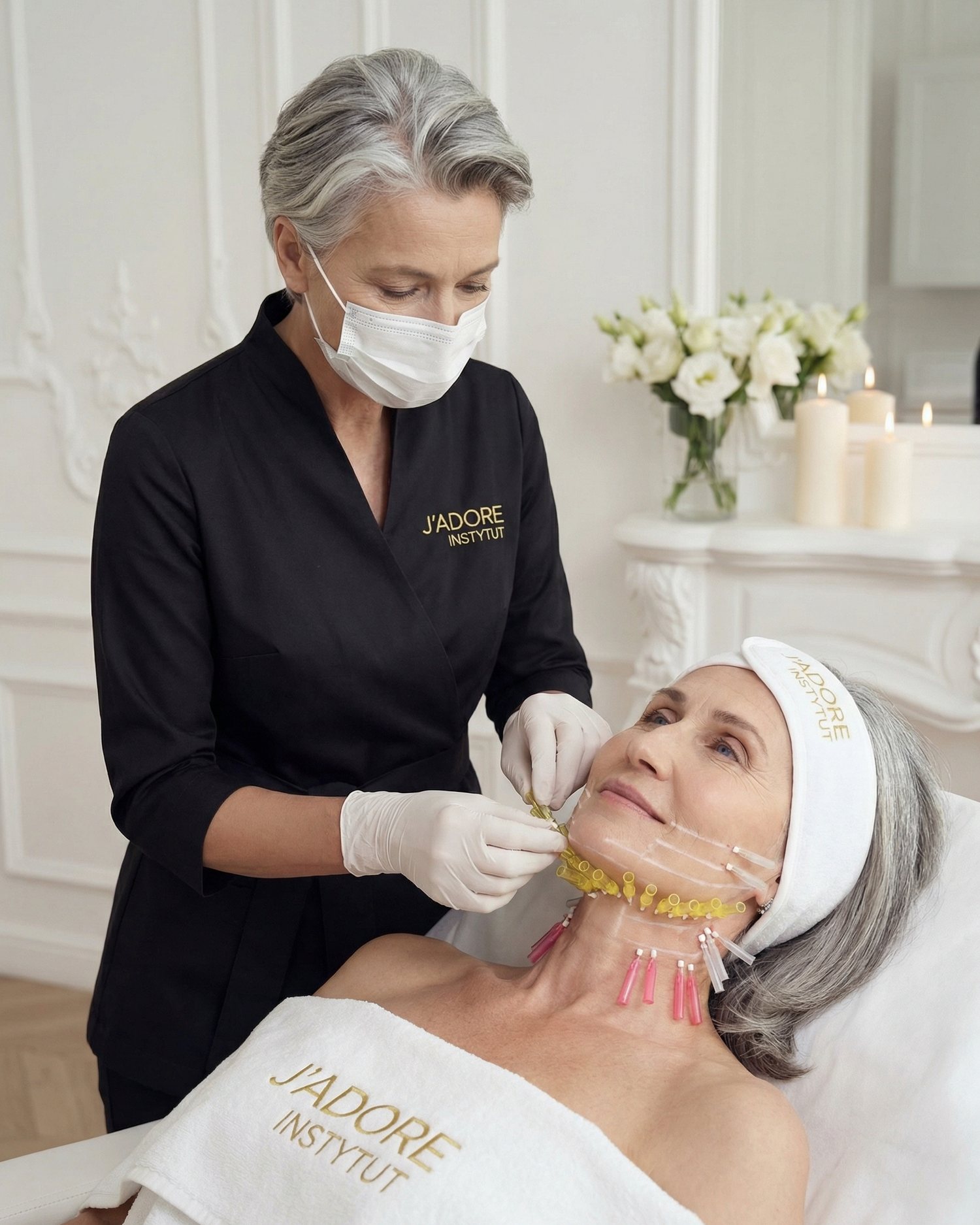

What fascia actually is — and why nobody talks about it
Fascia (from the Latin fascia) is connective tissue that forms continuous, three-dimensional membranes. These membranes surround, separate and connect muscles, organs, bones and blood vessels throughout the body. In the face and neck, fascia forms an extensive system of layers — from the deep musculoskeletal fascia, through the layer that links the facial muscles to the skin, to the thin subcutaneous network just beneath the surface.
For a long time, fascia was treated as "packaging" — a passive membrane that simply held things in place. We now know that's an incomplete picture. Fascia is a living, active tissue: it contains proprioceptive receptors, lymphatic and blood vessels, and — crucially — its own cells, fibroblasts, which continually remodel its structure. It can contract, tense, and respond to overload and inflammation. When healthy and well hydrated, it stays elastic and lets movement pass freely through it. When it becomes dysfunctional, it stiffens, forms adhesions and starts to restrict.
So why does it rarely come up in conversations about facial ageing? Probably because for decades, cosmetology focused on what's visible to the naked eye: skin, wrinkles, hyperpigmentation. Fascia is invisible and requires anatomical knowledge to understand. But a growing body of research, together with increasingly mature clinical practice, points to it as one of the key players in facial sagging.
SMAS — the fascia that shapes the face
Facial anatomy includes several fascial layers, but one carries particular weight for aesthetics: SMAS — the Superficial Musculo-Aponeurotic System. This layer connects the facial expression muscles to the subcutaneous tissue and skin. It lies deeper than skin and subcutaneous fat, but more superficially than nerves and major blood vessels — which makes it a natural point of intervention.
With age, SMAS changes much like other connective tissue in the body: it loses hydration, the collagen and elastin fibre content in its structure declines, and constant tensing from facial expressions accumulates micro-adhesions. Add gravity to the mix — over decades, it literally pulls the whole layer downward. The result: SMAS loosens, skin detaches from the deeper scaffold beneath it, and the contour begins to sag.
How fascia changes with age — four mechanisms
Facial fascia doesn't age through one simple mechanism. It's an interplay of four processes happening at once — and each has its own distinct character.
- 01
Dehydration and loss of elasticity
Healthy fascia is elastic because it's well hydrated — it contains large amounts of hyaluronic acid and proteoglycans that bind water. With age, water-binding capacity declines, and fascia thickens and stiffens. It loses its ability to glide smoothly between layers — it starts to stick together.
- 02
Build-up of restrictions and adhesions
Every micro-injury, every episode of inflammation, every prolonged muscular tension (clenching your jaw, chronic stress) leaves its mark on fascia in the form of restrictions — localised areas of increased stiffness. Over the years, these restrictions accumulate, and fascia stops being uniform. It becomes "cut up" and uneven, which limits its hinge-like function.
- 03
Loss of tension and gravity
As collagen and elastin decline in its structure, fascia loses its passive elasticity — its ability to return to its original shape after stretching. Gravity, which it must resist for a lifetime, starts to gain the upper hand. The layer holds the tissue lying on top of it less and less effectively.
- 04
Separation of layers
As fascia loses tension and develops restrictions, it also loses its ability to transmit movement evenly. Layers that should work together — skin, fat, SMAS, muscle — start to separate functionally. This is what produces the feeling of "loose" skin and a visibly sagging contour, even when the surface itself is in good condition.
Fascia and other facial layers — who talks to whom
Fascia doesn't work in isolation. It's part of a larger system, and its condition affects — and is affected by — everything happening in the surrounding layers. Understanding facial ageing means looking at the whole chain, not a single layer.
Healthy fascia — what it enables
when functioning correctly
- Subcutaneous fat stays at the right level
- Facial expression muscles transmit movement smoothly to the skin
- Skin has an anchor point — it doesn't "detach"
- Lymph and blood flow efficiently through its vascular network
- The face looks full and firm — even without intervention
Weakened fascia — what breaks down
when dysfunction sets in
- Fat pads slide downward — jowls form along the jawline
- Muscle movement transmits unevenly — folds deepen
- Skin loses support and starts to sag independently
- Lymphatic stagnation — puffiness and dark circles
- The contour loses definition, the jawline blurs
This chain of dependencies explains a paradox that sometimes shows up in clinic: skin in good condition, flawless skincare routine — and the contour still sags. Because the problem sits in a layer no cream can reach. And the reverse is also true: when fascia is well cared for, the skin itself looks better too, because it has consistent support and better blood supply.

What can realistically be done — the logic of working with fascia
Since fascia is a living tissue with its own metabolism, it can be influenced — both manually and technologically. The difference from working with skin is fundamental: here we're not applying anything to the surface. We work deep and address the mechanics of the layer itself.
- Manual techniques (fascial massage, Gua Sha, osteopathic techniques). Regularly releasing restrictions through experienced hands or the right tools can improve gliding between layers and restore elasticity to fascia. For many people, this produces quickly visible results in tissue tension and lymphatic drainage — but it requires consistency, because fascia "remembers" its habits.
- Wave technology and deep vibration work. Certain in-clinic technologies are designed to reach deeper connective tissue layers. They work through mechanical stimulation that can prompt fibroblasts within the fascia to regenerate. This is an area where technology and anatomical knowledge meet.
- Biostimulation and scaffold rebuilding. Treatments that stimulate skin and subcutaneous tissue to produce collagen also indirectly support fascia — they improve the quality of the environment it functions in. For many people, overall tissue tension and density improve.
- Working with muscles — because fascia and muscle form one network. Tense, shortened muscles (from bruxism, or hunching over a computer) pull on fascia and reinforce its restrictions. That's why relaxation treatments, work on neck and shoulder tension, and even posture correction can have a real effect on the facial contour. It sounds like a distant connection at first, but anatomically it holds up completely.
Lifting massage + biostimulators
Manual fascia work releases restrictions and improves gliding between layers, while biostimulation supports their quality from within — two complementary levels of the same work.
Deep stimulation techniques + home care
Treatments working on deeper layers give better results when the skin is well nourished and hydrated — good fascial hydration is a precondition for its elasticity.
Muscle tension work + lifting fascial techniques
Relaxing facial and neck muscles (bruxism, neck tension) removes the constant pulling forces on fascia — which makes the results of lifting techniques last longer.
Fascia and daily routine — what's worth knowing
Facial fascia responds not only to in-clinic treatments, but also to what you do — or don't do — every day. Here are a few connections that even people who take good care of themselves often miss:
- Hydration. Fascia is largely made up of water bound by glycosaminoglycans — substances that lose this ability under chronic dehydration. Drinking enough water isn't a cosmetic cliché; it's a precondition for the mechanical fluidity of fascia.
- Stress and muscular habits. Chronic tension in the jaw muscles (clenching, especially at night), raised shoulders, forward head posture at a computer — all of this directly deforms the fascia of the face and neck. Changing postural habits often brings surprisingly quick visible results.
- Movement and microcirculation. Fascia needs movement to stay elastic — much like joints do. Regular physical activity improves blood supply to fascia and supports its regeneration. Prolonged sedentary behaviour encourages stagnation and restrictions.
- Sleep quality and sleeping position. Consistently sleeping on one side of the face can, over the years, reinforce asymmetric patterns of fascial tension. The right pillow shape or sleeping on your back reduces this effect.
In practice, this means working with fascia isn't just a series of treatments — it's a shift in how you think about the face as a system, not a flat surface for applying products. Understanding this mechanism allows for more precise treatment, and results — both in-clinic and at home — last longer and stay more consistent.