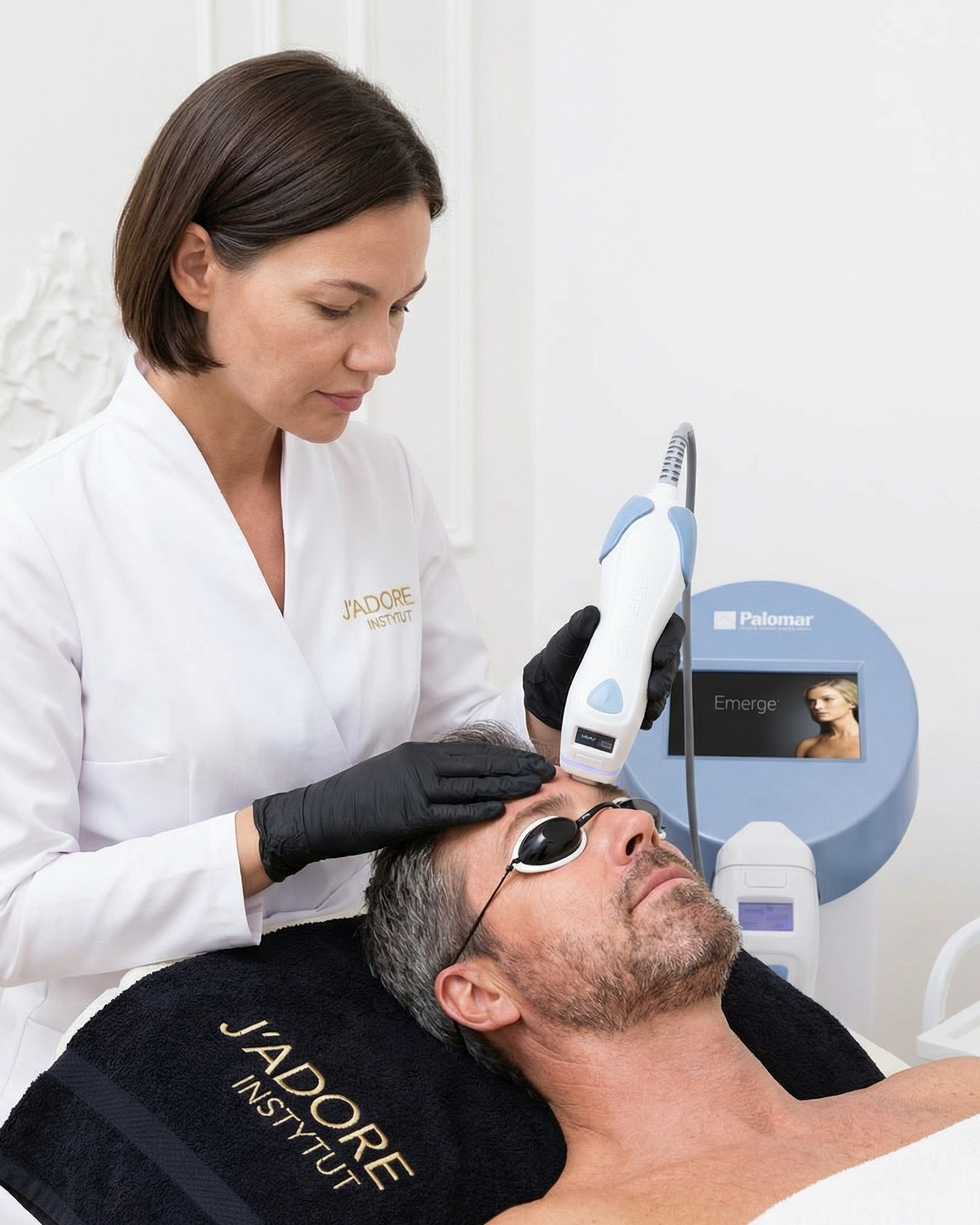

What a laser actually does when it hits a tattoo
To understand why this takes time, start with how a tattoo actually sits in the skin. Ink isn't a "coating" on the epidermis — if it were, it would fade along with a suntan in a few weeks. Pigment particles are embedded deeper, in the dermis, and they're too large for the body's clean-up cells to simply carry away. That's why tattoos are permanent: the body surrounds and "seals" the pigment because it can't get rid of it. It's a kind of stalemate — the pigment stays trapped for years.
A laser breaks this stalemate in a clever way. It sends ultra-short, very powerful pulses of light into the skin. These pulses are absorbed by the pigment particle but not by the surrounding skin. The pigment heats up almost instantly and — put simply — shatters into smaller fragments, rather like a glass marble struck with a hammer. Crucially, this happens so fast that the heat has no time to spread into nearby tissue. That's the whole philosophy behind these lasers: break up the ink, don't burn the skin.
And here lies the whole point of the patience this treatment requires: the laser only breaks up the ink — it doesn't remove it. The shattered pigment fragments are now small enough for the body's clean-up cells to finally engulf and carry away — through the lymphatic system, gradually, over weeks. Your body is what actually removes the tattoo. The laser simply does the groundwork. That's why time has to pass between sessions — so there's something to clean up, and someone to do the cleaning.
Why one session isn't enough — and neither are three
If a laser can break up pigment, why not do it all at once, in one long visit? Because skin has limits. During a single session, it's only safe to target part of the pigment particles — the ones the light can reach and break down without damaging the tissue above and around them. The rest of the ink waits for the next round. Trying to do everything in one go raises the risk to the skin — burns, scarring, permanent discolouration — far more than it raises the result.
The second reason matters even more: between sessions, it's not the laser working, but your own body. After each treatment, a period follows in which clean-up cells carry away the shattered pigment and the skin regenerates. Only once this work is done does the next session make sense — because it "reveals" the next layer of ink that the light couldn't previously reach. Repeating sessions too often doesn't speed anything up, and it can cause harm. That's why clear intervals are kept between visits — and why the whole process, however much you might wish otherwise, unfolds over months, not weeks.
That's why an honest conversation about the number of sessions never ends with a single figure. It ends with a range and conditions: "with this tattoo, these colours and this skin, we'd expect roughly this many visits, but we'll confirm that after the first sessions, once we see how your skin responds." That's not evasive — it's the only honest answer, because every tattoo responds individually, and the best predictor is how it fades after the first two or three sessions.
Why colours fade so differently
If there's one thing that surprises people most, it's this: not every ink colour fades equally easily. It isn't down to pigment being "stubborn" — it's physics. A laser works because its light is absorbed by the ink particle. Different colours absorb different wavelengths of light — much like a black T-shirt heats up more in the sun than a white one. That's why different colours need genuinely different "shades" of laser light, and some colours are simply harder targets.
- Black and dark navy — the easiest. Black absorbs virtually every wavelength of light, so the laser "sees" it easily and breaks it down effectively. That's why old, black, amateur tattoos usually fade best — and why they feed the "three sessions" myth. Most tattoos worldwide are predominantly black, which skews the overall picture.
- Red, orange — usually cooperative. Warm colours generally have a well-matched laser "shade" and respond decently, though not as readily as black.
- Green and blue — more resistant. These are the classic difficult cases. They absorb a narrow range of light, so they need a specially matched laser handpiece, and even then they fade more slowly and need more sessions. This is where the promise of "just a few sessions" falls apart fastest.
- Yellow, white, pastels — the most unpredictable. Light and "lightened" inks absorb little laser light, which can make them the hardest to shift. White can even play a trick and darken instead — more on that shortly.
The same logic explains an important truth about colourful, professional tattoos: they can be the hardest to remove not because they were done poorly, but precisely because they were done well — densely, intensely, with many colours at once. Each colour is a separate task for the laser. That's why a small black inscription and a multicoloured design of the same size are two completely different plans, even though they look similar from the outside.
What else really determines the number of sessions
Colour isn't everything. A whole list of factors shapes how many visits removal will actually take — which is exactly why two people with "the same" tattoo can end up with completely different plans. It's worth knowing these factors, because they explain why a consultation before the first pulse is genuinely necessary, not just a formality.
Favours faster fading
fewer sessions
- Amateur tattoo, single needle, little ink
- Old, faded — pigment already partly dispersed
- Black dominates over colour
- Location closer to the heart (better circulation and lymph flow)
- No smoking, good hydration, efficient regeneration
Extends the plan
more sessions
- Professional tattoo, densely and deeply inked
- Fresh, intense, sharp outlines
- Lots of colour, especially green and blue
- Location far from the heart — feet, calves, hands
- Smoking and poor lymphatic drainage in the area
Notice a recurring theme here: location on the body and overall condition. Since the lymphatic system carries away shattered pigment, areas with poorer circulation — ankles, feet, hands — fade more slowly than the torso or upper arm, simply because "transport" is sluggish there. For the same reason, hydration, movement, sleep and not smoking aren't empty leaflet advice — they're real support for the work your body does between sessions.

What the journey really looks like — and what to expect
The healthiest way to think about tattoo removal isn't as a single treatment, but as a process spread over time, in which what happens between visits matters just as much as the visits themselves. Below is the rhythm that explains why patience is built into the method itself — not a whim of the clinic.
- 01
Consultation & assessment
Someone experienced examines the tattoo: colours, density, age, location, skin type. This is where a realistic session range comes from — and the first honest "it depends", rather than a magic number.
- 02
First session
The laser breaks down part of the pigment — usually the layer easiest to reach. The skin reacts (momentary whitening, then redness). This is just the start, not "one-third of the result".
- 03
Break — the body gets to work
The most important, least visible stage. Clean-up cells carry away the shattered ink through the lymphatic system, and the skin heals. Without this time, the next session would have nothing to reveal.
- 04
Further sessions
Each one reveals and breaks down the next layer. The tattoo fades in stages — evenly, or in "patches", depending on the colours. After a few sessions, it becomes clear how quickly this particular design is fading.
- 05
Reviewing the plan
After the first sessions, the real plan becomes clearer — because the best predictor is how your skin actually responds, not a table found online.
It's also worth being honest about two things that adverts stay quiet about. First: not every tattoo always fades to a hundred percent — with some colours, significant lightening is a realistic, good outcome, rather than perfectly clear skin. Second: sometimes the goal isn't full removal at all, but lightening for a cover-up — and this usually takes fewer sessions than clearing the skin completely, because it's enough to break down the old design just enough for the new one to cover it well.
What to do next — a sensible starting point
If you take away one idea from this article, let it be this: tattoo removal isn't about paying for a "package of three sessions" — it's about a sober assessment of your specific tattoo on your specific skin. So the most sensible first step isn't booking a treatment blind. It's a consultation, where someone experienced examines the design, asks about its history, and gives you an honest range — including what you can realistically expect and what's unlikely.
Second: look after yourself between sessions, because you — specifically your lymphatic system — do half the work. Hydration, movement, sleep, not smoking, and following aftercare advice (skin protection, keeping out of the sun) genuinely support the clearing of shattered pigment. It's not magic — it's logistics. And third: don't compare yourself to someone else's story online — "my friend's cleared in three" tells you as much as "my uncle smoked and lived to ninety". Your tattoo is your own case.
Below we've gathered the treatments relevant to this topic — tattoo removal itself, permanent makeup removal (which follows slightly different rules), and skin regeneration support, for when we want the skin to look even and healthy once the whole journey is complete. How many sessions makes sense for you is best decided after we've seen the tattoo — that's the only genuinely honest answer. A consultation exists to turn "it depends" into a concrete, realistic plan.