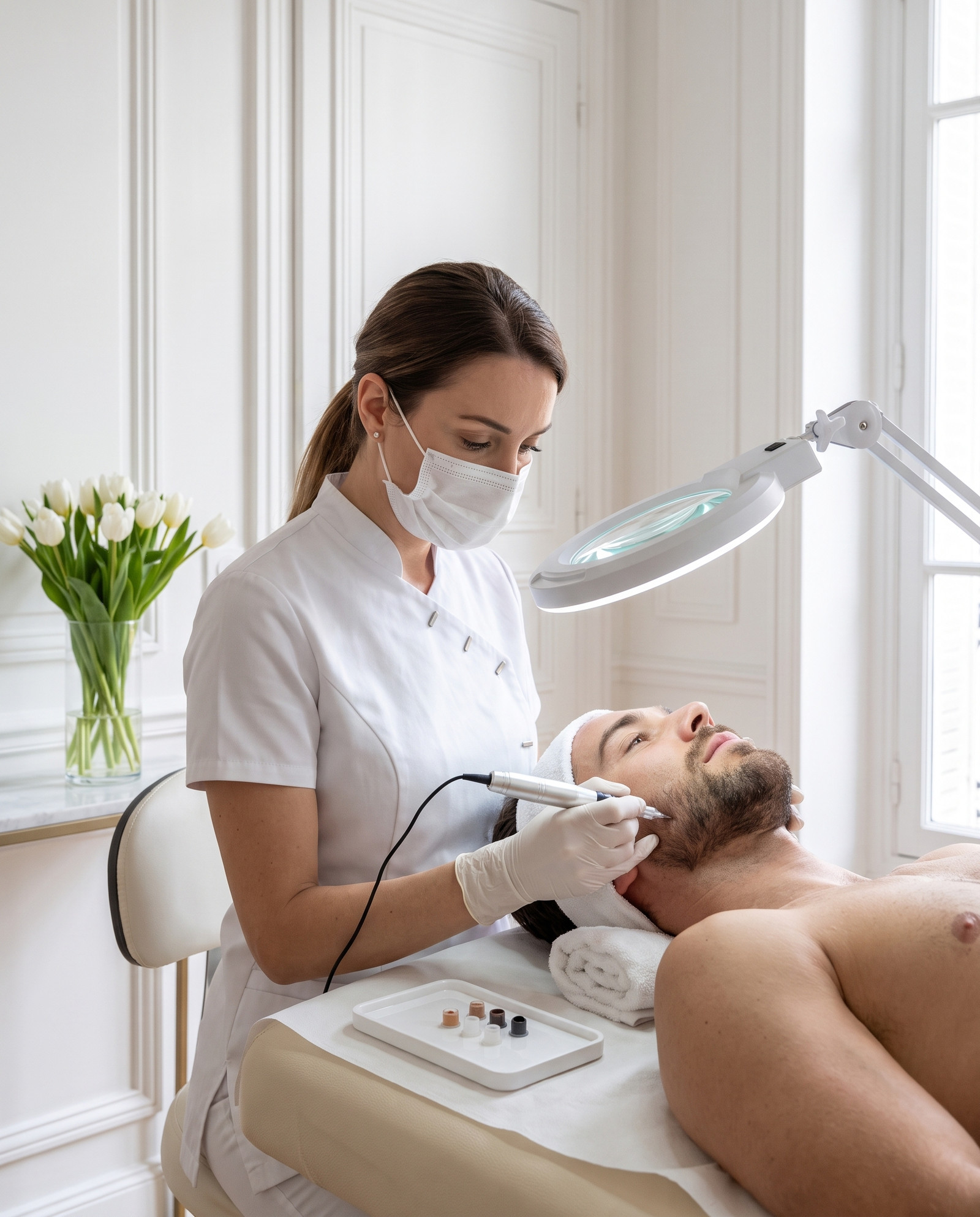
First, you must determine exactly what you want to disappear from view.
The term "thin beard" describes several completely different scenarios. One man may have hair growing everywhere, but it is light and fine. Another may have a clear gap surrounded by a dense beard. A third may have a smooth, lighter scar cutting through the line. Another situation is a sudden, round patch, which may require a medical diagnosis before any pigmentation. The same design will not solve all these problems.
During the qualification, it is not just the size of the area that matters. The linergist examines the colour of the hair at the root, its thickness, growth direction, density at the edge of the gap, skin texture, and shaving habits. If the beard is usually worn short, the optical shadow should behave differently than strokes planned between longer hairs. The design is created for a specific background, not for an inspirational photo of someone else's face.
Pigment reduces contrast but does not create hair volume.
Hair protrudes above the skin, catches light, casts a microscopic shadow, and moves under your touch. Pigment remains in the skin. For this reason, reconstruction is primarily an optical correction: darker skin between hairs seems less empty, and the edge of the gap ceases to be so legible. The better your existing beard breaks up the surface of the pigmentation, the harder it is to point out where nature ends and the design begins.
On a completely smooth, large area, the effect has a more difficult task. Up close, three-dimensional stubble will still not appear. In strong side lighting, the skin may reflect light differently than hair. An honest consultation does not promise a beard where there is not a single hair; it shows how far the impression of emptiness can be limited and at what length the result will be most consistent.
A natural result may require dots, strokes, or a combination of both.
- Dots. With very short stubble, they imitate the hair cross-sections visible near the skin.
- Strokes. Used between longer hairs, they should follow their natural direction.
- Gradation. At the transition between a dense beard and a gap, both techniques are combined to avoid creating a hard, drawn border.
Direction is just as important as colour. Moustaches lie differently near the philtrum and differently near the corners of the mouth. On the cheek, hair often changes course, and under the jaw, it can form a swirl. Even strokes set like a comb reveal the treatment even when the shade is correct. Controlled irregularity is more authentic here than mathematical symmetry.
Choosing a shade is not about holding one brown sample against your beard. A beard can be cooler near the skin, warmer at the ends, and mixed with red or grey hairs. Furthermore, pigment viewed through the epidermis behaves differently than paint on paper. Trying to copy the darkest hairs usually increases the risk of a heavy patch. A visually safer design is built delicately, allowing natural hair to remain in the foreground.
The colour immediately after pigmentation is not the final colour.
The first look in the mirror can be misleading. The skin is freshly worked, may be red or slightly swollen, and the pigment visible through the surface layer looks sharper. The contrast is also intensified by the precisely drawn borders of the design. This is a record of the treatment, not a finished photograph of the result.
During healing, the surface may be dry, and minor peeling temporarily disrupts the design. Later, the shade viewed through the healed epidermis becomes calmer. Individual spots may take the pigment unevenly, especially if the design area contains a scar, a greasier zone, or an area frequently irritated by shaving. Therefore, the final density should not be assessed in the first mirror or corrected impulsively before the skin regains a stable appearance.
- A
Immediately after the work
The design is clear, and the skin's reaction increases the contrast. We document the shape, not the final result.
- B
When the epidermis renews
The colour may look uneven and temporarily weaker. Do not scratch the surface or try to "save" it yourself with active cosmetics.
- C
After the skin has fully calmed down
Only then do we compare the design with the natural beard and decide if a local touch-up is needed.
A scar may stop cutting through the beard, although it will remain a scar.
In scar camouflage, two contrasts count at once: colour and spatial. Pigment can limit the former if the lighter strip is incorporated into the rhythm of the beard. It will not, however, even out the depression, thickening, or shine of the scar tissue. With light falling from the side, the texture may still be visible, even if you no longer notice a white gap when looking straight ahead.
Scar tissue can be less predictable: it may offer different resistance to the needle and retain colour differently than the surrounding skin. The maturity of the scar and the absence of an active healing process should be assessed before work. Attempting to cover a fresh, red, or changing scar is not a shortcut to an aesthetic result. Sometimes an earlier dermatological or surgical consultation is more sensible.
The effect changes with beard length and shaving method.
The placement of the contour cut also matters. If a barber regularly moves the cheek line lower than the planned pigmentation, a fragment of the design without hair may remain above the natural beard. Conversely, shaving over a freshly worked area against recommendations irritates the skin and hinders calm healing. The care plan must account for your real routine, not an ideal scenario for the session time.
Before the design, it is good to have a trial haircut and observe the gap for a few days. A man who comes to the consultation with a long beard may not remember how wide the gap becomes after trimming. Conversely, shaving completely deprives the specialist of important information about hair direction and colour. Photos from different lengths and a conversation with your barber allow you to choose a compromise that will not require one hairstyle for the entire duration of the pigment.
A contour that is too strong gives a quick effect but takes away freedom.
In a photo taken just after the treatment, a clear jawline may look spectacular. In the daily movement of the face, however, it behaves differently. A natural beard does not end in an even line from ear to chin: it has transitional hairs, varying density, and minor asymmetries. If the pigmentation closes the shape too rigidly, every hair trim will reveal an effect resembling an outline.
A more cautious border gives a less dramatic "after" photo, but it ages better visually. It also allows the barber to gently change the line without fighting a permanent design. This applies especially to cheeks and sideburns, where fashion for shapes may change, and the natural asymmetry of the face should not always be straightened to a ruler.
Integrated effect
Pigment remains a background
- soft transition at the gap border
- direction differentiation consistent with hair
- colour assessed also in daylight
- design considers usual beard length
Drawn effect
Pigment begins to dominate
- uniform density across the entire area
- a hard edge that stands out from the skin
- a shade that is too cool or too dark
- marks placed without regard for the direction of hair growth
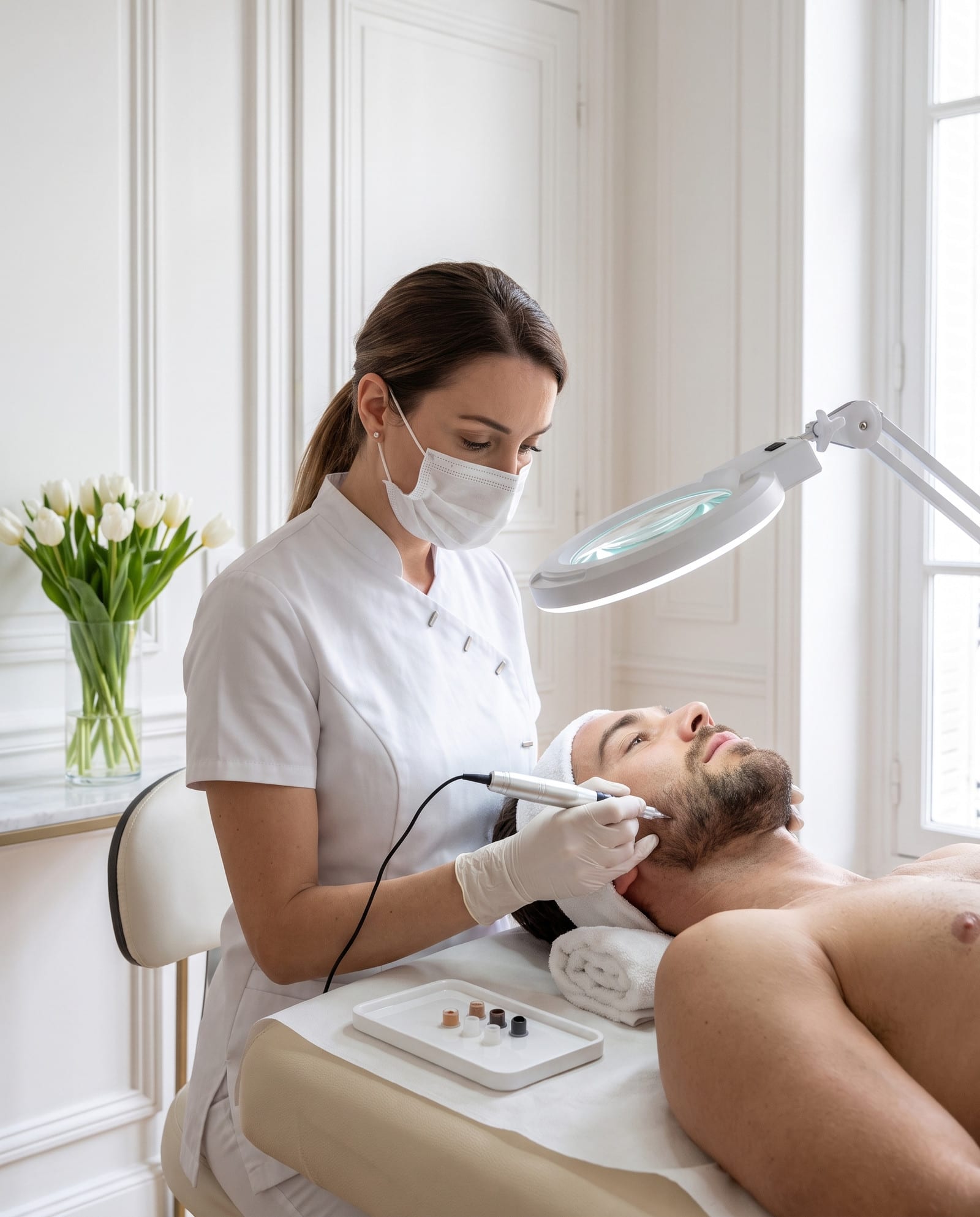
Fading is not a failure; it is part of the design.
Aesthetic pigmentation is intended to lose intensity over time. The rate varies from person to person. It is influenced by skin properties, radiation exposure, exfoliating skincare, friction and the healing process. A beard is also exposed to razors, shaving products, oils and frequent washing. We cannot responsibly promise a single refresh date based solely on the name of the treatment.
A well-planned result should not require adding pigment just because the calendar marks an anniversary. First, we assess whether the gap is noticeable again, how your natural beard has changed and whether the colour is fading evenly. Strengthening the pigment too often can create a heavy, flat patch that is difficult to make look light again later.
- Protect the healed area from excessive radiation according to the specialist's recommendations.
- Do not introduce strong exfoliation to the pigmented area without discussing its impact on the colour.
- Before a refresh, report any new skin treatments, inflammatory changes or unusual scarring.
- Bring photos to your follow-up taken in normal light with your typical beard length.
When reconstruction is not the best answer
If your main goal is to grow a full, long beard in an area without follicles, flat pigment will not provide hair or volume. If the loss appeared recently, itches, flakes or is growing, you first need a diagnosis of the cause. When the skin has active folliculitis, a fresh injury or an unstable scar, aesthetic camouflage takes a back seat.
Expectations of perfect symmetry can also make for a difficult starting point. The left and right sides of the face differ in structure, and the beard moves when you speak. Balancing a visible gap can improve symmetry, but it will not redesign your jawbone or make both profiles mirror images. Sometimes the best decision is a smaller scope of work combined with a change in haircut.
Inflammation, medication and old pigment can change the order of work
A client might say that painful spots appear on the neck after shaving, the skin stings and yellowish scabs remain in the beard. In the case of active folliculitis, the linergist does not cover the lesions with dots imitating stubble. We observe whether the redness is localised or extends beyond the shaved area, and whether there are fresh papules or weeping areas on the skin. Pigmentation is not a way to hide the problem in such cases; medical assessment and calming the skin are needed first.
The plan is different for a person taking medication that affects clotting or who is prone to easy bleeding. Tiny punctures may fill with blood and plasma more quickly, making the working trace less clear. The cosmetologist collects information about medications, does not recommend stopping them independently and may ask for the approval of your doctor. Sometimes it is more sensible to reschedule than to attempt a dense design on skin that does not provide stable conditions for work.
Previous beard pigmentation also requires a separate plan. If cool, blurred dots or a dark band near the jawline are visible under short hair, we do not automatically add another layer of brown. The linergist checks where the previous pigment lies, how it looks in daylight and whether it can be optically diffused by leaving more natural skin between the marks. The process may be divided into calmer stages so as not to turn an old contour into an even heavier patch.
The final result is tested in real life, not just in macro photography
A good documentation photo should have similar lighting, distance and beard length before and after. A close-up of fresh pigment shows the technique, but it does not answer the most important question: whether the face looks natural during conversation, in motion and after a regular shave. Filters, darkened photos and wet hair make assessment difficult, so an honest comparison requires calm conditions.
Your own assessment also needs a point of reference. Someone who has checked a single gap in every mirror for years may still look for it from a distance of a few centimetres, even if it has become unnoticeable to others. On the other hand, a photo from a distance can hide marks that are too regular. The best review combines a photo of the whole face, a profile shot, a detail without a filter and observation after a daily trim. Only this set shows whether the correction works outside a controlled frame.
If you are considering beard reconstruction in Warsaw, bring a photo of your beard at the length you wear most often to the consultation, and a second one after a short trim. This ensures the conversation is about the real goal: less contrast in the gap, a softer scar border or a calmer contour. You do not need to promise a new beard for a well-planned correction to be noticeable.
Plan your journey according to the appointment confirmation: Mińska 29A/46, 03-808 Warsaw is open Monday to Saturday 9–21, while Żelazna 59, 00-848 Warsaw is open Mon–Sat 8–21 and Sunday 11–19.