Why the facial contour loses firmness — a quick reminder
Facial skin is a multi-layered structure. At the very bottom sits bone and fat tissue; above that, a dense network of collagen and elastin fibres; and on top, the epidermis. Young skin has this fibre network well saturated and springy: it responds to touch, "bounces back" after a smile, and holds tissue in place. Over time, there are fewer fibres, and they become thinner and more widely spaced. Skin loses its ability to tighten — and slowly starts sagging under gravity. That's why the contour becomes less defined, and the jawline less sharp. This isn't about "surface ageing" — it's about a deeper scaffold that's settling.
What radiofrequency is, and why heat specifically
Radiofrequency (RF) is electromagnetic energy that penetrates tissue and converts into heat inside the skin — not on its surface. That's the key difference compared with lasers and intense light, which work differently and at different depths. RF works selectively: tissues that conduct energy heat up more than those that don't. Fibroblasts — the cells that produce collagen — belong to the first group.
Why heat? Because collagen contracts under heat — immediately. Each fibre responds to the right temperature like a spring being compressed. The tightening sensation some people feel right after the treatment is exactly this. But that's only the first phase. The second — and more important in the long run — is the fibroblast response. Fibroblasts read the heating of tissue as a signal: "there's damage here, repair is needed." And they start producing new collagen.
- 01
Energy penetrates deep into the skin
The RF wave passes through the epidermis and reaches the deeper layers of the dermis — where fibroblasts live and where the collagen scaffold sits.
- 02
Tissue heats up from within
Heat is generated inside the skin, not on the surface. The epidermis stays cool (cooled by the device head), while energy builds up deeper down.
- 03
Existing collagen fibres contract
Collagen responds to heat with an immediate contraction. This is the first phase of the effect — part of the tightening is visible straight after the treatment.
- 04
Fibroblasts read the signal
The cells responsible for collagen production respond to the heating of tissue as a repair stimulus. They start producing new fibres.
- 05
New collagen matures over weeks
Newly produced fibres mature and densify the network over several weeks to several months. The effect builds over time — full results are often visible after 2–3 months.
Different types of RF — not all work the same way
RF isn't a single technology — it's a whole family of devices and methods. This matters, because they differ in depth of action, target groups and results. Here's a simplified breakdown worth knowing:
Monopolar / bipolar RF
classic RF for the face and body
- Works in the deeper layer of the dermis
- Strengthens the collagen scaffold
- Improves firmness and elasticity
- Often combined with other technologies (e.g. micro-infusion, ultrasound)
Fractional microneedling RF
RF with micro-channels in the skin
- Combines a microneedling mechanical stimulus with RF energy
- Precise remodelling zones deep in the skin
- Used for scars, pores and photoageing
- A more intensive effect, but also recovery after the treatment
This article focuses on needle-free RF — variants that work by non-invasively applying the device head to the skin. These are treatments with zero downtime, easy to fit between meetings, with no visible marks on the face once you leave the salon.
What the treatment involves — what to expect
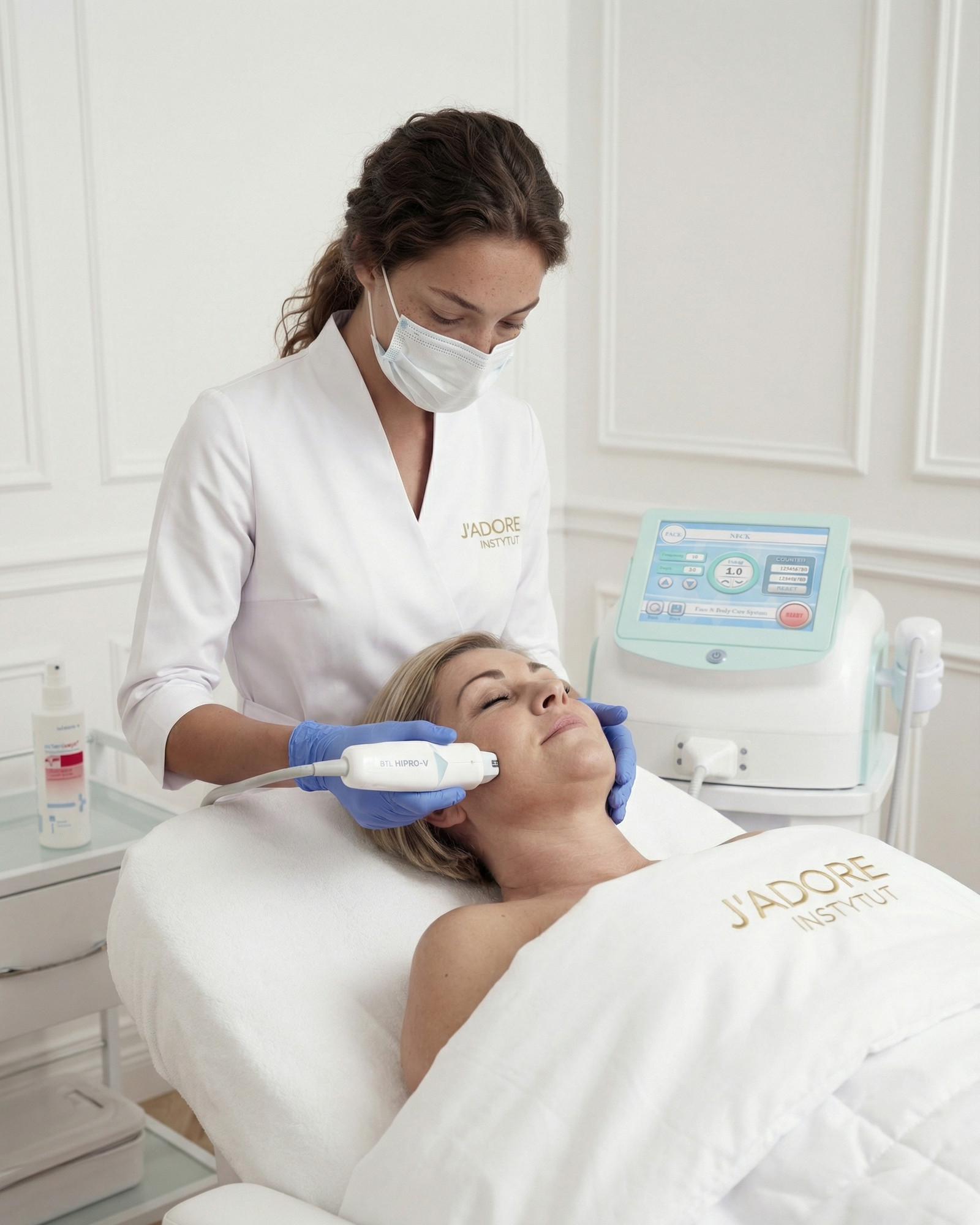
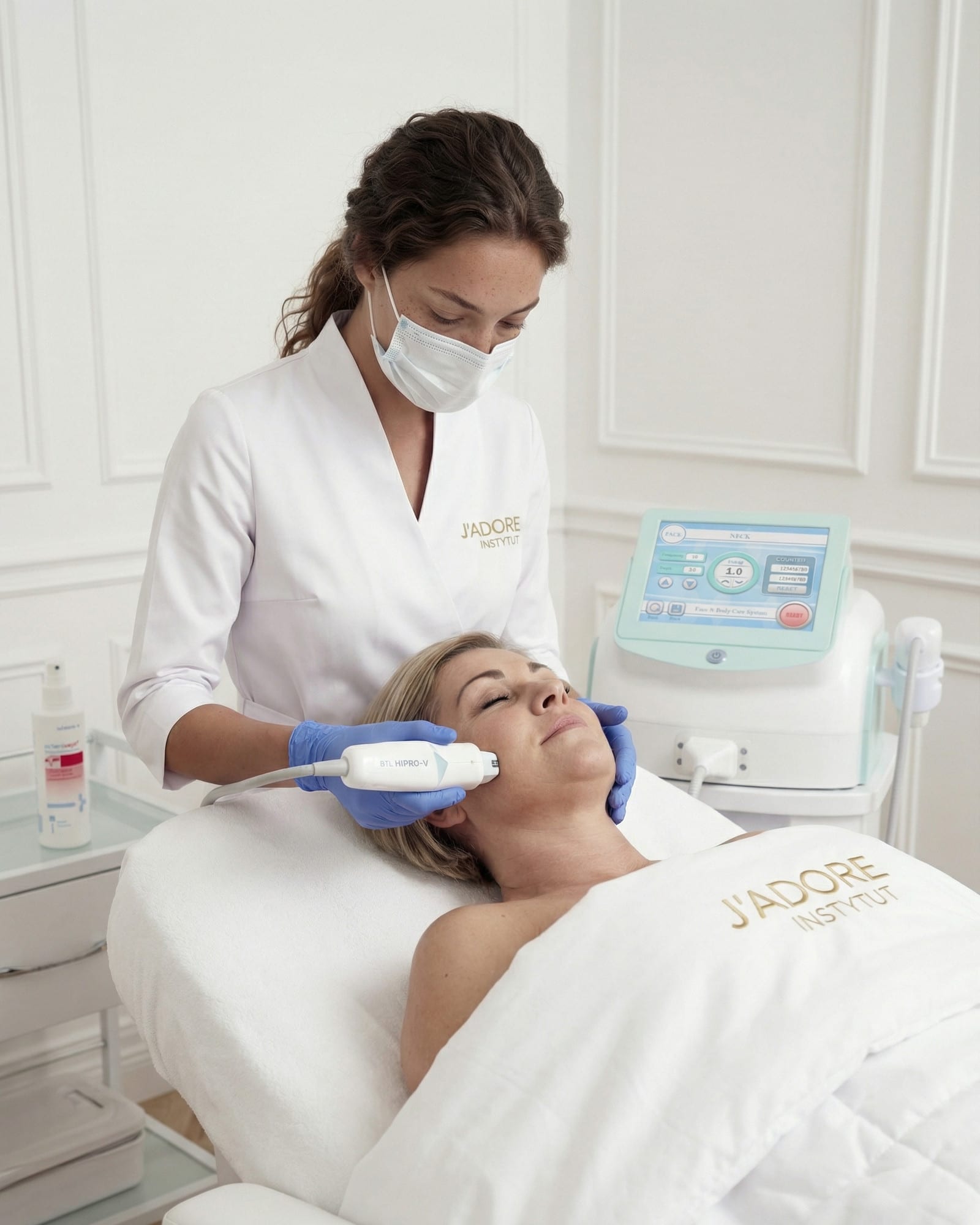
For anyone used to intensive aesthetic treatments, RF can feel surprisingly calm. There are no needles, no break in the skin's surface, no drama at all. The device head moves across the face in set patterns, and the skin receives pulses of energy — usually felt as pleasant, deep warmth.
- Sensation: deep heat, comfortable for most people
- Afterwards: possible mild redness — usually fading within an hour
- Downtime: none — full activity possible straight away
- Results: build up gradually, often most visible after a few weeks
- Series of treatments: results accumulate — the plan usually involves several sessions
Who can benefit — and what expectations make sense
RF is a widely used technology — for both women and men, at different ages. Most people who choose RF are noticing the first signs of losing firmness: a less defined jawline, sagging skin around the cheeks, a tired look despite good sleep. This is a good moment to start — the better the starting collagen scaffold, the greater the potential for stimulation.
RF isn't a solution for everything, and it doesn't replace every other treatment. When tissue sagging is advanced and volume loss is significant, RF may need to be combined with other methods — or form part of a broader plan rather than the only tool. This is exactly why a specialist consultation is a genuine starting point for effective therapy: it lets you assess which layer of the problem matters most and which combination of methods makes sense.
RF works well when...
optimal indications
- Skin is starting to lose firmness, but isn't significantly sagging
- The contour is becoming less defined, the jawline less sharp
- Skin is lax and lacks "bounce", but without deep sagging
- You want a natural result, without altering facial features
- You're looking for a treatment with no downtime and no visible marks
Worth considering other or additional methods when...
situations that call for a broader plan
- Tissue sagging is significant and advanced
- Significant volume loss (hollow cheeks, temples)
- You expect a very fast result (RF builds its effect over weeks)
- You're looking for a one-off, dramatic "transformation"
How RF fits into a broader care plan
RF isn't a treatment used "instead of" others — it works well in combination with other methods. There's a lot of flexibility in building a plan: RF can form the basis of a series of treatments on its own, but it can also enhance the results of other technologies or complement previously restored volume or skin quality.
RF + biostimulators
RF improves firmness and the deeper scaffold; biostimulators add hydration and skin density. Together they work at different levels — without duplicating the effect.
RF + HIFU
HIFU reaches even deeper than standard RF — down to the muscular fascia. Combining both technologies addresses different tissue depths in a single protocol.
RF + good home care
Retinoids, antioxidants and SPF support the same environment that RF stimulates. Home care won't replace a treatment — but it can clearly extend and deepen its results.
RF + mesotherapy
Mesotherapy delivers nutrients and hydration directly into the skin. RF working deeper and mesotherapy working on higher layers make a logical pairing.
A good plan doesn't have to be complicated or expensive. Often a few RF sessions, spread out over time, are enough — with results maintained through home care and occasional maintenance sessions. This is exactly the conversation worth having during a consultation: not "what's most revolutionary", but "what makes the most sense for this particular face at this particular moment".