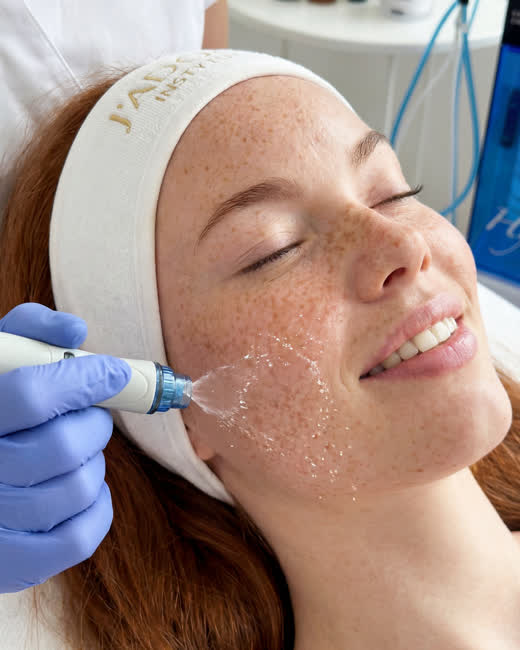
Why skin doesn't want to absorb what you put on it
Before you understand how fractional mesotherapy works, it helps to know why we need it in the first place. Skin is a barrier, not a sponge. Its outermost layer — the epidermis, and more precisely its horny layer — is one of the most efficient seals in the human body. Over millions of years of evolution, it developed to do the opposite of what we're now asking of it: keep everything out, hold water in, and protect living tissue from pathogens, toxins and UV.
This means most active ingredients in creams and serums — hyaluronic acid, vitamin C, peptides, collagen — don't penetrate the epidermis in any meaningful amount. The molecules are simply too large or too polar to break through the barrier on their own. Skin does exactly what evolution designed it to do: keeps them out. A cream works on the horny layer, and that's it — the rest is packaging.
The micro-channel — what it is and how it forms
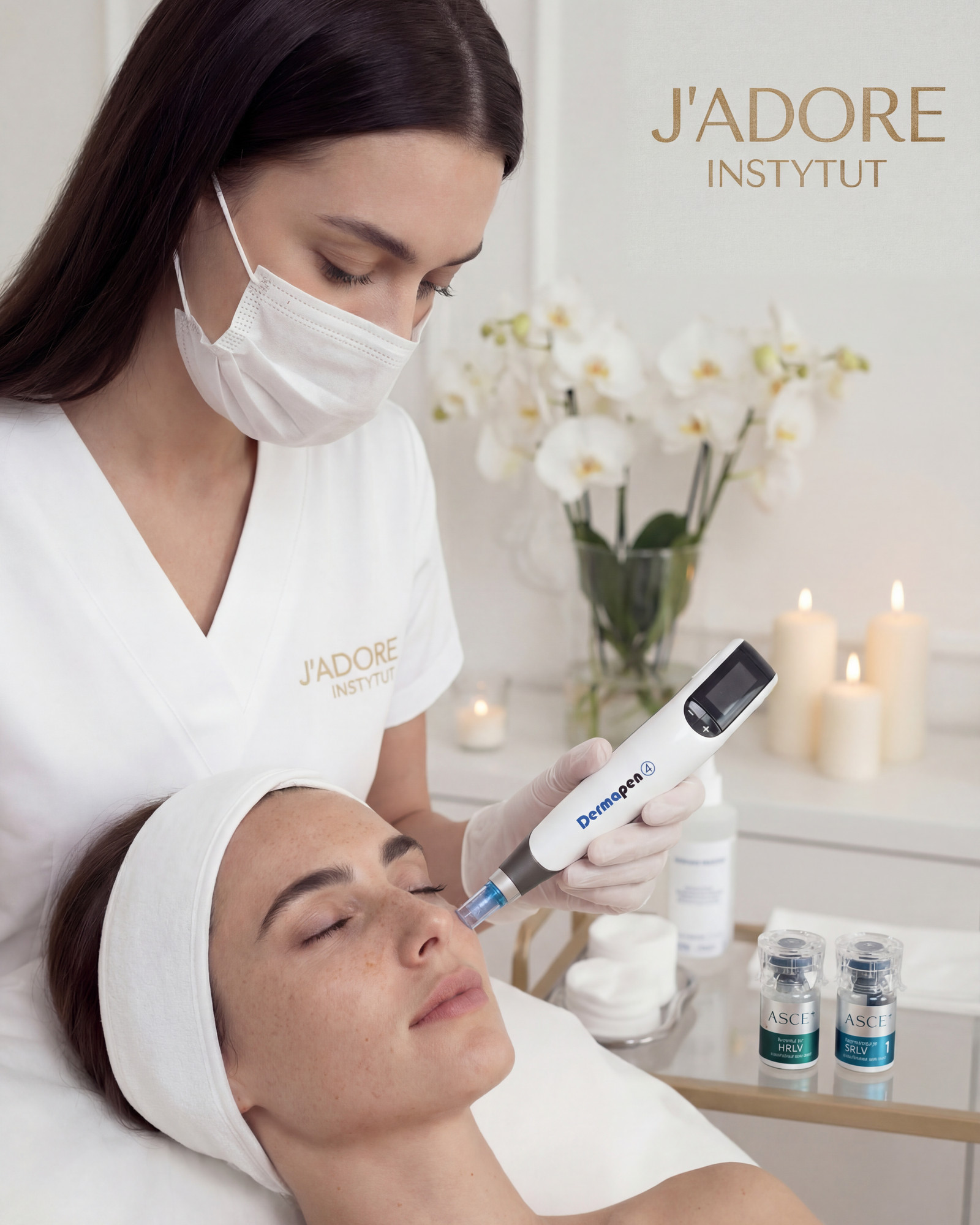
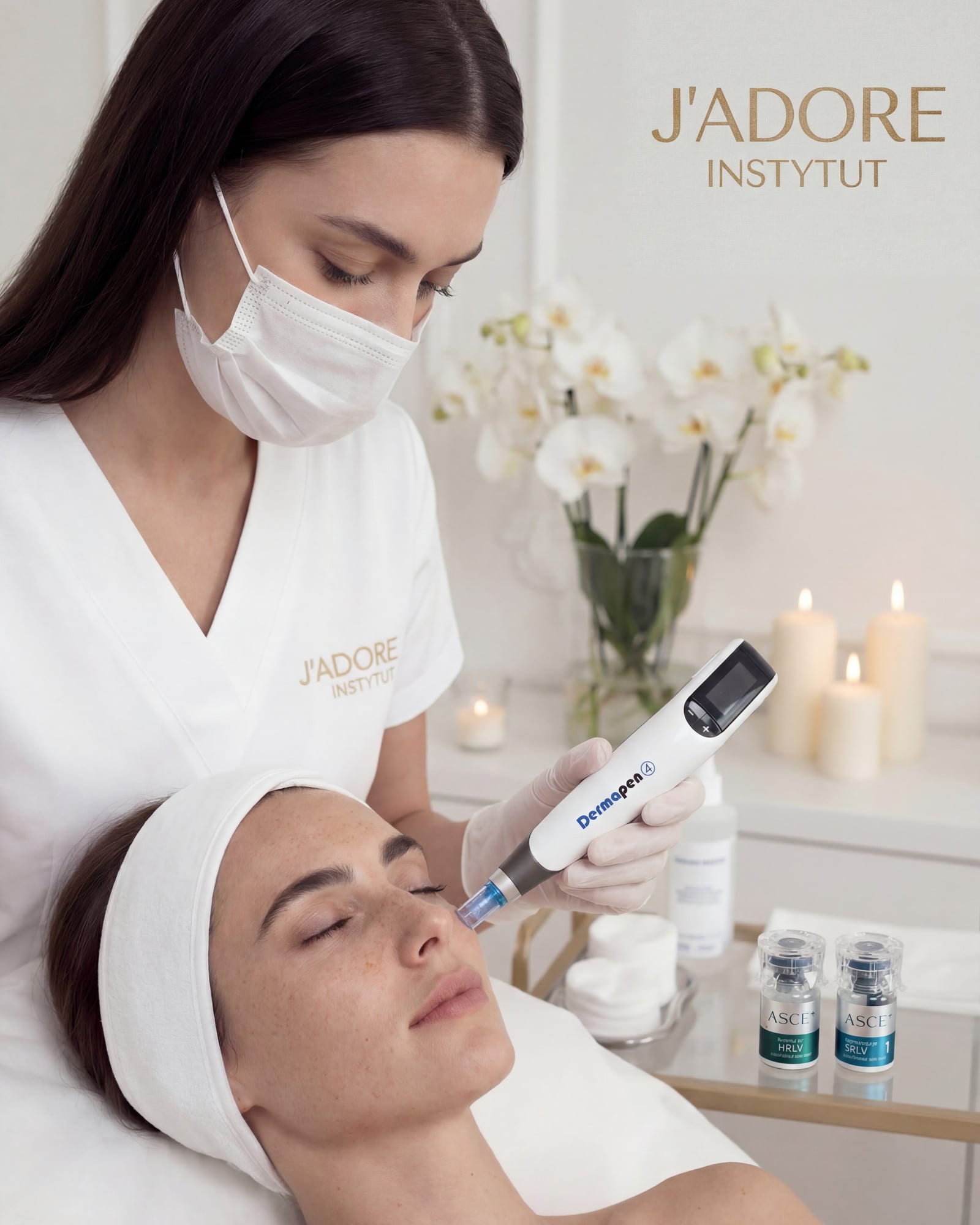
Fractional mesotherapy works through a temporary breach of the barrier. A device head with a matrix of microneedles punctures the skin at precisely arranged points — hence "fractional": not the whole surface, only a fraction of it, in regular patterns of micro-injury. Each puncture opens a narrow, vertical channel running through the epidermis towards the dermis.
These micro-channels last a very short time — skin is designed to react to any breach instantly. Repair processes start almost immediately. But in the window before the channels close, serum applied right after the treatment has a physical route inward. It doesn't need to fight through the horny barrier — it already has a way in.
- 01
Puncture
Microneedles penetrate the epidermis and reach the dermis. Each point is a separate, precise micro-channel. Only the fraction of the surface targeted by the device head is punctured.
- 02
Absorption window
Straight after the puncturing, serum or a cocktail of active substances is applied to the skin. Through the open micro-channels, ingredients reach the deeper layers — the dermis — where they couldn't normally get from inside a jar.
- 03
Repair response
The skin immediately triggers healing processes. The micro-channels close. At the same time, the micro-injuries stimulate fibroblasts — the cells responsible for producing collagen and elastin. This is the second mechanism at work, alongside the delivery of substances.
- 04
Regeneration processes
Over the following days, the skin "repairs" the punctured fraction of the surface, building new tissue. For many people, it's this stage — not the serum delivery itself — that accounts for the long-term improvement in skin quality and density.
What actually gets delivered — and why serum choice matters
Micro-channels are a route — but a route isn't valuable on its own. What matters is what travels through it. And here, fractional mesotherapy faces a question that's often glossed over in marketing: not every serum makes equal sense as part of the treatment.
Substances applied through the micro-channels reach the dermis — a layer built from collagen, elastin, hyaluronic acid and fibroblasts. It's a biological environment with specific needs. The substances that work best are those that act within the dermis and, at the same time, wouldn't reach it through standard application via creams. That's why mesotherapy favours low-molecular-weight hyaluronic acid (it reaches where a cream can't), signalling peptides (they communicate with fibroblasts), and cocktails with vitamins and amino acids (they nourish the cellular environment).
A dual mechanism: delivery and stimulation
Fractional mesotherapy works two ways at once — and both matter, though the logic behind each is different. Many people focus on the first (serum straight into the skin) and forget about the second, which for some people turns out to be more important.
Mechanism 1 — delivery
immediate, via micro-channels
- Active ingredients reach the dermis
- Bypass the epidermal barrier
- Works within the treatment's time window
- Effectiveness depends on serum choice and channel depth
Mechanism 2 — stimulation
delayed, via micro-injuries
- Micro-injuries trigger repair processes
- Fibroblasts speed up collagen and elastin production
- Results develop over weeks after the treatment
- Doesn't depend on serum — it's a biological response
This split has an important practical consequence: a single session mainly delivers results from the first mechanism — hydration, radiance, improved texture. Triggering real collagen stimulation (the second mechanism) requires a series of sessions at the right intervals. That's why specialists usually plan several sessions — not because one treatment "didn't work", but because biology needs repetition.
Skin after the treatment — what happens and what to expect
Right after fractional mesotherapy, your skin looks different from usual — and that's normal and expected. Knowing what you're seeing in the mirror after the treatment helps you avoid mistaking a repair response for a problem.
- Redness — immediate and typical. It's a vascular response to the micro-injuries: blood vessels widen to deliver blood and nutrients to repair cells. For many people, it fades within a few hours to a day.
- Mild swelling — skin may feel slightly puffy, which for some people gives it a fresher, more "plumped" look right after the treatment. It's a first-phase inflammatory response, harmless and temporary.
- Sensitivity and tightness — for a few days, skin may be more sensitive to touch, temperature and skincare products. This is a physiological stage of regeneration.
- Visible improvement — for many people, noticeable within a few days of the treatment: skin may look more hydrated, radiant and smoothed. This effect comes mainly from the first mechanism (serum delivery).
- Long-term changes — improved density, firmness and skin quality, visible after a series of sessions, comes from collagen stimulation. It takes time and consistency.
Ideal for — and when this tool makes sense
Fractional mesotherapy isn't a treatment "for everything" — it has clear strengths and situations where it works better than other methods. Like any tool, it performs best when matched to a specific concern.
- Loss of hydration and radiance — dull, dry, lacklustre skin; serum with hyaluronic acid delivered deep can give a quick, visible result.
- Early signs of density loss — thin skin, fine lines, reduced elasticity; collagen stimulation through a series of sessions can slow down and partly reverse these changes.
- Shallow acne scars and texture unevenness — micro-injuries encourage tissue remodelling, which for some people leads to a smoother surface.
- Preparing skin for other treatments — fractional mesotherapy is sometimes used as an early or complementary step in multi-treatment protocols, improving skin condition and its receptiveness to other methods.
- Skin after laser treatments or chemical peels — when the skin is in a regeneration phase and needs deep "nourishment".
Fractional mesotherapy vs other methods — where it fits
Fractional mesotherapy exists within an ecosystem of treatments — and it's best understood not as a standalone "cure-all" but as one tool with a clearly defined job. It helps to know where its role ends and where another method's role begins.
Fractional mesotherapy
delivery + stimulation via micro-channels
- Works at the level of the dermis
- Delivers active substances deep into the skin
- Stimulates fibroblasts through micro-injuries
- Good for dehydration, loss of density, scarring
Biostimulators and fillers
rebuilding volume and support
- Work at a structural level
- Fill or stimulate rebuilding of the scaffold
- Visible change in facial geometry
- A different logic from serum delivery
That's exactly why, in well-planned protocols, these methods tend to complement each other rather than compete. Fractional mesotherapy can improve skin condition and quality — its hydration, density and texture evenness. That's a completely different job from rebuilding volume or lifting tissue, which require different tools. Mapping these differences is one of the key topics of a consultation before planning treatments.
Biostimulators
Fractional mesotherapy improves skin quality and condition; biostimulators rebuild its scaffold and volume — two complementary levels of action.
Chemical peel
A peel renews the surface and evens out texture; fractional mesotherapy then delivers nourishing substances deep after that renewal — a logical sequence of preparation, then nourishment.
Fractional laser
The laser works more intensively on tissue remodelling; fractional mesotherapy can serve as a regenerative or preparatory step — depending on the protocol and skin condition.