Four tools, four different jobs
The simplest way to remember it: TCA exfoliates deeply and rebuilds, PRX-T33 biorevitalises without peeling, PQ AGE lifts and smooths, Retix.C renews through retinol. Each works on a different level of the problem — which is exactly why they so often complement rather than replace one another.
TCA (trichloroacetic acid)
deep exfoliation and remodelling
- acne scars, deeper hyperpigmentation
- pronounced texture, photoageing
- result visible after recovery — a few days of peeling
- requires an experienced specialist
PRX-T33
biorevitalisation without peeling
- grey, lax skin lacking radiance
- no lifting effect after pregnancy or chronic fatigue
- no visible peeling — often called a "lunch peel"
- a series improves density and hydration from within
PQ AGE
lifting effect and antioxidant action
- mature skin, loss of contour
- greyness and loss of firmness
- visible firming effect after the first session
- antioxidant-enhanced
One more thing worth remembering: deeper doesn't mean better. A strong TCA peel offers real possibilities — but only when there's a genuine indication for it. On grey, tired skin without structural damage, a gentle PRX-T33 biorevitalisation delivered as a well-planned series can give a better, more natural result than aggressive exfoliation.
How to recognise what you need — a mirror test
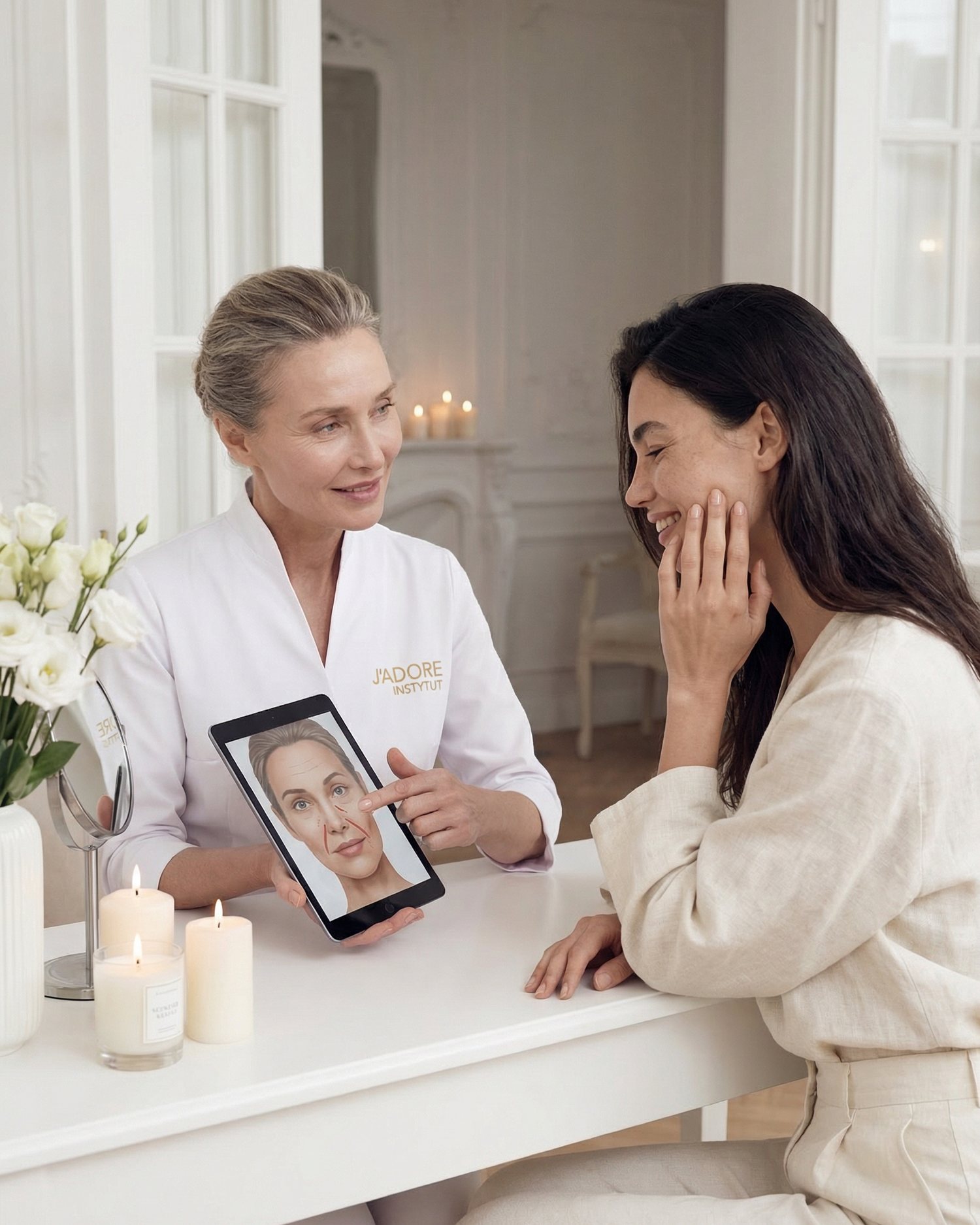
Before a specialist suggests a specific protocol, you can do a simple mirror check. It takes a minute and immediately sets the consultation on the right track:
- You see marks left by spots, either level or indented — irregular texture, hard to cover with foundation → this is a structural problem that goes deeper → direction: TCA or Retix.C in higher-strength protocols.
- Skin looks "tired": grey, dull, as if it's lost its life — colours in the face paler than a year ago, symptoms after winter, stress or childbirth → direction: PRX-T33 or PQ AGE.
- You see hyperpigmentation: sun spots, post-acne marks, even brown discolouration → it depends on depth: superficial (brown, sharply defined) → acid peels or Retix.C; deeper (blurred, hormone-related) → consultation needed, because depth alone isn't enough.
- You feel your face is "dropping": the contour less defined, cheeks seemingly lower → this is volume and firmness loss → direction: PQ AGE as support, but also a conversation about biostimulators or fillers.
Of course, the home test is only a starting point, not a diagnosis. Mature skin usually shows a bit of each category — a few marks from acne, some greyness, and the first sun-related pigmentation. But simply naming what bothers you most means the consultation starts from something concrete.
When TCA, and when medical lines — a comparison in one place
To settle this once and for all, here's the whole comparison in one place. This isn't a decision table — it's a map of problems and directions worth checking with a cosmetologist:
When TCA
deep skin remodelling
- atrophic acne scars
- pronounced, uneven texture
- deeper static wrinkles
- photoageing — skin "thickened" and dulled after years of sun exposure
When PRX-T33 or PQ AGE
biorevitalisation and lifting with zero downtime
- grey, dehydrated skin lacking radiance
- loss of firmness without visible scarring
- you want results without several days of peeling
- preparation before an important event (wedding, holiday)
When Retix.C
renewal through retinol
- first expression and static lines
- uneven skin tone, post-acne hyperpigmentation
- you want to address several concerns at once
- mature skin, needing long-term renewal
When it's best to combine peels with other treatments
Medical peels rarely give the best results in isolation — they're usually part of a broader plan. The logic of combining treatments is simple: a peel prepares or reinforces, and other treatments complete what a peel alone cannot achieve. A specialist decides on the order and intervals:
TCA + hydrating series (e.g. mesotherapy)
After deep exfoliation, skin absorbs active ingredients intensively — a hydrating series after recovery reinforces and locks in the remodelling effect.
PRX-T33 + biostimulators
Biorevitalisation from the outside, supported by stimulating your own collagen from within — density and radiance build up faster.
Retix.C + LED therapy
Retinol stimulates renewal, LED speeds up recovery and calms reactivity. A common combination for mature skin.
PQ AGE + fillers or biostimulators
PQ AGE improves the condition and firmness of the epidermis; the complementary treatment restores volume where needed. They work together, not against each other.
Series of peels + fractional laser (in a long-term plan)
Strong results — peels prepare the skin or extend the laser's effects. Always with an appropriate interval and according to an individual schedule.
This is exactly why a good treatment plan is never "one miracle peel for everything" — it's a set of tools matched to specific layers of the problem. If someone offers a single treatment for every problem right from the start, that's a sign to ask which specific problem that treatment solves, and why that one.