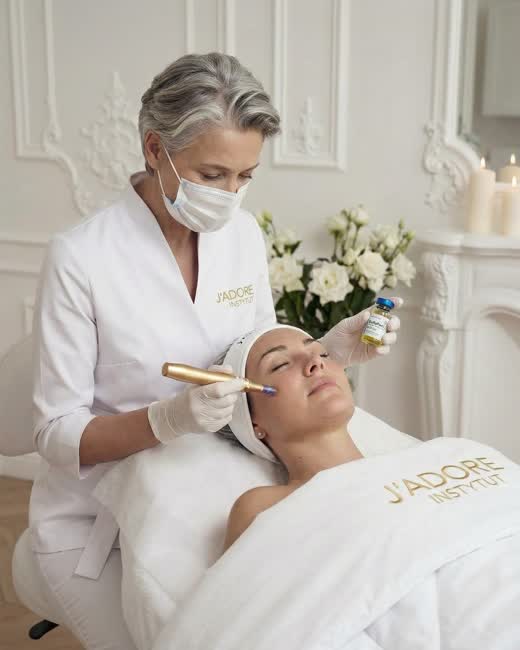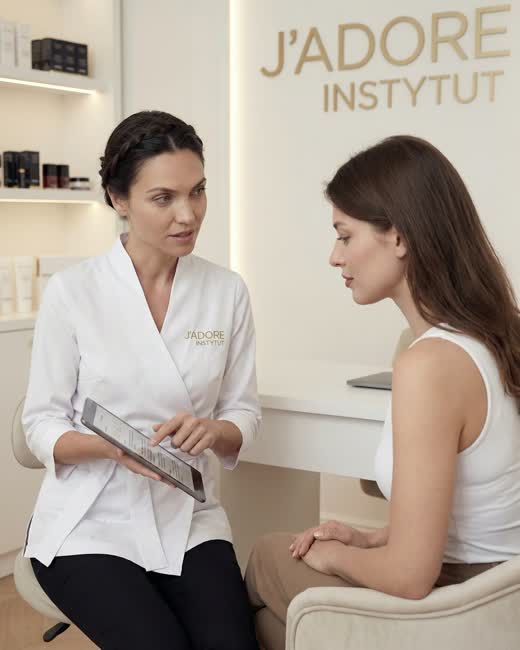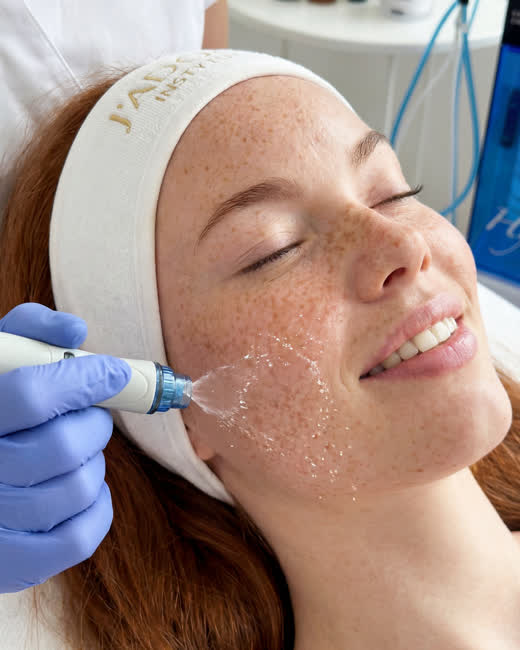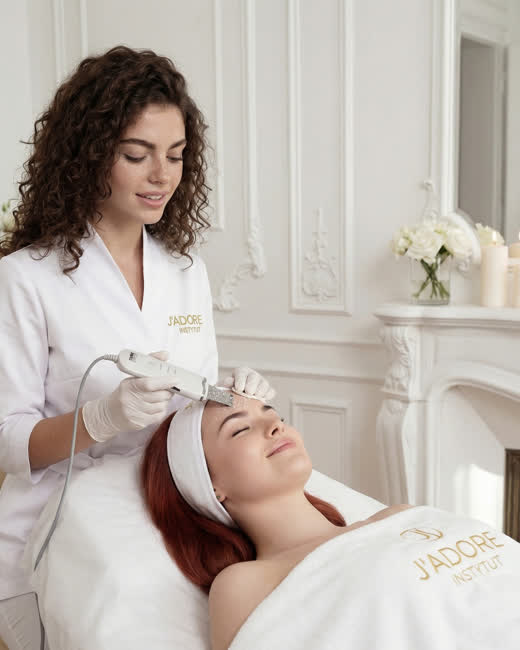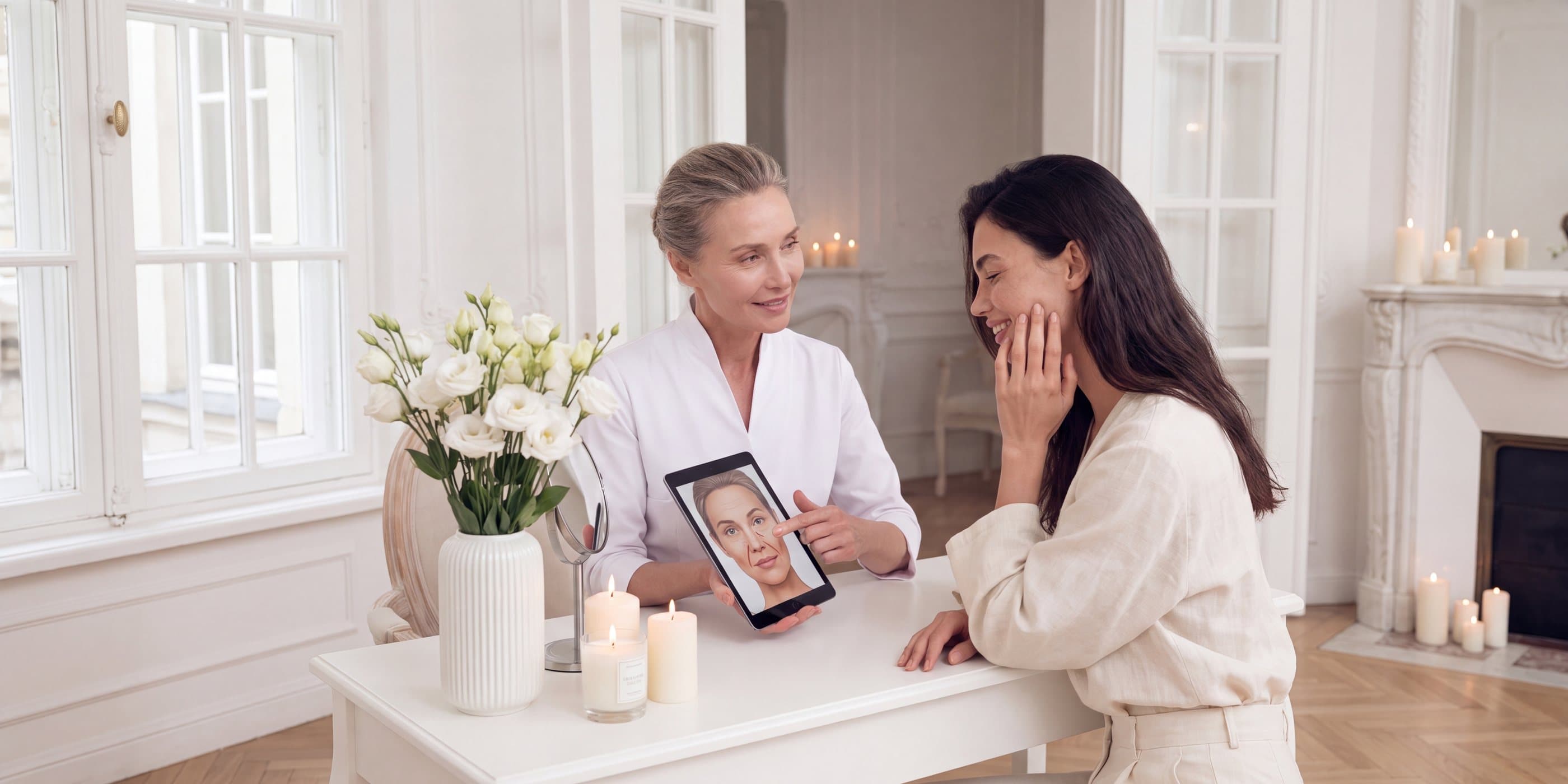
 A treatment room at J'adore
MEDICAL PEELS
A face oval that is "drifting", cheeks less firm than a decade ago, dull grey skin without radiance and hyperpigmentation that becomes more and more pronounced with age — these are not one problem, but several at once. PQ Age (PQ AGE Advanced, Toskani) is a peel that addresses them together: it combines exfoliating acids with a firming-biorevitalising complex (including phytoestrogens and DMAE), so it not only refreshes the surface but works on the firmness and density of the skin. That is why we call it a biorevitalising peel, and not a "plain acid for radiance".
It is also available in a variant combined with microneedling (microneedle mesotherapy) — then the ingredients penetrate deeper, but the treatment breaches the skin and has a different recovery course. At J'adore Instytut it is performed by an experienced cosmetologist. Below you will find everything worth knowing before your first visit: whether it works, whether it stings, whether and for how many days you will peel, when the effect is visible, how many treatments in a series and why "medical" in the name does not mean it is performed by a doctor.
a series of 4–6 sessions every 1–2 weeks (sometimes 2–3 "intensive" sessions for a specific concern)
How it works
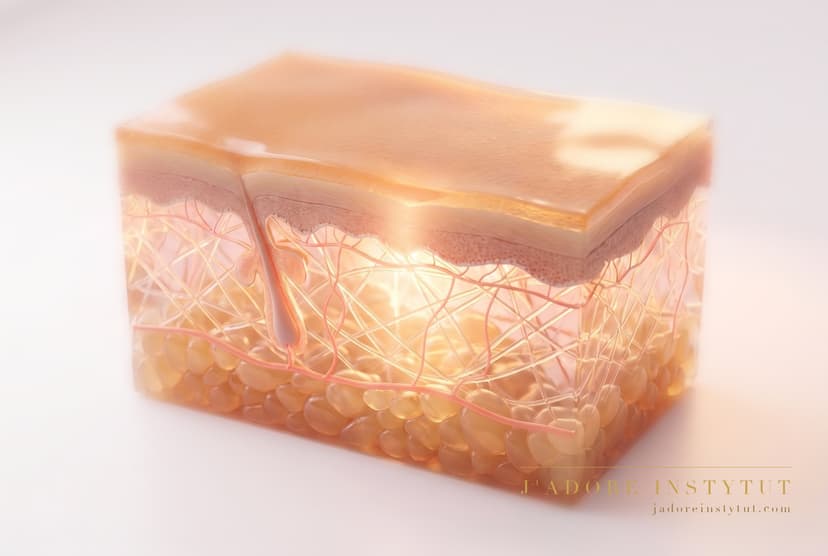
PQ Age (PQ AGE Advanced by Toskani) is a biorevitalising and firming peel. The first layer of action is classic exfoliation: lactic acid (AHA — gentler than TCA, deeply hydrating, brightens hyperpigmentation and evens skin tone) supported by salicylic acid (BHA — clears pores, has anti-inflammatory properties). This is what gives you radiance and a smoother texture.
The second, more important layer is biorevitalisation and firming. The preparation carries a phytoestrogen complex (including soy isoflavones and resveratrol), which mimic the action of oestrogens in the skin and stimulate fibroblasts to produce collagen — and it is precisely the decline in oestrogens that is one of the main causes of loss of firmness in women over 40. Added to this are DMAE (a compound that gives a tightening effect — hence the quickly perceptible "tightness" of the skin), melanin-blocking ingredients (they inhibit tyrosinase, brighten and limit the recurrence of hyperpigmentation) and peptides and antioxidants (including vitamin E, carnitine). A single treatment therefore addresses several things at once: firmness, colour, radiance and skin quality.
There's also a variant combined with microneedling (needling meso): fine punctures create micro-channels through which active ingredients reach deeper, and the injury itself triggers additional collagen rebuilding. This breaks the skin barrier — it follows a different course, with a different recovery time and a stricter list of contraindications than the peel alone.
This is a beauty treatment — at J'adore it's performed by an experienced cosmetologist. The word "medical" applied to peels describes the class and strength of the product, not that a doctor performs it.
Ideal for
A fact worth knowing: "oestrogen" in a peel's description might sound like a hormone in a jar, but it isn't. Phytoestrogens (e.g. from soy) are plant compounds with a structure similar to oestrogens — they bind to the same receptors in the skin and gently "encourage" fibroblasts to make collagen, but they are not a hormonal drug and have no systemic effect. That's why PQ Age suits skin losing firmness alongside declining oestrogen so well.
The female zone and the male zone
PQ Age in women is most often the skin's response after 40, perimenopausal and photoageing: loss of firmness, "greyness", hyperpigmentation (including melasma — often exacerbated after pregnancy or during hormone therapy). This is where a phytoestrogen complex is particularly effective, which is why the peel is readily chosen as part of a rejuvenating programme — on its own or in a plan with medical treatments.
What we work with
PQ Age for men is most often chosen by men aged 40–55+ who notice sagging cheeks and loss of density but aren't ready for injections yet. Men's skin is thicker and oilier, more often marked by acne scars and shaving marks, and after years without an SPF habit — with pronounced photoageing and hyperpigmentation. DMAE gives a noticeable tightening effect without needles, and a series genuinely improves contour and texture.
What we work with
From the cosmetologist's chair
Men, more often than women, come in "for a single session, just to see the effect". I explain the same thing every time: DMAE gives instant tightening, but denser, smoother skin is the work of a series. And one more thing — men routinely skip SPF. Without it the peel loses its purpose, since freshly exposed skin immediately picks up new hyperpigmentation.
Safety
With "medical" peels, results and safety depend on a few things worth asking about at any salon:
Your cosmetologist sets the strength, exposure time and variant (with or without needling) after taking your history — a peel performed "on the spot", without a skin assessment or sun exposure history, risks hyperpigmentation and irritation.
We use original PQ Age, stored according to requirements. A non-original or poorly stored product gives unpredictable results.
Lack of sun protection after a peel is the most common reason results don't last, or new hyperpigmentation appears.
A good salon sets out a plan and maintenance sessions with you, rather than selling a single treatment with a promise of instant transformation.
Red flags with a peel ·
Contraindications
Some contraindications are permanent, others temporary — in which case we simply postpone the treatment until the situation passes. We always go through the list individually at consultation.
From the cosmetologist's chair
The issue most often underestimated is cold sores. Clients think "I only have one on my lip, and the peel covers the whole face — that shouldn't matter." It does: the peel itself can wake it up, and with the needling variant even more so. Better to postpone by a few days than treat a spreading outbreak.
This isn't a complete list — we'll go through your medications, conditions, skin phototype and treatment history individually at consultation, and use that to choose the right strength and variant.

Does it hurt, does it sting
The most common question before a first peel is: "does it hurt?" PQ Age stings and warms during application — this is brief burning and warmth, normal and expected, fading soon after it's removed. It can feel more pronounced than with gentle mandelic peels, but it's well tolerated. With the microneedling variant, you'll also feel fine pricks — for that we more often use a topical anaesthetic.
Consultation and history
skin phototype, sun exposure history, medications, contraception/HRT; for a first session, a reaction test on a small area
Cleansing and degreasing
preparing the skin so the acid works evenly
Applying PQ Age
even application with a brush, controlled exposure time — this is when you'll feel the stinging
Neutralising / removal
stopping the acid's action according to protocol
Soothing mask + SPF
calming the skin, strengthening the barrier, and mandatory sun protection before you leave
The needling variant includes an extra microneedling step after application (or alternating with it) — this makes the treatment slightly longer, and the skin can be more visibly red afterwards.
Portfolio
A record of the work in our salons — the place where we publish treatment frames and, after photo sessions, results.
A record of results — in preparation. We publish photographs of our clients only with their consent.
Will I flake, and for how many days
This question comes up with every peel, so let's be direct: yes, PQ Age can cause flaking, though it's usually mild rather than peeling "in sheets". The extent depends on the strength of the treatment, your skin, and whether the needling variant was chosen.
Flaking is a natural part of skin renewal, not a side effect or a "failed treatment". The worst thing you can do is speed it up with a mechanical scrub or pick it off with your nails — that's a sure way to cause irritation and hyperpigmentation. Let the skin shed at its own pace, keep it moisturised, and protect it with SPF.
From the cosmetologist's chair
Clients sometimes write on the second day, "nothing is peeling, so it didn't work?". Quite the opposite — with PQ Age, mild peeling or none at all is fine; effectiveness is shown by the result after a series, not by the amount of dried skin. The needle variant causes more redness, but that also subsides within a few days.
PQ Age and your lifestyle
Most questions concern what comes after: sun, makeup, sauna, sport, home acids and holidays. With a peel there's one rule — for a few days your skin is renewing itself and is more sensitive, so we don't want to irritate it or expose it to the sun unprotected.
This is the single most important point with any peel. Freshly exposed skin picks up new hyperpigmentation easily. Apply SPF 50+ daily (even on cloudy days) for at least a few weeks after the series — without it, a peel for hyperpigmentation loses its purpose.
No sunbeds and no intensive tanning after the treatment. That's why it's best to plan a series for autumn or winter, rather than right before a holiday in full sun.
Let your skin rest on the day of the treatment. Makeup is usually fine from the following day, applied to lightly moisturised skin. With the needling variant, wait a little longer — we'll tell you how long.
High temperatures and chlorinated water irritate renewing skin. Sauna, hammam and swimming pool — only once flaking and redness have cleared.
Stop retinoids and strong acids in your home skincare during the series and for a few weeks afterwards — combining them causes irritation. Return to them after checking with us at consultation.
Heavy sweating soon after a peel stings and encourages irritation. Take it easy for a day or two, especially after the microneedling variant.
Want to look your best for a wedding or a photo shoot? Plan your series so the last session's flaking clears well before the date — ideally with several weeks to spare.
Why "medical" when a cosmetologist performs it
Two questions that come up most often. First: if it's a "medical peel", why doesn't a doctor perform it? Because "medical" describes the class and strength of the product, not the practitioner. PQ Age is a beauty treatment — at J'adore it's performed by an experienced cosmetologist, who assesses your skin, chooses the strength and is responsible for how it's carried out. It's a different treatment from aesthetic medicine involving a doctor's needle.
Second: why isn't a peel "associated with a professional setting" as cheap as a drugstore acid? Because you're not paying for the substance alone, but for the original product from a legal supply chain, the consultation, the choice of strength and a safe protocol — including running the series and overseeing your recovery. A suspiciously cheap "medical peel" is usually a warning sign: where does the product come from, how is it stored, and who is actually assessing your skin.
From the cosmetologist's chair
I'll say it plainly: a good peel is 20% product and 80% the judgement of the person choosing and running it. I see the best results not where a client bought the "strongest" treatment, but where she stuck to the series plan and — every day — applied SPF.
PQ Age
"A peel is a peel" — that's a misconception. Different formulas do different things and don't replace one another. Here's a simple comparison of three common choices:
biorevitalisation + firming + skin tone
not an injection — won't fill a deep static fold or rebuild significant volume loss
a light refresh and glow
doesn't reach as deep, works less effectively on firmness and lasting tone improvement
targeted correction of melasma and hyperpigmentation
this isn't a "firming peel" — it targets pigment rather than skin firmness; it requires discipline at home
Combine with
PQ Age works well as part of a programme, not on its own. Your cosmetologist decides the sequence and spacing at consultation, but the general logic stays the same: preparation and skin tone first, then deeper rebuilding.
The most common mismatch: someone comes in "for PQ Age for melasma", but the hyperpigmentation turns out to be so pronounced that a depigmenting protocol (Cosmelan/Dermamelan) will do a better job, with PQ Age supporting skin tone and firmness. And the reverse — when the main concern is a sagging, grey facial contour, PQ Age, not depigmentation alone, is the right tool.
Products included
We tailor PQ Age to the zone, the concern and your skin's condition — there's no single "one size fits all" version. Here are the most common treatment variants in our salons:
The basic biorevitalising peel variant: acids + phytoestrogens + DMAE for firmness, skin tone and radiance.
Dla kogoFirst experience with PQ Age, mature skin, grey complexion, mild hyperpigmentation.
Extending the zone to areas that reveal age fastest — the neck and décolletage are treated with the same protocol.
Dla kogoComprehensive rejuvenation, when the neck/décolletage "stand out" against a well-cared-for face.
Rejuvenation of ageing hand skin — brightening spots and improving skin quality.
Dla kogoAge spots and photoageing on the hands, often as a complement to a facial treatment.
A combined variant: microneedling creates channels for deeper ingredient penetration and further stimulates collagen.
Dla kogoMore pronounced loss of firmness, scarring, when deeper action is wanted — at the cost of longer recovery.
Fact: Where do the differences come from? The strength of the treatment depends on exposure time, the number of layers, and whether microneedling is added — all of which your cosmetologist tailors to your skin phototype, sensitivity and treatment history. "Stronger" doesn't mean "better": what matters is the right strength and a full series, not a single overdone session.
Price list
Checking free hours…
Gift voucher
Buy a voucher for this treatment in the J'ADORE online boutique — an elegant gift, redeemable at the salon of your choice.
Voucher pricePLN 360
Buy the voucher (opens in a new tab)Purchase and payment take place in the J'ADORE online store. The voucher is valid for 12 months from purchase and covers the selected treatment variant.
From the magazine
Editorial pieces on how this treatment works in practice — what happens during the session, how to prepare, where the limits are and what the first days after look like.
See also
The result lastsinitial radiance appears quickly; firming and even skin tone build up over weeks and become established with a seriesJ’adore Instytut
Informational text. The description above is for information and education only — it does not replace a consultation or an individual skin assessment. PQ Age is a beauty treatment (the term "medical peel" refers to the class and strength of the product, not to it being performed by a doctor). The choice of peel, its strength, the number of sessions in a series and any contraindications are decided by a cosmetologist/specialist during an individual consultation.
Home care
Cosmetics matched to what your skin needs after a treatment — so the clinic effect lasts longer.
 skin firmnessPeel MissionLIFT TONIC 200mlView in the shop(opens in a new tab)
 post-treatment regenerationCell Fusion CDermagenis pH Biome SerumView in the shop(opens in a new tab)
 sun protectionDermaQuestSunArmor SPF50 30 mlView in the shop(opens in a new tab)
 skin firmnessMedidermaSens-Age Lift Firming Cream 50mlView in the shop(opens in a new tab)
 post-treatment regenerationMedMelanoSkinbiotic Elixir Probiotic Repair Serum 50 mlView in the shop(opens in a new tab)
 sun protectionSesdermaREPASKIN Silk Touch Color SPF50View in the shop(opens in a new tab)
 skin firmnessDermoMedica0.1% Retinal Cream 15 mlView in the shop(opens in a new tab)
 post-treatment regenerationVagheggiEmozioni Plus — Anti-Stress Face Mask 75mlView in the shop(opens in a new tab)