What are free radicals — and why are they harmful?
Let’s start with the basics. Everything in the body is made of atoms. Atoms form molecules through pairs of electrons. A free radical is a molecule that has, for some reason, lost one electron. This makes it extremely unstable. To “settle down”, it immediately tries to steal an electron from a neighbouring molecule. That molecule then becomes a radical too and attacks the next one. In this way, one harmful molecule triggers an avalanche of damage — dozens or hundreds of further reactions before the cascade is stopped.
In the skin, this cascade destroys what matters most. Free radicals attack collagen and elastin fibres (breaking them down faster than the body can replace them), skin barrier lipids (damaging the protective layer, so the skin loses water and becomes reactive) and skin-cell DNA (disrupting cell function and accelerating ageing). This multi-layered destruction is why oxidative stress is now recognised as one of the main mechanisms of skin ageing — and more than just ageing.
Where do free radicals in the skin come from — five sources
Free radicals are not unnatural — the body produces them during normal metabolism. The problem begins when their amount exceeds the body’s ability to neutralise them. This balance is easy to disrupt, as there are many sources of oxidative stress at once.
- UV radiation. The best-documented and strongest source. UVA penetrates deeply and generates free radicals in living skin layers, directly attacking collagen. UVB damages cellular DNA. Years of unprotected exposure cause cumulative damage. It becomes visible in the skin’s texture, tone and firmness.
- Air pollution (smog). PM2.5 particles and nitrogen oxides penetrate the skin barrier and generate radicals independently of sunlight. This is one reason why urban skin often looks tired and dull despite good skincare — the external oxidative load is simply higher.
- Psychological stress. Cortisol and other stress hormones disrupt skin-cell function and increase free-radical production from within. Skin that “shows stress” often literally experiences it — at a biochemical level.
- Diet and stimulants. Processed foods, sugar (which drives glycation — a related process that damages collagen), alcohol and cigarettes are powerful sources of systemic oxidative stress. A smoker’s skin ages faster than that of the same person who does not smoke — research confirms this clearly.
- Lack of sleep and fatigue. During sleep, the skin produces repair and antioxidant enzymes. Chronic sleep deprivation means this nightly “repair” is incomplete — radicals accumulate and collagen renewal is reduced.
What exactly does oxidative stress damage — three levels
Understanding exactly what free radicals attack explains many things we see in the mirror. The damage is not uniform. It occurs on three different levels, each with a different visible effect.
- 01
Collagen and elastin — the skin’s framework
Free radicals activate enzymes called matrix metalloproteinases, which break down collagen and elastin fibres. The result is a gradual loss of firmness, the appearance of wrinkles and skin that bounces back less effectively after deformation. Importantly, damaged collagen is of poorer quality. New fibres have a weaker structure than the original ones.
- 02
The lipid barrier — protection and hydration
The skin has a multi-layered barrier made of lipids: ceramides, fatty acids and cholesterol. Free radicals oxidise these lipids, damaging the barrier’s structure. The result: the skin loses more water (TEWL — transepidermal water loss), becomes prone to irritation, may become reactive and feels dry even after applying cream. A damaged barrier does not only fail to protect. It also allows harmful particles to penetrate more easily.
- 03
Cellular DNA — the instructions for function
Free radicals damage the genetic material of skin cells. A cell with damaged DNA does not function properly. It produces collagen less effectively and renews itself more slowly. As this damage accumulates, cellular ageing accelerates (senescence). Cells enter a form of “hibernation”: they stop dividing but release inflammatory substances that harm their surroundings. This is one mechanism that makes oxidative stress more than just an aesthetic process.
How antioxidants really work — and why vitamin C alone is not enough
An antioxidant is a molecule that donates an electron to a free radical, neutralising it — without becoming a harmful radical itself. This is not magic. It is chemistry. The problem is that once it has donated an electron, an antioxidant is “used up”. It must be regenerated by another antioxidant or supplied again from outside. This is why consistent, varied replenishment is needed.
In the skin, antioxidants work in a network of mutual regeneration. Vitamin C regenerates used vitamin E. Vitamin E protects cell-membrane lipids. Glutathione restores both C and E. When one link is missing, the whole chain is weaker. That is why the idea that “one super-ingredient solves everything” rarely reflects reality — effective antioxidant protection is a system, not a solo act.
Antioxidant skincare
works on the surface and in the upper layers
- Vitamin C — brightening, UV protection, collagen stimulation
- Vitamin E — lipid protection, barrier support
- Niacinamide — sebum regulation, reduction of discolouration, barrier strengthening
- Resveratrol, polyphenols — strong protection against environmental radicals
- Retinol — stimulation of cellular renewal and collagen synthesis
Treatments that stimulate renewal
work deeper than a cream
- Activation of the skin’s own antioxidant enzymes
- Stimulation of new collagen synthesis in damaged areas
- Acceleration of cellular turnover and removal of cells with damaged DNA
- Restoration of the lipid barrier from within
What you see in the mirror — how oxidative stress appears on the complexion
Oxidative stress rarely has one clear “symptom”. It acts cumulatively and in different ways. This is exactly why it is easy to overlook or wrongly attribute to other causes. Here are several typical signs that often share a common factor: excessive oxidative stress.
- A grey, dull complexion. When damaged epidermal cells remain for longer because renewal has slowed, and the skin tone is uneven, the skin loses its radiance. This is one of the first and most common signs that the oxidative balance is disrupted.
- Discolouration after sun exposure. Photoageing is a classic effect of UV-driven oxidation. Discolouration is not simply “too much melanin” — it is a sign that melanocyte DNA has been damaged and its regulation no longer functions properly.
- Wrinkles and loss of firmness disproportionate to age. When the framework — collagen and elastin — degrades faster than the body can rebuild it, as oxidative stress causes it to do, the skin ages faster than its chronological age would suggest.
- Skin reactivity and sensitivity. A damaged lipid barrier means skin that reacts to more and more factors — wind, temperature changes and cosmetics that were previously neutral. This is often a sign that the barrier needs restoring, rather than another active ingredient.
- Skin that does not respond to skincare. When a cream “does not work” despite a promising ingredient list, the reason may be that the skin has too much to repair and too few resources. Oxidative overload blocks the effective absorption and action of ingredients.
What really helps — from daily habits to salon treatments
The good news is that oxidative stress is one of the processes we can genuinely influence. We cannot reverse every accumulated year, but we can significantly reduce the current burden and encourage the skin to repair itself more effectively. The approach is layered. First, we reduce the sources. Then, we strengthen defences. Finally, if needed, we stimulate deeper regeneration.
- 01
UV protection — every day, without exceptions
SPF 50 every day, not only in summer or when it is sunny. UVA penetrates clouds and glass. It is the simplest, best-documented and most affordable antioxidant intervention we know — and also the one most often overlooked.
- 02
Antioxidants in your morning skincare routine
In the morning, apply a layer of active antioxidants beneath your SPF (vitamin C, niacinamide, resveratrol). Use them in the morning because their role is to protect throughout the day, not repair during sleep. Leave retinol and repairing ingredients for the evening.
- 03
Diet as support from within
Colourful vegetables and fruit (polyphenols, carotenoids), oily fish (omega-3 fatty acids that protect barrier lipids) and nuts (vitamin E) are not poetic metaphors. They are genuine substrates for the skin’s enzymatic antioxidant systems. Sugar, processed junk food and alcohol work in the opposite direction.
- 04
Sleep as a repair window
Night-time is when the skin produces its own antioxidant enzymes and repairs damaged DNA. Chronic sleep deprivation disrupts this cycle — no cream can replace it. 7–8 hours is not an aesthetic luxury. It is a biological requirement for effective repair.
- 05
Treatments — when the build-up is too significant
When oxidative damage is already visible — greyness, loss of firmness, hyperpigmentation or reactivity — cream is no longer enough. This is where treatments can help. They not only replenish antioxidants, but also stimulate deeper collagen remodelling and accelerate cell turnover.
Needle mesotherapy + antioxidants
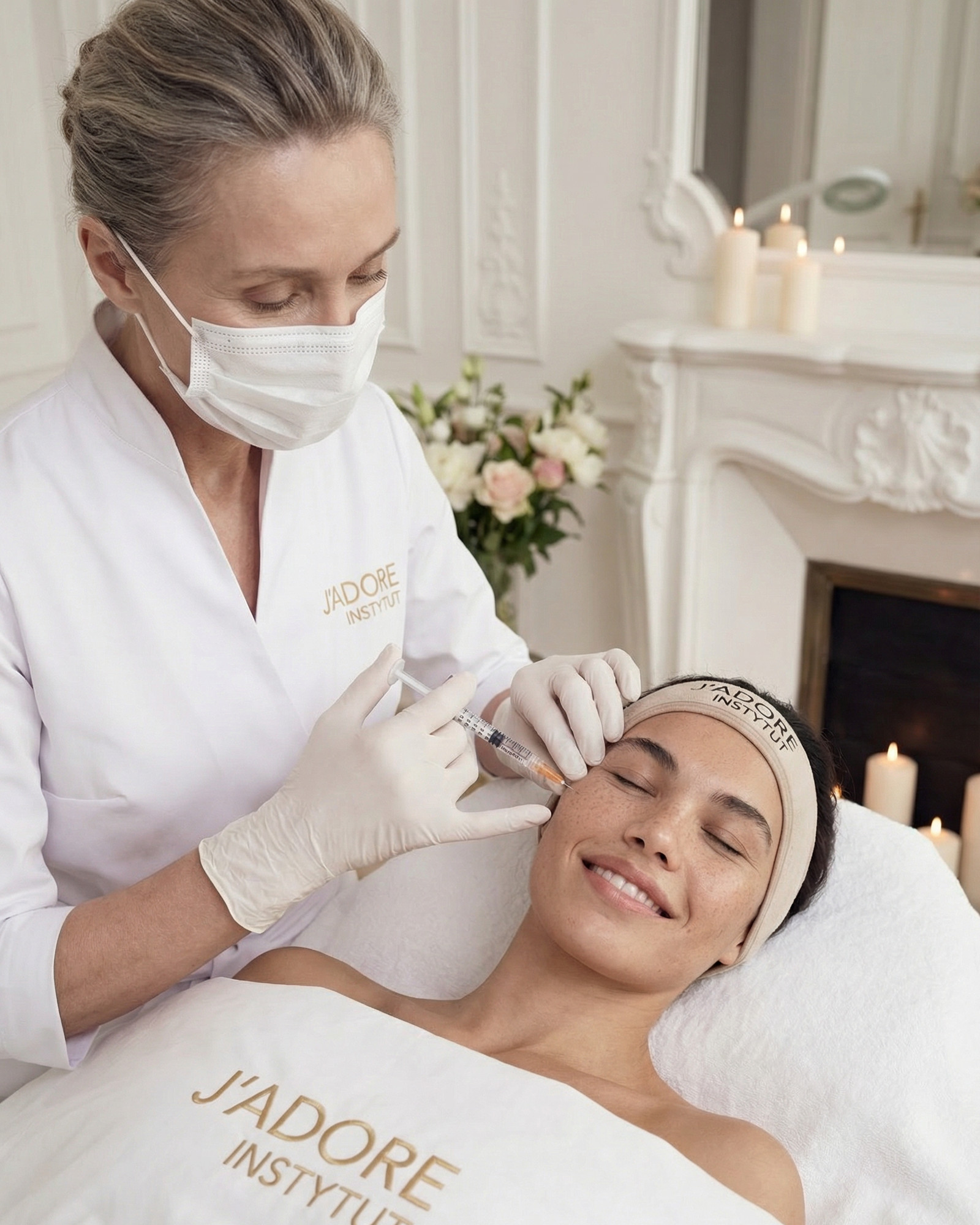
Delivery of concentrated repairing ingredients (vitamin C, glutathione, coenzyme Q10) directly into the dermis — bypassing the epidermal barrier. Often used for greyness, loss of radiance and signs of accumulated photoageing.
Biostimulators + restoring skin quality
When oxidative stress has led to a noticeable loss of skin density and quality, biostimulators encourage fibroblasts to produce new collagen — repairing the framework, not only the surface.
Chemical peels + epidermal renewal
Removal of the layer of cells with accumulated oxidative damage — improving tone, texture and absorption of active ingredients.
Cleansing + barrier regeneration
When reactivity and dryness suggest a damaged lipid barrier — barrier-regenerating treatments (ceramides, rebuilding ingredients) reduce TEWL and restore resistance to further oxidative damage.