Why there are so many myths around one device
Microdermabrasion has been available for decades. Over the years, it has become a “basic treatment” — available almost everywhere, from local salons to shopping-centre chains. This popularity has consequences. When a treatment becomes commonplace, hygiene standards start to be treated as optional rather than essential. The second issue is price competition. When you can compare several offers on one page, salons cut what cannot be seen — and hygiene and equipment are often the first costs to fall below a safe standard.
Five myths we hear most often
Myth 1: “Microdermabrasion is risk-free, so hygiene is a minor detail.” This is the most dangerous oversimplification in the industry. Microdermabrasion disrupts the epidermal protective barrier — which is exactly why hygiene rules are as important here as in any treatment involving living tissue. After exfoliation, the skin is more permeable to microorganisms for a time. A non-sterile tip, insufficiently cleaned guides or repeatedly used components can easily lead to irritation, an inflammatory response or, in extreme cases, an infection that undermines the entire purpose of the treatment.
Myth 2: “The treatment head affects comfort, not effectiveness.” In reality, the condition of a diamond or crystal treatment head determines how even and predictable exfoliation is. A new tip works precisely. A worn one works unevenly, meaning some areas of skin may be treated too intensively and others insufficiently. Results may be uneven and the risk of micro-damage increases. Replacing the tip or having it professionally restored is a cost that an honest salon includes in the treatment price — rather than omitting it to win on price.
Myth 3: “If it hurts, it means it works more intensely”. Pain during microdermabrasion is not evidence of effectiveness — it is a sign that something has gone wrong. A correctly performed treatment may create a sensation of gentle pulling and warmth, but not sharp pain, burning or tiny cuts. Pain often accompanies a worn tip. Instead of exfoliating in a controlled way, it “pulls” at the epidermis. This is not more intensive action. It is damage.
Myth 4: “Redness after treatment is always normal”. Mild, temporary redness after microdermabrasion is normal and usually fades within a few hours. However, severe redness lasting for days, burning, swelling or pustules indicate an inflammatory reaction. They should prompt questions about hygiene and treatment technique. Not every redness is “standard” — it is worth knowing when to contact the salon.
Myth 5: “Microdermabrasion can be performed on any skin, without consultation”. The treatment has genuine contraindications: active acne with lesions, enlarged blood vessels, eczema, psoriasis, active cold sores, a fresh tan and certain systemic medications. A salon that skips consultation to speed up the appointment or reduce labour costs shifts the risk onto you. A standard pre-treatment assessment is not a formality. It is a filter that separates an effective treatment from a harmful one.
What to look for before saying “yes” to treatment
Assessing a salon before microdermabrasion does not require specialist knowledge. A few observations and questions are enough. The first question worth asking is: “When were the treatment head or diamond tips last replaced?” An honest salon will give a specific answer. If the answer is “we replace them when needed”, that says everything. Professional equipment maintenance follows a schedule. It is not a reaction to something stopping working.
The second question is: “How are components that come into contact with the skin disinfected?” Single-use items cannot be disinfected. They can only be discarded and replaced with new ones. Reusable components should undergo a certified disinfection protocol. If the cosmetologist cannot answer this question or seems surprised by it, that is important information.
- Ask about the disinfection protocol — every professional salon has a ready answer.
- Check whether a pre-treatment assessment is carried out, rather than only once the device is already operating.
- Pay attention to the time allocated for consultation — if it takes less than a few minutes, something has been missed.
- Remember what the tip or treatment head looks like — a new one is even, while a worn one is visibly abraded or damaged.
- After the treatment: mild, temporary redness is normal; burning, swelling or pustules after 24 hours — contact the salon.
What really accounts for price differences
The costs incurred by a salon following appropriate standards are fixed and significant: regular replacement of diamond tips or crystals, certified disinfectants, single-use components that come into contact with the face, the cosmetologist’s time for assessment and consultation, appropriate insurance and qualifications. None of these costs can fall below zero — they can only be removed from the treatment price and shifted onto you in another form: as risk.
A low-price salon without standards
Low price, hidden costs
- Worn or rarely replaced tip
- No or simplified pre-treatment assessment
- Unspecified disinfection protocol
- Shortened treatment time without consultation
- No option for correction or aftercare support
A salon with hygiene standards
Fair price, visible costs
- Regularly replaced tips, following a schedule
- Pre-treatment assessment — questions about medications, skin changes and previous treatments
- Certified disinfection protocol for reusable components
- Time to tailor treatment depth and technique to your skin
- Contact and aftercare support if you have questions
Microdermabrasion worth considering — when it truly works
When performed correctly, microdermabrasion can be one of the most cost-effective exfoliating treatments. It is particularly suitable for dull skin, uneven texture, post-inflammatory changes or blackheads. For many people, it brings visible even skin tone and smoother skin texture. Results are built through a series. One treatment refreshes the skin; a series brings a visible change in skin quality.
An important context: microdermabrasion works at epidermal level, not in the dermis. Deeper concerns — significant acne scars, wrinkles or loss of skin firmness — require other methods or a combination of treatments. Understanding this scope helps prevent disappointment. It is an exfoliating treatment, not a revitalising one. Excellent when used appropriately, but limited where deeper intervention is needed.
Treatment combinations — when microdermabrasion works as a duo
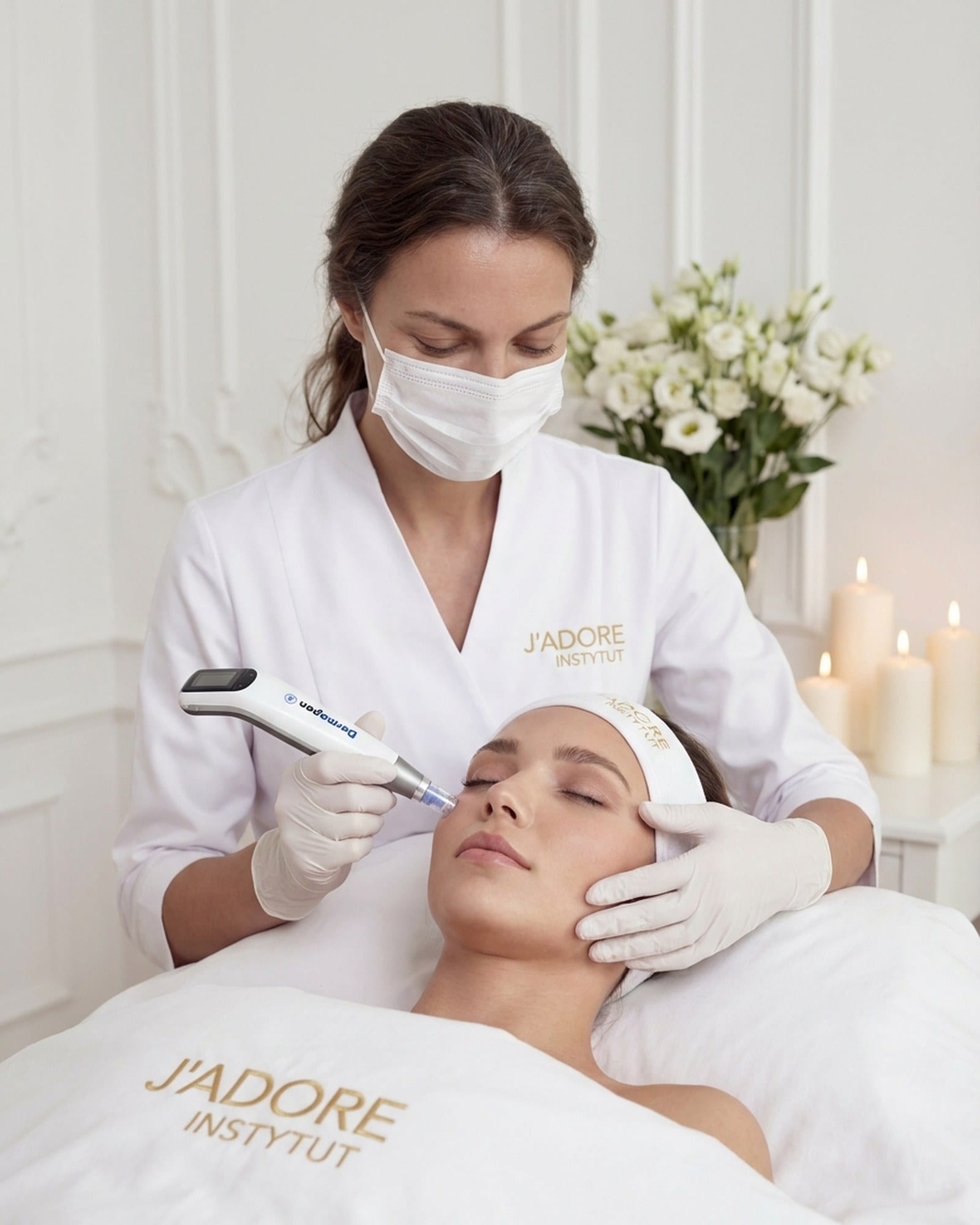
Microdermabrasion often delivers the best results as Skin preparation before deeper treatments or for maintaining their results afterwards. Exfoliated, cleansed skin absorbs active ingredients better and responds more evenly to subsequent procedures. Below are several combinations we often use in practice.
Microdermabrasion + hydrogen cleansing (hydrodermabrasion)
A combination of mechanical exfoliation with simultaneous hydration and infusion of active ingredients — particularly beneficial for dehydrated skin or enlarged pores.
Microdermabrasion + acid peel
Mechanical and chemical exfoliation in one session or performed sequentially — this requires precise selection of concentrations and depth. It is not standard for everyone; the decision belongs to the cosmetologist after assessing your skin.
Microdermabrasion + collagen or algae mask
Immediately after exfoliation, the skin is more receptive. A mask applied to cleansed skin works more effectively and also soothes potential irritation.
Microdermabrasion as preparation for mesotherapy
Removing the outer layer of the epidermis may improve the distribution of active ingredients used during mesotherapy. A specialist determines the order of treatments and the interval between them.
Before you decide — three questions worth asking
Whether you are looking for a salon for the first time or returning to one you visited years ago, three questions will tell you more than any website. First: when were the tips or treatment head last replaced? A specific answer is a good sign. An evasive answer or surprise at the question is worth considering. Second: what is the disinfection protocol for reusable elements? A certified product, exposure time and documentation are standard, not excessive. Third: will there be a consultation before the treatment? Without a consultation, there is no properly selected treatment.
- 01
Consultation and assessment
The cosmetologist asks about your skin, medication, previous treatments and any contraindications. Based on this, they select the depth and technique.
- 02
Skin assessment
The skin is examined under magnification. Texture, blackheads, blood vessel condition and hydration are assessed. This is essential when selecting the intensity.
- 03
Treatment with a new or properly maintained tip
Even exfoliation with controlled suction. Pain and intense burning indicate that something is wrong.
- 04
Finishing care
A soothing mask or serum, followed by UV protection. Your skin needs protection after the treatment. Skipping this final step is another shortcut that reduces the effect.
- 05
Aftercare instructions
Information on home care, SPF cream, avoiding hot water and the gym for several hours, and how to contact us in case of an unexpected reaction.
When performed properly — with suitable equipment, by a qualified specialist and in line with hygiene standards — microdermabrasion has a very good safety profile. The issue is not the treatment itself, but shortcuts that remain invisible until the skin reacts. That is why the only truly inexpensive microdermabrasion is one that leaves your skin cared for, not irritated.