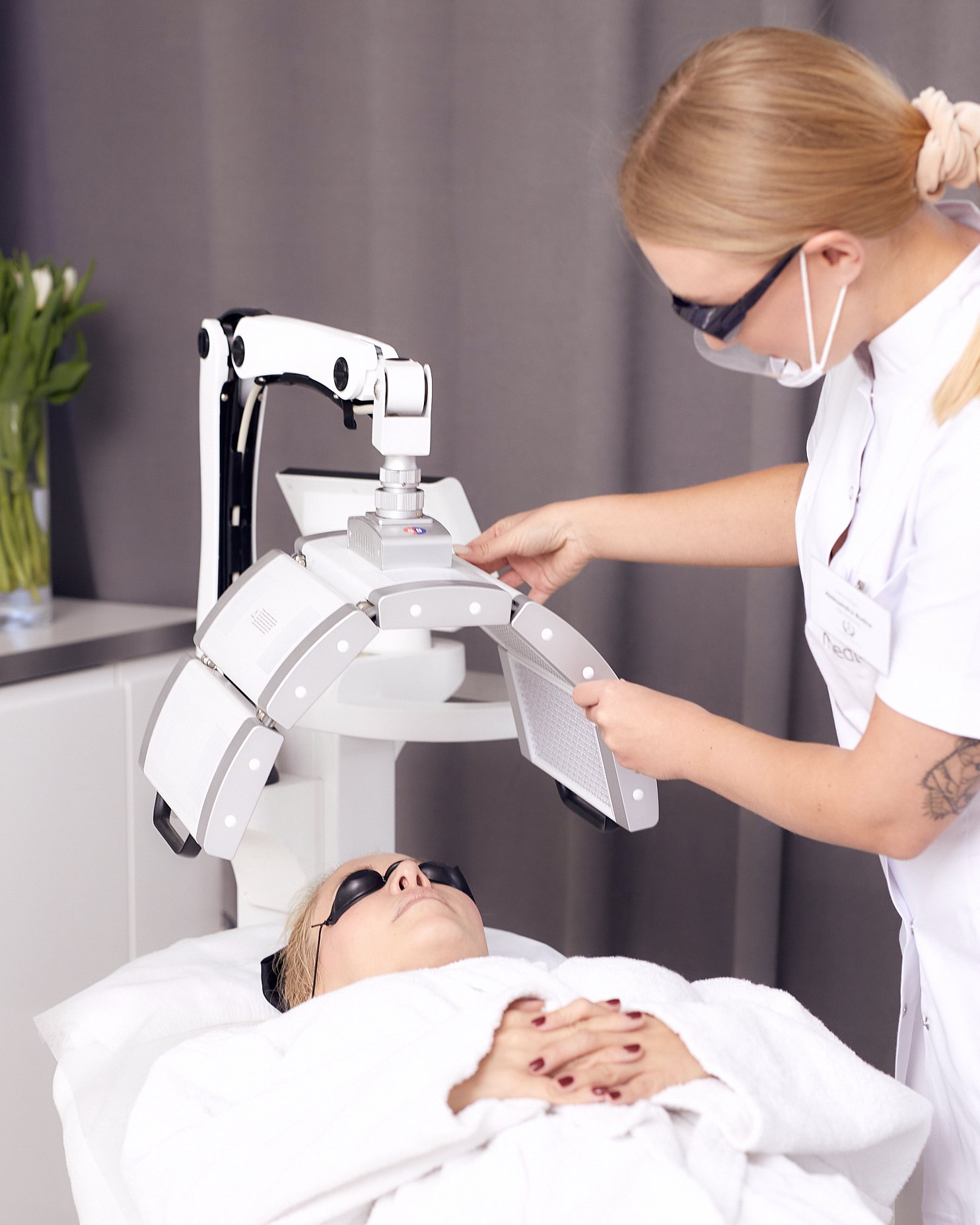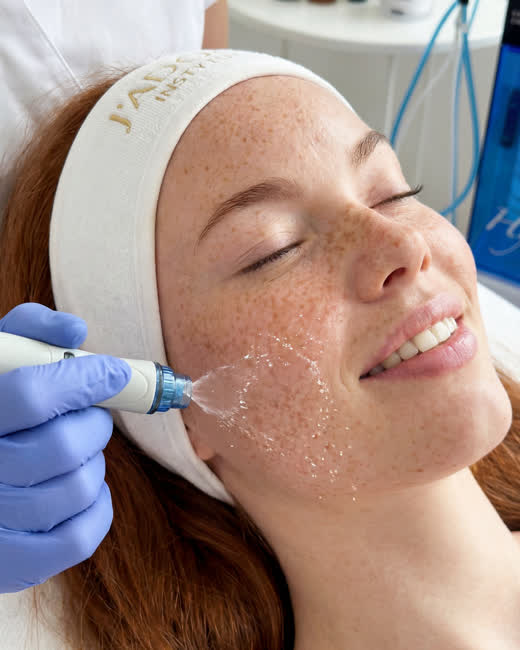
The name LED is not enough — safety depends on the device and the dose.
Panels can emit different wavelengths, have different power, working distances and exposure times. A home device is not automatically equivalent to a salon one, and a red light protocol does not have to fit a blue one. Contraindications must be read for the specific product, not for the word "lamp".
Photosensitising medications and supplements must be checked, not guessed from memory.
Some medications, herbal preparations and substances applied to the skin can increase the reaction to light. There is no short list that a patient should tick off once and for all. What matters is the substance, the dose, the time since intake, the wavelength and the manufacturer's indications for the device.
- Provide the names of all prescription and over-the-counter medications.
- Include supplements and herbal preparations, including St John's wort.
- List topical products, especially new medications and dermatological treatments.
- Do not stop a therapy recommended by a doctor in order to perform LED.
- In case of doubt, ask a doctor or pharmacist to assess the specific combination.
The American Academy of Dermatology recommends consultation before red light for people taking medications that increase sensitivity to light. The FDA also lists photosensitising medications as a contraindication in information about certain photobiomodulation procedures. This is a reason to check, not to shorten your medication course on your own.
Diseases with light sensitivity require a doctor's decision.
If light causes you a rash, long-lasting burning, swelling or exacerbation of a disease, do not test LED without explaining the cause. The AAD indicates that diseases causing photosensitivity, such as lupus, may worsen. Porphyrias and other photosensitivity disorders also require special assessment.
Eye protection follows from the instructions and cannot be replaced by sunglasses.
Intense light can cause discomfort, and devices differ in parameters and the way the face is exposed. If the instructions require shields, you must use the protection intended for that device every time. The AAD emphasises not to replace recommended goggles with ordinary sunglasses.
- Report eye diseases, ophthalmic procedures and unusual photophobia.
- Tell us about medications that may affect the retina or the reaction to light.
- Do not remove protection to check the colour of the panel.
- Stop exposure in case of eye pain, blurred vision or severe discomfort.
- Do not use damaged, random or ill-fitting shields.
Closed eyelids are not always the protection intended by the manufacturer. The rules are decided by the device instructions and the assessment of the person performing the qualification. In the case of eye disease, an ophthalmologist's consent or resignation from the procedure may be needed.
Pregnancy and breastfeeding are not the time to bypass the lack of data.
For some devices, the safety of use in pregnancy has not been established, and the FDA lists pregnancy or its planning among situations where certain photobiomodulation procedures are not recommended. This does not mean that every LED light has a proven harmful effect. It means there is no basis for arbitrarily applying the protocol to this group.
Report pregnancy, the possibility of it and breastfeeding as early as when booking. You must consider not only the light, but also the cosmetics applied before and after the treatment and the combined procedure. If the instructions do not cover this situation, a reasonable decision may be to postpone until the qualification is unambiguous.
Active infection, a wound and a suspicious lesion should stop the treatment.
LED is not used to mask diagnostics. Herpes, a weeping wound, infection, fresh skin damage or a lesion of unclear character require assessment before exposure. The FDA lists active infection, a wound or a lesion in the area as a contraindication for certain photobiomodulation devices.
Reschedule and clarify:
first the cause
- active herpes
- weeping or pus
- open wound
- fever and infection
- suspicious new lesion
Return after qualification:
new appointment after assessment
- healed skin
- established diagnosis
- completed treatment
- consent from the practitioner in charge
- current medication history
A history of cancer in the area requires a decision before irradiation.
Do not irradiate a suspicious or unassessed lesion to see if it settles. The FDA recommends caution near cancerous lesions, and some device information lists skin cancer or a history of cancer at the treatment site. The scope of the contraindication depends on the device and the clinical situation.
- Inform us about your cancer history and the site of previous treatment.
- Do not cover a mole to avoid the need for its assessment.
- Show any new or changing lesion to a dermatologist before the treatment.
- Bring a doctor’s recommendations if the procedure is to concern an area after treatment.
- Do not treat the reception staff’s opinion as oncological or dermatological consent.
LED has a limited cosmetic scope. It does not diagnose moles and does not treat cancer. For a person with an unexplained lesion, this treatment is not worthwhile, as it delays proper assessment and may create a false sense of action.
Migraine, epilepsy and reactions to flashing light must be reported before the session.
Devices can operate in continuous or pulsed mode. A person with photosensitive epilepsy, light-induced migraine or unexplained neurological symptoms should not assume that every panel is neutral. Data and contraindications differ between devices; a doctor’s decision and a check of the operating mode are required.
A combined treatment may have stricter contraindications than LED alone.
A panel is sometimes used after a peel, microneedling, laser or another procedure. In such cases, safety is not determined solely by the light. The damage to the barrier, substances used, risk of infection, skin phototype and recommendations for the previously performed device all matter. A gentle LED does not invalidate the contraindications of a stronger stage.
- Provide the exact name and date of the previous treatment.
- List the substances applied to the skin before exposure.
- Report prolonged healing, blisters and unusual discolouration.
- Do not add a home LED mask to a fresh treatment without instructions.
- In case of a reaction, contact the clinic instead of increasing the number of sessions.
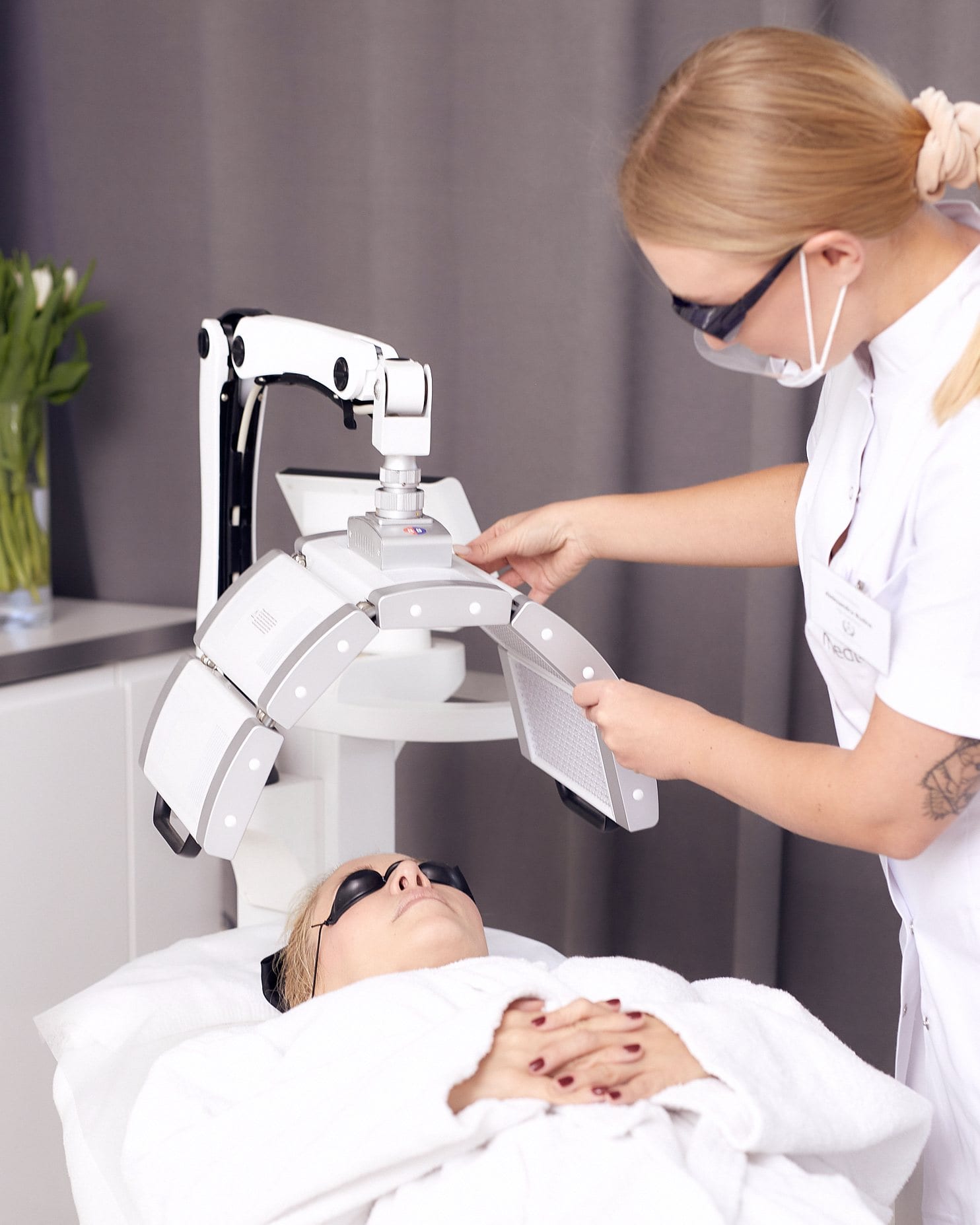
A darker skin phototype and a tendency towards hyperpigmentation require careful observation.
Visible light can affect pigmentation, and the reaction is not identical for every skin phototype. The AAD notes that people with darker skin may be more sensitive to visible light and should discuss home red light with a dermatologist. In the clinic, the device, dose, problem and history of hyperpigmentation after irritation are what matter.
- Tell us about melasma and post-inflammatory hyperpigmentation.
- Show photos of reactions after previous lamps, lasers or sun exposure.
- Do not increase the time yourself when the effect seems subtle.
- Observe any new uneven skin tone between sessions.
- If darkening occurs, stop the series and ask for an assessment instead of masking the change with make-up.
A patch test on a small area does not invalidate a general contraindication.
A short trial exposure can help assess local tolerance in a protocol provided by the manufacturer. However, it does not prove safety in the case of a photosensitive disease, medication, pregnancy, epilepsy or an ophthalmological problem. The reaction may depend on the cumulative dose, a larger surface area and time, and may not appear during a few minutes of testing.
What a test can show:
early local tolerance
- immediate burning
- strong redness
- eye discomfort despite protection
- unusual skin reaction
- the need to stop the procedure
What a test does not confirm:
full safety
- lack of interaction with a medication
- safety during pregnancy
- lack of a delayed reaction
- the validity of a series
- effectiveness for a given goal
If a contraindication requires a doctor or the device manual excludes the treatment, a test is not a shortcut. Qualification is decided first, and only then is tolerance potentially tested.
The history must be repeated before subsequent sessions because medications and the skin change.
A safe first session does not give permanent permission for the whole year. Between visits, an antibiotic, a new dermatological medication, an ophthalmological procedure, pregnancy, an infection or a disease exacerbation may occur. A short question about changes before each exposure is of greater value than a form signed many months earlier.
Burning, eye pain, and new discolouration are signs to stop
A session may feel bright and gently warm, depending on the device. However, you must report increasing burning, pain, dizziness, eye pain, or vision disturbances immediately. Observe your reaction after the treatment, especially if your skin is darker or prone to post-irritation discolouration.
The AAD recommends stopping home red light therapy and seeking a dermatological assessment if a skin condition worsens, or if you notice new hyperpigmentation, pain, or unusual photosensitivity. In the clinic, the rule is simpler: do not wait for the timer to finish if the sensation differs from the discussed procedure.
LED therapy in Krakow begins with your current list of medications
J'ADORE INSTYTUT in Krakow is located at ul. Karmelicka 45/2B, 31-128 Krakow and is open Monday to Saturday from 08:00 to 20:00. You can find the current description on the LED therapy in Krakow page.
Bring a list of your medications, supplements, and topical products to your appointment. Disclose any pregnancy, eye conditions, migraines, epilepsy, cancer, light sensitivity, or recent treatments. If you have started an antibiotic, developed an infection, or noticed a new skin lesion since booking, report this before starting the exposure.
Safe LED therapy means the right light for the right person, not universal relaxation
LED therapy is usually a gentle procedure. However, safety depends on wavelengths, dosage, the device, medications, and your health status. The biggest mistake is assuming that because the treatment does not break the skin, the consultation can be skipped.
Reschedule your appointment if you have an active infection, wound, unexplained lesion, or a new reaction to light. Seek a doctor's assessment if you have a photosensitive condition, a significant ophthalmological, neurological, or oncological history, or if you are unsure about a medication. A few minutes under a panel is not more important than a properly addressed contraindication.