The hair follicle: a small organ with big demands
The hair follicle is one of the most metabolically active mini-organs in the human body. It lives in cycles — growth phase (anagen), transitional phase (catagen), resting phase (telogen) — and for most of that time it works continuously, day and night, dividing, building, renewing itself. That takes energy. A lot of energy.
This energy comes from oxidative processes taking place in the follicle's cells. For these processes to run efficiently, the cells need a steady, regular supply of oxygenated blood. Blood reaches them through a dense network of tiny capillaries wrapped around each follicle like capillary lace. When this network functions well, the follicle gets everything it needs. When something disrupts it, the follicle gets less — and starts working less efficiently.
The problem is that the scalp is particularly prone to stagnation. Fascial tension, restricted mobility, sebum build-up, stress and muscle tension — all of these can gradually restrict microcirculation in this area. And when blood circulates less efficiently, the hair follicle receives less oxygen and fewer nutrients — and this starts to show in the hair.
What the Bohr effect is — and why it matters
The Bohr effect describes a phenomenon discovered by the Danish physiologist Christian Bohr in the early 20th century. Put simply: haemoglobin — the protein that carries oxygen in the blood — releases oxygen more or less readily depending on the environment it's in. The higher the carbon dioxide concentration and the lower the pH in a tissue, the more readily haemoglobin "releases" oxygen to the cells.
What does this mean for the scalp? A hair follicle in the growth phase works intensively and creates a local environment with elevated CO₂ levels — which encourages haemoglobin to release oxygen. But this mechanism only works optimally when blood actually reaches the follicle in sufficient quantity and at the right rate. If microcirculation is slowed, even properly oxygenated blood may not arrive in time — or may arrive in too small a quantity.
In other words: the Bohr effect is a mechanism that, in theory, works in the follicle's favour. But for it to actually work, one basic condition needs to be met — efficient microcirculation. And that's exactly what's worth looking after if you want your hair to grow in optimal conditions.
What disrupts oxygen delivery to the follicles
A slowdown in scalp microcirculation is a problem that builds up slowly and often goes unnoticed. It doesn't usually hurt or itch, and it doesn't signal itself sharply. Hair simply becomes thinner over time, grows more slowly, and sheds a little more than usual. The causes vary — and they often overlap.
- Tension in the scalp fascia and muscles. For many people, the scalp is surprisingly immobile — almost "glued" to the skull. Tight fascia restricts space for blood vessels and hinders free blood flow. Chronic stress, jaw clenching and long hours at a computer all contribute to this.
- Sebum and residue build-up on the scalp. Sebum is a natural protective lipid — in the right amount, it's desirable. But an excess, mixed with impurities, can form a film that interferes with the follicle openings and the microenvironment functioning properly.
- Chronic scalp inflammation. Dandruff, seborrhoeic dermatitis, hyper-reactivity — these aren't just cosmetic issues. Inflammation disrupts the local biochemical environment, affects pH, and can prevent microcirculation from functioning properly.
- Limited physical activity and systemic hypoxia. Blood needs to be well oxygenated for the Bohr effect to deliver that oxygen. A sedentary lifestyle, shallow breathing and poor cardiovascular fitness all affect the baseline quality of the blood reaching the scalp.
- Age and natural changes in blood vessels. Over time, small vessels become less elastic and less responsive — a biological fact that affects the whole body, including the scalp.
The scalp: a neglected organ
It's an interesting paradox: we spend a lot of time and money caring for the hair strands — conditioners, masks, oils — while almost completely ignoring the environment the hair grows from. Yet it's the scalp that determines whether a new hair emerges thin or thick, strong or weak, and whether the growth phase lasts one year or three.
Hair-strand care
works on the length of the hair
- Hydration and smoothing of the hair shaft surface
- Protection against mechanical damage
- Shine, softness, manageability
- Results visible immediately
Scalp care
works at the source of growth
- Microcirculation and follicle oxygenation
- Sebum balance and inflammation
- Length and quality of the growth phase (anagen)
- Strength and thickness of new hair
The conclusion is simple, though rarely stated outright: hair care and scalp care are two different tasks. You can take excellent care of one and completely neglect the other. And it's precisely this neglect that often lies behind problems we mistakenly blame on the wrong shampoo or a vitamin deficiency.
What can improve the follicle's oxygen environment
If the problem lies in microcirculation and the environment the follicle lives in, it makes sense that solutions should work at that same level — not on the surface, but at depth. Here's what works, or can work, from several directions at once.
- 01
Diagnostics — where to start
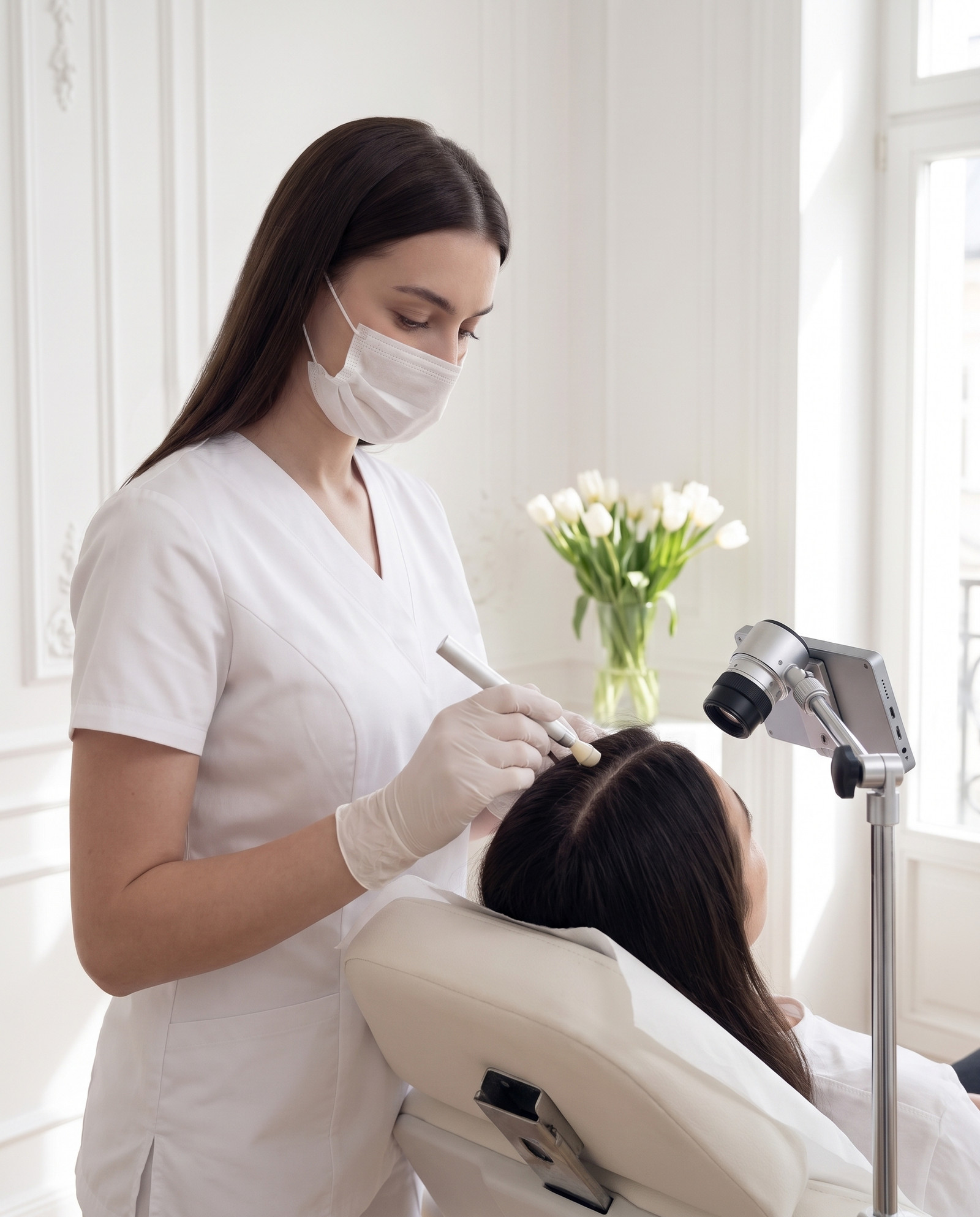
Trichoscopy (dermatoscopic assessment of the scalp and follicles) lets you see what's happening in a place invisible to the naked eye: whether the follicles are active, whether the openings are blocked, whether there's inflammation. Without this picture, targeted action is difficult — it's a starting point, not a formality.
- 02
Stimulating microcirculation
Scalp massage — especially deep massage that addresses fascial tension — can improve local blood flow. Not as a one-off ritual, but as a regular practice. Dedicated in-salon treatments work far deeper than home techniques.
- 03
Cleansing and balancing the environment
Removing excess sebum, residue and blocked follicle openings is an initial step that "opens up" the scalp for further action. A cleansed scalp responds better to active ingredients and stimulating treatments.
- 04
Nourishment from within
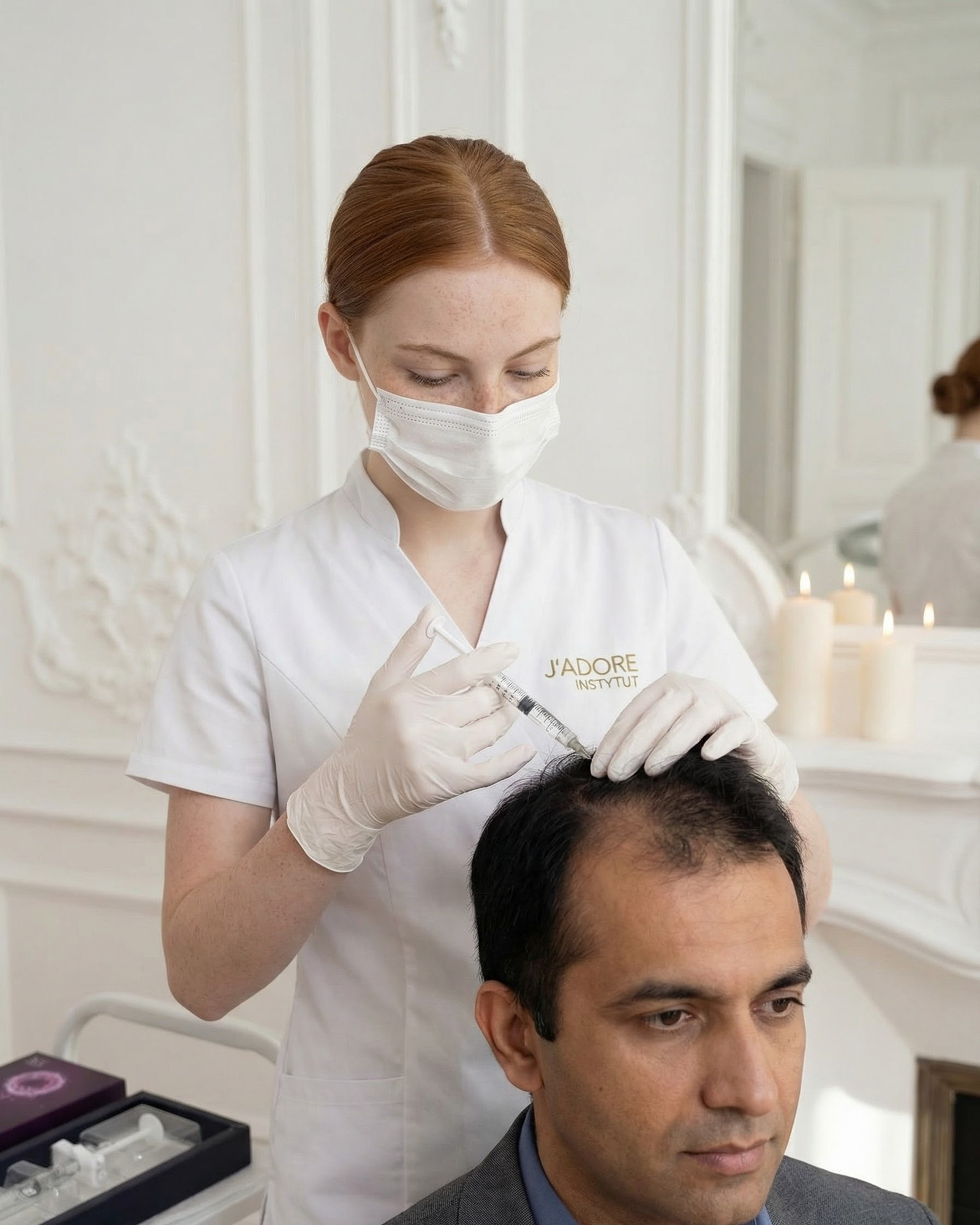
Scalp mesotherapy — delivering active ingredients directly into the follicle zone — bypasses the skin barrier and reaches places creams and serums, by definition, cannot. Different protocols address different problems: shedding, slow growth, follicle quality.
- 05
Maintaining results — home and salon
The salon provides the impulse; home care sustains it. Well-chosen scalp products (not just hair products), and the right washing and massage technique, won't replace a treatment — but they'll extend its results and build lasting habits.
When it makes sense — and when to look for another cause
Working on scalp microcirculation and environment makes sense as part of a broader strategy — but not as the only action when the problem runs deeper. There are situations where it's worth starting with a different question than "which treatment?"
- Hair loss after severe stress or illness (telogen effluvium): here the mechanism is different — a mass entry of follicles into the resting phase. Stimulating treatments can support recovery, but they won't shorten the biological regrowth cycle.
- Hormonal and genetic (androgenic) hair loss: the cause is systemic, not local. Scalp treatments can offer support, but they need to be combined with dermatological or endocrinological treatment.
- Alopecia areata: an autoimmune condition — a different approach, a different treatment path.
- Acute scalp inflammation or infection: a stimulating treatment isn't the first step — treatment comes first, care comes after.
This is why a trichology consultation — including a scalp assessment and a conversation about your hair-loss history — is more valuable than searching online for the "best hair treatment". The mechanisms vary, and effective action requires knowing which one is dominant for you specifically.
Scalp mesotherapy
Delivering active ingredients directly to the follicle zone bypasses the skin barrier — the most precise tool for working on the environment the follicle lives in.
Diagnostic trichoscopy
An assessment of the scalp and follicles under a dermatoscope — a starting point that lets you understand the mechanism instead of working blind.
Scalp cleansing treatment
Removes residue, sebum and blocked follicle openings — "opens up" the scalp for further stimulating treatments and improves absorption of active ingredients.