The INCI list is the only part of the label whose shape is set by law
The front of the pack is marketing space: the manufacturer chooses which ingredient to feature, and the law mainly requires the message to be true and provable. The form of the ingredient list, by contrast, is set by EU Regulation 1223/2009 on cosmetic products. It is the same in every EU country, so you read it by the same rules regardless of price, brand or where you bought it.
So the list tells you about proportions, not numbers: you can see what there is more and less of, but not exactly how much. The one-percent threshold is a rule of thumb, not a measuring stick — it marks the point beyond which order stops meaning anything. At the shelf, then, you don't look for concentrations. You look for the point where the tail of the list begins.
One label, five minutes: taking a serum apart, front to back
The label below was put together for this lesson from elements you see on pharmacy and drugstore shelves every week. It carries no brand, because the brand changes nothing here — what matters is how you read it.
- 01
Minute one: the first five positions
Aqua, Glycerin, Propanediol, Niacinamide, Butylene Glycol. This is the backbone of the product and where most of the work happens. The main hydrator is glycerin, which the front doesn't mention at all.
- 02
Minute two: find phenoxyethanol
It sits in ninth place. Everything after it is already in the any-order zone — from here on, you are reading the tail of the list.
- 03
Minute three: where the front-of-pack heroes stand
Sodium hyaluronate right after the preservative, vitamin C only after the fragrance. The first is normal for that ingredient; the second is a warning sign.
- 04
Minute four: Parfum and three names at the end
Limonene, Linalool and Citral are fragrance allergens named individually because they exceeded the legal threshold. On a product described as “for sensitive skin”.
- 05
Minute five: packaging and date
Clear glass and a dropper that lets air in every time it is opened. On the bottom, an open-jar symbol with a number of months, or a minimum durability date.
The most interesting information on this label never made it to the front. Niacinamide stands fourth, ahead of panthenol and betaine, and the manufacturer says nothing about it. It is one of the better-researched skincare ingredients: it supports the epidermal barrier and helps even out skin tone. If this serum changes anything in the skin, it is mostly thanks to niacinamide and glycerin, not to the ingredients printed in gold.
Sodium hyaluronate right after the preservative is no abuse. This ingredient works in small amounts, and in larger ones the formula turns sticky and leaves a film. Sodium Hyaluronate holds water on the surface and in the uppermost layers of the epidermis; the hydrolysed form has smaller molecules. The trouble only starts when the front promises “deep hydration” and the buyer expects the effect of a treatment — we break that difference down in the article on how hyaluronic acid differs in a cream, an injection and a supplement.
Vitamin C is a different story. On the front it stands on a par with hyaluronic acid; in the ingredient list it comes after Parfum, in the any-order zone. On top of that, it isn't pure ascorbic acid but its stable derivative, Sodium Ascorbyl Phosphate: gentler and more resistant to oxidation, but it has to be converted into the active form in the skin. At this amount it plays the role of an extra rather than a main ingredient. The claim “with vitamin C” is true. It just isn't a statement about effectiveness.
The front-of-pack promise versus what the ingredient list says
The front promises
what you see from a distance
- “With hyaluronic acid” — suggests that it is what does the hydrating.
- “With vitamin C” — suggests brightening and a more even tone.
- “For sensitive skin” — suggests a formula without irritating additives.
- “Glow effect” — suggests a change in the skin itself.
- “Dermatologically tested” — suggests the product will suit everyone.
The ingredient list says
what you see up close
- Hydration comes mainly from glycerin in second place; hyaluronate is present at the amount typical for that ingredient.
- The vitamin C is a stable derivative at the tail of the list, after the fragrance.
- The formula contains Parfum and three fragrance allergens named individually.
- The glow comes mainly from a hydrated epidermal surface — visible straight away, fading once washed off.
- The test took place under a dermatologist's supervision. The label doesn't say on how many people or with what result.
That doesn't make the serum bad. The front and the ingredient list simply describe two different products: the one you want to buy and the one that actually lands in your basket — a decent, light hydrating product with niacinamide, with added fragrance and a trace of a vitamin C derivative. If that's what you are after, it's a sensible choice. If you are looking for a serum for discolouration, this isn't it.
Packaging and pH: two things the list doesn't say outright
The ingredient list tells you what went into the bottle at the factory, but not what will be left after a few weeks in the bathroom. That is decided by the packaging, especially for ingredients that react with air and light. The law requires a minimum durability date on products with a short shelf life; for longer-lasting ones, an open-jar symbol with the number of months the product keeps its properties after opening is enough.
The most temperamental is pure vitamin C, listed as Ascorbic Acid. In a water-based solution it oxidises, and the serum changes colour: from almost colourless or straw-coloured to yellow, then orange and brown. Research by Pinnell's team in the early 2000s also showed that this form penetrates the skin only in a clearly acidic environment. Such a formula is always a compromise between effectiveness, stability and skin comfort. What helps stabilise it is covered in the article on why ferulic acid strengthens vitamin C; the packaging decides the rest.
- A jar lets in air and fingers every time it is opened. It works for rich creams with simple formulas, less well for antioxidants.
- Clear glass with a dropper looks good in photos, but light and air reach the formula with every use.
- Dark glass or an opaque tube protects from light, not from air.
- Airless packaging with a pump keeps the formula away from air right down to the last dose — the best home for vitamin C and retinoids.
- A small volume is an advantage too: it runs out before the ingredient has time to break down.
“Dermatologically tested”, “hypoallergenic”, “free from…”: what front-of-pack claims really mean
Front-of-pack claims are regulated too, just in general terms. Regulation 655/2013 requires a claim to be legally compliant, truthful, supported by evidence, honest, fair, and to allow an informed choice; the European Commission spelled out these criteria in guidelines applied since 2019. The law, however, contains no definitions of individual claims — and that is where their flexibility comes from.
- “Dermatologically tested” means the product went through some test under a dermatologist's supervision. You don't know what test, on how many people, with what result, or whether the participants had skin like yours.
- “Hypoallergenic”, according to the guidelines, requires a formula designed to minimise the risk of allergy, and evidence that it does. It does not rule out an allergic reaction.
- “Paraben-free” and similar claims are discouraged by the guidelines when they disparage ingredients permitted by law. The absence of one preservative usually means another one is present.
- “For sensitive skin” has no definition at all. You verify it in the ingredient list: Parfum, essential oils, alcohol high on the list.
- “Natural” has no legal definition in cosmetics law; at most, private certifications give it meaning, if the product has them.
The second trap concerns scent. A product without the word Parfum can still smell of essential oils, which appear in the INCI under the Latin names of plants, for example Lavandula Angustifolia Oil. An essential oil is also a mixture of fragrance substances, and its allergens end up on the list anyway. For reactive skin, then, “no added fragrance” doesn't mean “free of fragrance substances”.
Where a cosmetic's work ends and a treatment protocol begins
A shelf cosmetic has to be safe in the hands of anyone who buys it — without a skin assessment, without supervision, daily, for months. Its limits aren't a flaw of the formula but the condition for it to stand on an open shelf at all. Why even a good ingredient stops in the uppermost layers of the epidermis is covered in the article on the skin barrier and penetration. Here the point is a different one: the information that can't be written on a label.
A protocol won't fit on a label: contact time measured on a specific person's skin, pH matched to how that skin reacts, the moment of neutralisation, the route by which an ingredient is delivered. In the clinic, these parameters are set and adjusted as the treatment goes. They, not concentration alone, are the real difference between a peel from the shelf and a peel in the clinic.
- In a chemical peel, the specialist first assesses the skin, then watches contact time and reaction, and ends the treatment by neutralising or rinsing off the preparation. An acid toner used every evening has none of these stages.
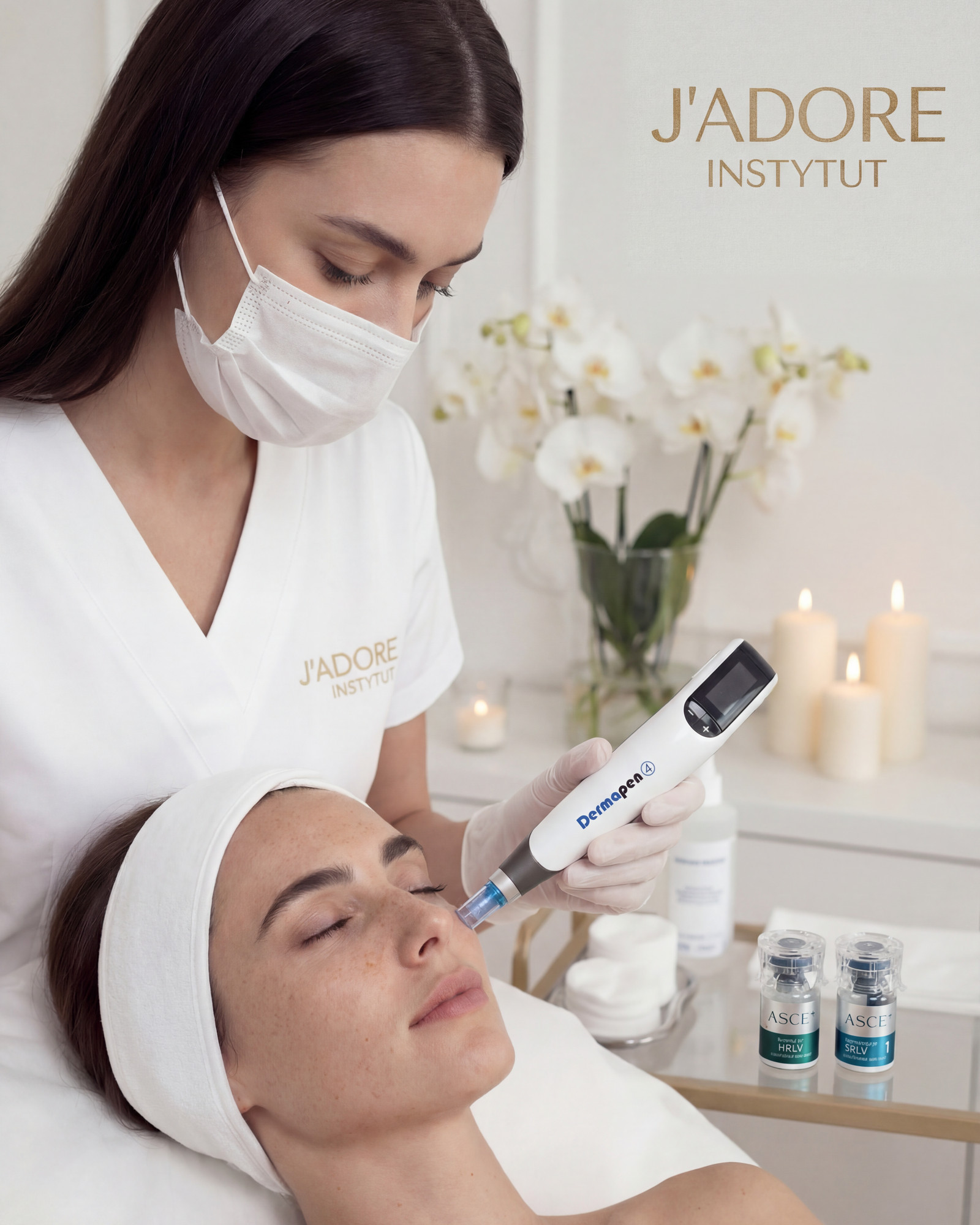
- In fractional mesotherapy, micro-punctures create channels in the skin through which serum reaches deeper than when it is simply applied to the surface.
- In needle-free mesotherapy, electroporation and ultrasound increase the penetration of ingredients without breaking the skin.
- In each of these treatments, the preparation is matched to the skin the specialist sees that day, not to the description on the packaging.
An example from this lesson: if a vitamin C serum doesn't give you the radiance you are after, the vitamin C peel in Warsaw combines it with acids in a protocol where contact time and skin reaction are under control — we also perform the same treatment in Krakow. For sensitive skin we more often start with mandelic acid. When the goal is to deliver ingredients deeper, the options are fractional mesotherapy, needle-free mesotherapy or Nanopore, which combines microchannels with an infusion of a professional formula.
Questions about ingredient lists that come up in consultations
- Does an ingredient at the very end of the list do anything at all?
It depends on the ingredient. Some work in very small amounts — sodium hyaluronate, peptides, some antioxidants. Others need a larger share of the formula. A place at the tail doesn't rule an ingredient out, but it should make you ask why it is in the product: to work, or to make it onto the front.
- Is a short ingredient list better than a long one?
Not by definition. A short list makes it easier to spot an ingredient that doesn't suit your skin and can be a good choice for reactive skin. A long one may mean a well-thought-out formula with several ingredients working together. What counts is the start of the list and whether it contains substances your skin can't tolerate.
- How do I know the concentration of an active ingredient?
You can't read it from the INCI list alone. Some manufacturers state the concentration on the front voluntarily; then the list lets you check whether the claim matches the ingredient's position. If the front declares a concentration above the ordering threshold, yet the ingredient stands after phenoxyethanol, something doesn't add up.
- Does “dermatologically tested” mean the product won't cause an allergy?
No. The claim only says the test took place under a dermatologist's supervision. It doesn't cover your skin, your history of reactions, or what you apply alongside the product. If you are prone to irritation, try a new cosmetic on a small patch of skin for a few days first.
- Is a good serum enough to make treatments unnecessary?
For many needs — yes. A treatment makes sense when the goal requires parameters a shelf cosmetic can't have: controlled exfoliation, delivering ingredients deeper, working in a series under a specialist's eye. An honest consultation sometimes ends with the conclusion that swapping two products at home is enough.
- What should I bring to a consultation?
The cosmetics you use every day, or photos of their ingredient lists. We will read them together, point out what doubles up, what might irritate and what is missing — and only then talk about a treatment.
Five minutes at the shelf won't turn anyone into a cosmetic chemist, but it is enough to buy the product that is really in the bottle rather than the one drawn on the front. The skin assessment, the choice of protocol and the plan for the weeks ahead happen in the clinic. Bring your cosmetics to a consultation at J'adore Instytut in Warsaw or Krakow: the first change often happens in the bathroom, and only the second in the treatment chair.