Melasma isn't a mark — it's an overzealous pigment factory
To understand melasma, it helps to look beneath the surface for a moment. Skin contains specialised cells — melanocytes — whose sole job is to produce melanin, the pigment that gives colour to skin, hair and eyes. Melanin isn't the enemy: it's a natural shield that protects the deeper layers of skin from radiation. The problem starts when melanocytes in one area begin working too intensely and without restraint — and that's exactly what happens with melasma.
This is why it's misleading to think of melasma as "dirt on the skin" that can be washed or scrubbed off. It isn't a surface deposit — it's pigment overproduction at the source. You can exfoliate the pigmented epidermis until it's completely clear, but if the melanocytes underneath still have their "engine running", they'll simply produce fresh pigment. Hence the frustrating loop: you lighten it, the patch fades briefly, then it returns as if nothing happened.
- Melanocyte — the producer. This is the cell that makes melanin. In melasma, it's overactive, "revved up" — and hard to calm through external treatment alone.
- Tyrosinase — the key enzyme. This is essentially the "switch" for pigment production. Without this enzyme, skin simply cannot produce pigment. That's why the most effective approach to melasma targets the enzyme itself — calming it down, rather than scraping away the result of its work.
- Epidermis vs depth. Some pigment sits shallow, in the epidermis — this is usually easier to lighten — and some sits deeper, in the dermis, where it's stubborn and unpredictable. Most cases of melasma are a mix of both, which explains why patches "partly fade, and partly don't".
Why you specifically — hormones, sun and genetics, all in one
Melasma rarely has a single cause. It's usually a combination of several factors at once — which is why two people in seemingly similar situations can have very different levels of severity. Behind most cases of melasma sits a triad: a genetic predisposition, a hormonal trigger and — almost always — sun exposure, which sets the whole thing off. Remove one element and the picture changes. That's why a sensible approach starts with understanding which factor is driving things in your case.
Hormonal background
the most common trigger in women
- Pregnancy — hence the common term "pregnancy mask"
- Hormonal contraception
- Hormone replacement therapy (HRT)
- Hormonal fluctuations on their own — with no single "guilty" medication
Predisposition and skin phototype
the ground it grows on
- Family tendency — "my mother had it too"
- Darker skin phototypes react more readily and more strongly
- Reactive skin that pigments easily after inflammation
Sun — the catalyst
this is what "triggers the shot"
- UV stimulates melanocytes into action
- Reactivates patches that have already faded
- Works even on a cloudy day and through glass
Notice one thing: two of the three pillars — hormones and genetics — are beyond the reach of any cream or treatment. That's not a reason to give up; it's the key to realistic expectations. With melasma, we're not usually aiming for a "once and done" fix, but for a clear lightening effect and — just as important — maintaining it through consistent skincare and sun protection. This is more about managing a tendency than curing it once and for all.
The trap almost everyone falls into: laser and aggression
This is the paradox that's hardest to accept: with melasma, stronger doesn't mean better — it often means worse. Most types of hyperpigmentation, such as classic sun spots and freckles, respond well to strong intervention: heat, break up the pigment, exfoliate. Melasma works the opposite way. It's like an oversensitive alarm — the harder you hit it, the louder it "shouts back" with fresh pigment production. Inflammation, irritation and high temperature are all signals that can rev a melanocyte up even further.
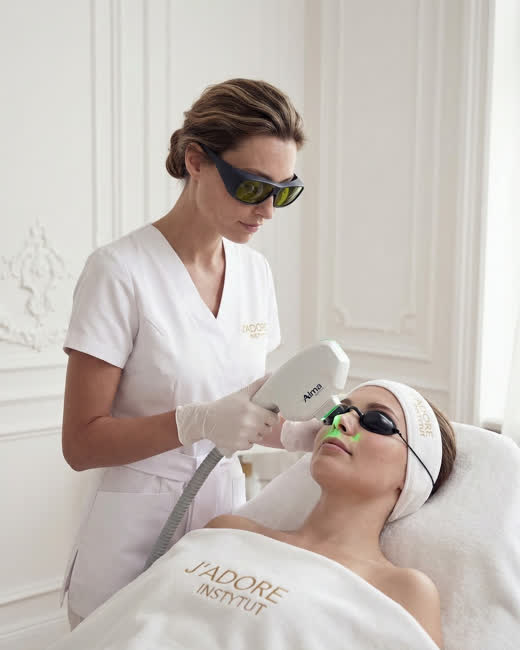
The most painful example is often laser treatment. For ordinary sun spots, it can work brilliantly. But with hormonal melasma, thermal energy can be a trap: instead of calming things down, it provokes them — and women frequently leave the salon with pigmentation that's darker and more widespread than before the treatment. Hence the golden rule: melasma isn't diagnosed casually "on the side", and it shouldn't be lumped together with every other type of pigmentation. Identifying it as melasma has to come before choosing a method.
This doesn't mean doing nothing and waiting. It means melasma calls for a different strategy from other types of hyperpigmentation — more patient, more about calming things down than scraping them off. And the first step isn't choosing a treatment, but identifying whether it really is melasma, how deep the pigment sits, and what your skin phototype is.
The quiet hero of the whole story: SPF isn't a suggestion
If you take away one sentence from this article, let it be this: with melasma, sun protection isn't a cosmetic extra — it's the foundation of the entire treatment. Put bluntly: without solid daily SPF, even the best-designed lightening treatment is working uphill, and will eventually lose. This isn't a "nice to have"; it's a condition without which the rest of the plan loses its purpose.
The reason is simple, and follows directly from the mechanism described above. Melanin reactivates under UV exposure very quickly — just a few days of unprotected exposure is enough for a patch that had just started fading to begin coming back. And UV, contrary to how we usually picture it, doesn't take a day off when it's cloudy, or behind glass — it's active in winter, on the commute, by an office window and in the car.
The practical takeaway is unusually cost-effective: an ordinary, high-protection sunscreen applied every day outperforms many a pricier treatment in terms of value — because it's what protects the results you're working towards. With melasma, SPF isn't a step you can skip on an off day. It's a constant, all year round, regardless of the weather.
What genuinely makes sense — calm it down, don't scrape it away
Since melasma is pigment overproduction at the source, a sensible approach isn't about "scrubbing the patch away" — it's about calming the factory down and keeping it calm. In practice, this comes together as a few strategies that usually work alongside each other rather than competing — and they always start with confirming that it really is melasma, and assessing skin phototype and pigment depth.
Calming it down at the source
the heart of melasma treatment
- Depigmenting protocols that target the pigment-producing enzyme, not just the epidermis
- Working "from the root" — less new pigment forms, and existing pigment gradually fades
- Usually a protocol spread out over time, continued at home
Gentle lightening
when a delicate approach is needed
- Treatments and gentler peels chosen for reactive skin and darker phototypes
- Support for radiance and even skin tone, without provoking inflammation
- A slower pace, but safer for melasma
Skin quality and maintenance
so the result holds
- Nourishing and strengthening skin "from within" so it copes better with treatment
- Consistent home care matched to the protocol
- Daily SPF — without it, nothing else will hold
- 01
Diagnosis
First, confirming that it's melasma (not an ordinary sun spot), assessing your skin phototype and how deep the pigment sits. This step decides what not to do.
- 02
Calming it down at the source
A tailored depigmenting protocol that targets pigment production — often spread over several weeks, continued at home.
- 03
Consolidation
The home-care phase, keeping the pigmentation from coming back. This isn't an "add-on after the treatment" — it's half of the whole job.
- 04
Ongoing protection
Daily SPF and sensible sun habits — not just for the duration of the treatment, but for years, because melasma is quick to return given the chance.
Which of these paths makes sense for you — and in what order — isn't something an article or an advert can decide. Only looking at your specific skin can. Below, we've grouped our approaches exactly along these lines, so it's clear what each one is for.