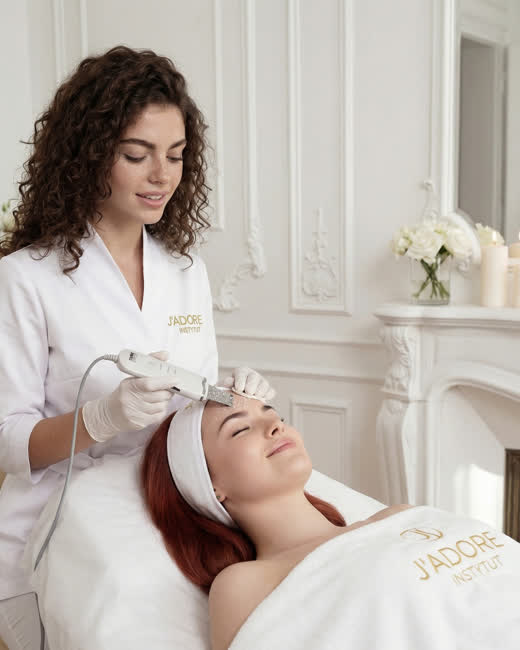
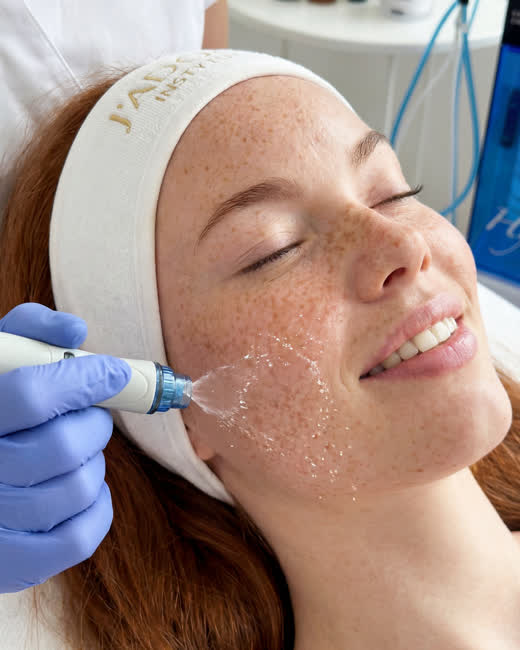
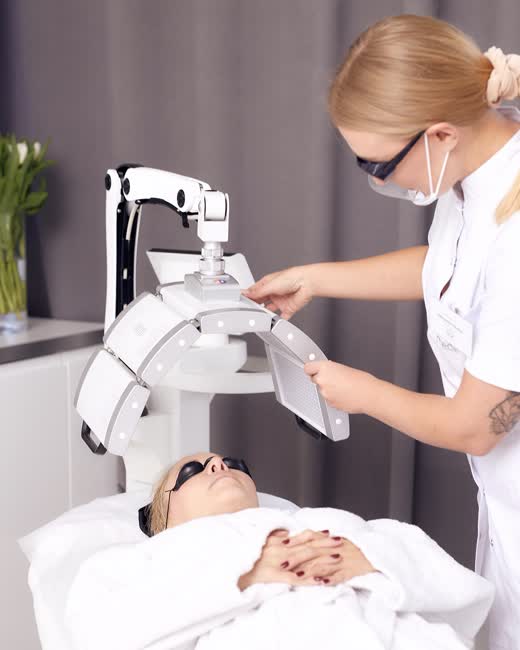
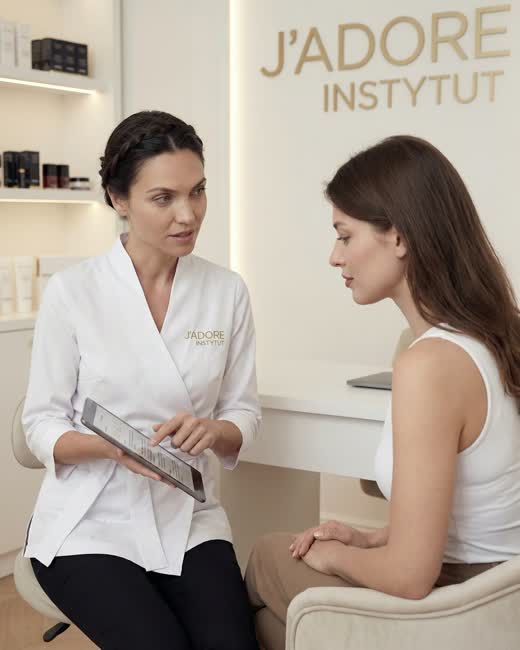
A treatment room at J'adore
MEDICAL PEELS
Symmetrical brown patches on the cheeks, above the upper lip, on the forehead — melasma is the most difficult type of hyperpigmentation to remove, because it has a hormonal basis and returns as soon as the surface is exfoliated. Cosmelan by mesoestetic works differently from a classic peel: it does not merely remove the pigmented epidermis, but blocks tyrosinase — the enzyme that produces melanin.
It is a two-phase system: mask Cosmelan 1 applied in the clinic + cream Cosmelan 2 for continued use at home for several weeks. At J'adore Instytut the treatment is carried out by an experienced cosmetologist. Below you will find everything worth knowing before deciding on the treatment: whether it hurts, how many days you will be peeling, when you will see the effect and why SPF is not an option here, but a condition.
One salon treatment + several weeks of home care
How it works
Most peels lighten the skin "from the top" — they exfoliate the pigmented epidermis and wait for lighter skin to grow back. With melasma, that's not enough: melanocytes carry on producing pigment, so the patches quickly return. Cosmelan works at the source — its active ingredients inhibit tyrosinase, the enzyme without which skin can't produce melanin. Less enzyme means less new pigment, and existing pigment gradually fades.
This is a two-phase mesoestetic system, not a single mask. Phase 1 is the thick Cosmelan 1 mask applied in the salon, which you remove yourself at home after a set exposure time. Phase 2 is Cosmelan 2 cream, used at home for several weeks — this is what locks in the results and keeps hyperpigmentation from returning. Without the home phase, the whole protocol loses its point.
Good to know: the key to success isn't the "strength" of the peel — it's consistency. Melanin reactivates under UV within days. That's why the success of Cosmelan depends not on the treatment itself, but on consistency: home cream and daily SPF for many weeks afterwards.
Ideal for
Cosmelan is the right choice for stubborn hyperpigmentation — when lighter brightening peels or home creams are no longer enough. For mild, recent, uneven tone, it's sometimes more sensible to start with a gentler course — we'll determine this during consultation.
Female zone and male zone
In women, melasma is usually hormonal in origin — it appears or worsens during pregnancy, with contraception, or with HRT. It can be extensive and symmetrical, and attempts to "mask" it with repeated peels often irritate it further. This is a classic area for Cosmelan in women — depigmentation at the source rather than fighting the symptom.
What we work with
In men, hyperpigmentation is usually the result of years without sunscreen — sun spots on the forehead, temples, an uneven line between face and neck, and post-inflammatory marks from acne and acne scarring. On top of that, skin tends to be oilier, and there's often no SPF habit. This is an area for Cosmelan in men — evening out skin tone without altering features.
What we work with
Good to know: the depigmentation mechanism is the same for women and men — tyrosinase doesn't distinguish by gender. What differs is the cause of the patches (hormones vs. sun) and skin thickness, which affects the choice of mask exposure time. That's why the protocol is always set individually, never "off the internet."
Safety
With depigmentation, results and safety depend on a few things worth asking about at any salon — because "stronger" doesn't mean "better":
Cosmelan and Dermamelan are not the same thing, and skin phototype changes the mask exposure time. At J'adore, the type of peel, its strength and duration are selected by an experienced cosmetologist after analysing the skin and phototype — not from a rigid template.
We use only genuine mesoestetic products from legitimate supply. A counterfeit or poorly stored peel means unpredictable results and a real risk of irritation or reverse hyperpigmentation.
Cosmelan only works as a whole: mask + a several-week home course + SPF. We plan the series and the aftercare in advance; "a peel sold without a home plan" is the most common reason the result doesn't last.
Red flags with depigmentation ·
MEDICAL PEELS
From the cosmetologist's chair
The most common misunderstanding: people think Cosmelan "happens" in the salon. In the salon, we only apply the mask — the most important part happens at home: removing the mask on time, correctly, and keeping up the cream and SPF consistently over the following weeks. These seemingly mundane steps are what decide whether the result is spectacular or average.
Contraindications
Some contraindications are permanent, others temporary — in which case we simply postpone the treatment until the situation passes. We go through the full list individually during consultation.
From the cosmetologist's chair
The most commonly overlooked issue: herpes. A peel can "wake" the virus, even when the outbreak is elsewhere on the face. If you have active herpes, we postpone by a few days. If it recurs regularly for you, mention it during consultation so we can plan antiviral prophylaxis before the protocol.
This isn't a complete list — we'll discuss your medications, health conditions, phototype and previous treatments individually during consultation.

What to expect
Most importantly: peeling is part of the mechanism, not a complication. Applying the mask itself is painless. Discomfort — a feeling of tightness, stinging, itching — appears during the peeling phase, most intensely at its peak. Melan Recovery soothes these sensations, and most people describe the whole process as "manageable and worth the result."
Clients sometimes call on day three, worried that they're "peeling too much." That's exactly what should be happening — peak peeling looks dramatic, but it's expected and temporary. There's one rule: don't pull or scratch off the shedding skin, as it risks irritation and… new hyperpigmentation.
We assess full results only after several weeks of home care, not right after peeling ends. With consistent SPF, an even skin tone usually lasts 12–18 months; without protection, hyperpigmentation can return much sooner.
Portfolio
A record of the work in our salons — the place where we publish treatment frames and, after photo sessions, results.
A record of results — in preparation. We publish photographs of our clients only with their consent.
Cosmelan and your lifestyle
With depigmentation, most questions aren't about the treatment itself, but about what comes after: sun, makeup, sport, active skincare, holidays. There's one overriding rule — protect freshly renewed skin from UV and irritation, since these are what reverse the result.
This is the most important rule of the whole protocol. You apply SPF 50+ every day for many weeks — including on cloudy days and in winter. UV reactivates melanin within days and can undo the entire treatment. Without consistent SPF, Cosmelan has no point.
Intensive sunbathing, a beach holiday, and sunbeds are the enemy of depigmentation. That's why we plan the protocol for the cooler part of the year, away from any holidays booked in full sun.
During intensive peeling, we pause foundation and heavy makeup, to avoid clogging or irritating shedding skin. Once healed, you return to makeup normally — always with an SPF base.
No personal retinoids, acids, or exfoliating "actives" during the protocol — you use only what we give you (Cosmelan 2, Melan Recovery, SPF). Combining these with home actives risks over-irritation.
At peak peeling, intense exercise and heavy sweating can sting and irritate skin. Return to full training once skin has healed; after training, rinse off sweat gently, without scrubbing.
High temperatures and chlorinated water further irritate skin during the peeling phase. We put off sauna and pool visits until peeling has stopped.
Cosmelan
There are several routes to treating hyperpigmentation, and they aren't interchangeable — especially with melasma, where the choice of method can determine success or make things worse:
depigmentation at the source
not a "quick peel for tomorrow" — requires a series of peeling days and several weeks of cream
lightens "from the top"
rarely enough on its own for deep melasma — pigment returns without addressing it at the source
breaks down pigment with light
can be risky with hormonal melasma — heat can make it worse; Cosmelan is usually the safer choice here
Combine with
Cosmelan is a "solo" course — during it we do not combine it with other active treatments. Only after the course is completed does the freshly renewed skin work excellently with treatments that improve quality. The order and intervals are decided by the cosmetologist during the consultation, but the logic is constant:
I most often hear: “I want a laser for these spots”. For ordinary sun spots — great. But if it is hormonal melasma, a laser can lighten it for a while and then make it worse. A simple rule: a single, sun-related spot → a laser can be a good choice; symmetrical, hormonal melasma → first depigmentation of the Cosmelan type. What you have on your face, we identify during a consultation.
Cosmelan and Dermamelan
Under the name "mesoestetic depigmentation" there are two peels from the same family, differing in strength and indication. You don't choose them "off the shelf" — they are selected by a cosmetologist according to the type and depth of hyperpigmentation and your phototype.
Universal-strength depigmenting peel — in-clinic mask Cosmelan 1 + at-home cream Cosmelan 2. Shorter healing.
Dla kogoMild to moderate hyperpigmentation: sun-related, post-inflammatory, uneven tone, milder melasma.
A stronger peel from the same line — for stubborn, deep pigmentation. Usually longer, more intensive exfoliation.
Dla kogoDeep, long-standing melasma and chloasma, hyperpigmentation resistant to gentler methods.
Fact: Where does the difference lie? In the strength of the preparation and how deeply the pigment reaches. Stronger does not mean "for everyone" — with light hyperpigmentation, a stronger peel means unnecessarily longer healing, not a better result. That is why the choice between Cosmelan and Dermamelan is determined by an assessment of the skin during a consultation with photodocumentation, not by price or "the stronger, the better".
Price list
Checking free hours…
From the magazine
Editorial pieces on how this treatment works in practice — what happens during the session, how to prepare, where the limits are and what the first days after look like.
See also
The result lasts12–18 months with daily SPFJ’adore Instytut
This text is for informational purposes only and does not replace a consultation. The choice of peel (Cosmelan or Dermamelan), the strength of the protocol, the length of the series and any contraindications are determined by a cosmetologist/specialist during an individual consultation with a skin and phototype assessment. Cosmelan is a beauty treatment; the term "medical" in the peel category name refers to the class and strength of the product, not to the fact that it's performed by a doctor — it is carried out by an experienced cosmetologist, not a doctor.
Home care
Cosmetics matched to what your skin needs after a treatment — so the clinic effect lasts longer.
 hyperpigmentationSesdermaMANDELAC Liposomal SerumView in the shop(opens in a new tab)
 sun protectionCell Fusion CAquatica Sunscreen 100 SPF 50+/PA++++View in the shop(opens in a new tab)
 post-treatment regenerationMedMelanoSkinbiotic Elixir Probiotic Repair Serum 50 mlView in the shop(opens in a new tab)
 hyperpigmentationPeel MissionMelasma & PIH Cream 50 mlView in the shop(opens in a new tab)
 sun protectionDermaQuestSunArmor SPF50 30 mlView in the shop(opens in a new tab)
 post-treatment regenerationVagheggiEmozioni Plus — Anti-Stress Face Mask 75mlView in the shop(opens in a new tab)
 hyperpigmentationDermoMedicaTRX C Foam Cleanser 150 mlView in the shop(opens in a new tab)
 hyperpigmentationMediderma1+1 Set — FR-Antiox MD Concentrate + Mela 360 Bellis TRX Brighter SPF 50View in the shop(opens in a new tab)