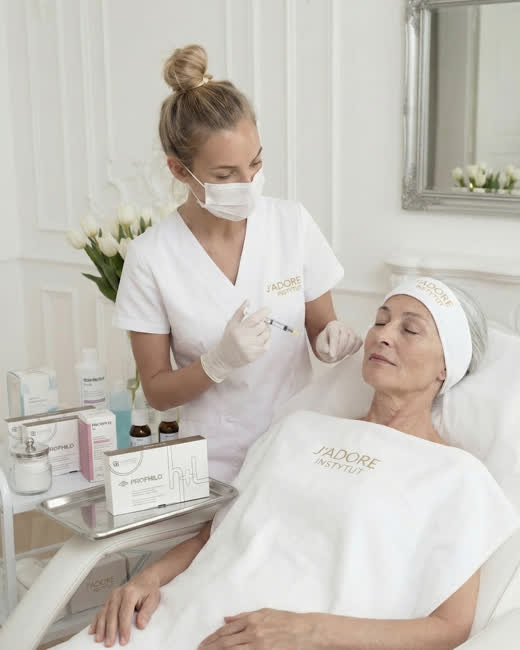
Why does skin need ingredients by injection — when we can eat them?
This question gets asked surprisingly rarely. We eat collagen in supplements. We take vitamins as tablets. We get amino acids from our diet. So why inject them into the skin? The answer lies in biology, not marketing: skin is a poorly vascularised organ, especially its upper layers — the dermis and the structures just below the epidermis, where most ageing processes take place. What we take orally circulates in the bloodstream and reaches the skin last, in whatever amount remains once every more important organ has been supplied.
Then there's the epidermal barrier — one of the best-designed structures in nature. It protects the skin from the outside world so effectively that it also blocks most active ingredients from skincare products. A cream with 5% hyaluronic acid applied to the face mostly reaches the epidermis. A substance injected directly into the dermis doesn't need to get through anything. It arrives exactly where it's needed, at a concentration that makes a difference.
What a mesotherapy cocktail actually is
A mesotherapy cocktail — whatever the brand name — is a ready-made preparation for intradermal injection, containing a combination of active substances in controlled proportions. It's manufactured in a laboratory, sterile, and optimised for a specific purpose. That's what sets it apart from working with single ingredients: instead of injecting vitamin C, amino acids and hyaluronic acid separately, you deliver a ready-made, balanced blend — just as a finished dish behaves differently from its ingredients eaten one by one.
You'll come across a few main groups of preparations. Not every manufacturer builds cocktails the same way, but the underlying logic always comes down to a few questions: what should it do in the skin, which cells should it reach, and what mechanism should it work through? So before a name gets mentioned, the goal should come first.
- Revitalisation and skin "feeding" — cocktails rich in vitamins, trace elements and amino acids (e.g. NCTF). The aim is to replenish what skin loses with age or from poor general condition. Skin can look better "fed" after this treatment, with a healthier tone.
- Hydration and barrier repair — preparations with hyaluronic acid at different molecular weights (e.g. Cytocare). Low-molecular-weight HA penetrates deeper and holds water in the tissue; higher-weight HA works more on the surface and plumps. This isn't the same as an HA cream — this works from within.
- Stimulating fibre rebuilding — amino acids at a concentration capable of activating fibroblasts (e.g. Jalupro). Fibroblasts are the cells that produce collagen and elastin. On their own, they can't produce enough — the preparation gives them "raw material" and a signal to get to work.
- Targeted applications — preparations aimed at specific problems: hyperpigmentation, hair loss, regeneration after damage (e.g. Dermaheal). Here the formula is more specialised, often containing signal peptides or growth factors.
Four preparations — four different approaches
Rather than describing each preparation on its own — which would end up as a list of ingredients without context — it's more useful to compare them through one question: which skin problem does each one primarily address? That's what really sets NCTF apart from Jalupro.
NCTF
Revitalisation and replenishing deficiencies
- A rich blend of vitamins, amino acids, coenzymes and trace elements
- Works like a "multivitamin for skin" — delivering what skin doesn't get from the bloodstream
- Suited to skin that's tired, grey, lacking radiance — general condition ahead of deeper concerns
- One of the longest-established mesotherapy protocols
Cytocare
Hydration and tissue stabilisation
- Non-stabilised hyaluronic acid + a vitamin and mineral complex
- Goal: deep tissue hydration and restoring "turgor" — skin firmness from within
- Different formulas (e.g. 532, 516, 538) — the numbers refer to different concentrations and compositions, matched to your needs
- Often chosen when skin is losing elasticity and volume, and lines have a "dehydration" character
Jalupro
Stimulating fibroblasts to produce collagen
- Amino acids (glycine, L-proline, L-leucine, L-lysine) + hyaluronic acid
- Goal: not to add collagen from outside, but to stimulate skin to produce its own
- Jalupro HMW version — larger HA molecules, a stronger matrix for fibroblasts
- Suited to deeper wrinkles, scars, skin with pronounced ageing, or as regeneration support
Dermaheal
Targeted, regenerative preparations
- A line of preparations with signal peptides and growth factors
- Different formulas: HL (hair loss), SR (skin regeneration), SB (hyperpigmentation), HSR (rejuvenation)
- Goal: reach specific cellular processes — inhibiting melanin production, stimulating hair follicles, speeding up healing
- A more specialised protocol — used when you have a defined, narrow problem to address
Does it work the same way for everyone?
No — and that's the crux of something rarely said out loud. Mesotherapy cocktails work through the skin's biological processes — and those depend on age, condition, treatment history, lifestyle and individual cellular response. A 35-year-old's skin with a tired tone will respond to NCTF differently from a 55-year-old's skin with significant density loss — even with the same preparation.
That's why working sensibly with mesotherapy isn't about finding "the best preparation" in general, but choosing the right one for your skin's actual state at a given time. A protocol often combines several approaches: a series of NCTF might come before Jalupro — because it's worth "feeding" the tissue first, before stimulating it to rebuild. Sometimes Dermaheal for hair loss and Cytocare for the face run alongside each other.
What you can actually do with this
Now that you understand NCTF, Cytocare, Jalupro and Dermaheal are different tools for different problems, the logical next step is a conversation about what's happening with your skin. Not "which preparation to pick", but: is your skin losing hydration? Is it thinning and losing density? Is there a tone issue? Is hair loss part of the picture?
These questions sound simple, but they need proper assessment — skin rarely has just one problem, and what it needs changes with age and with what it's been through (sun, stress, diet, hormones). That's why a consultation before mesotherapy isn't a formality — it's the point where you decide whether the treatment will be a precise answer or a shot in the dark.