Why one bottle causes so much confusion
Olaplex is a brand that over the course of a decade went from a niche tool for colourists to a product on the front page of TikTok. The more popular the brand, the more worthwhile it is to counterfeit it — and that is where the problem begins. There are at least three categories of "Olaplex for pennies" in circulation: the grey-market original (redirected from another country outside the brand's sales network), a diluted product (the original decanted by an intermediary with a filler) and a counterfeit (bottle, scent and colour close to the original, the chemistry — entirely different). The buyer often does not know which category they have ended up in.
Myths about "cheaper Olaplex" feed on several things at once. First — the brand is expensive, so any cheaper source seems like a reasonable choice. Second — the effects are subtle on first use (especially on severely damaged hair, which needs time), making it hard to tell by eye whether the product has worked at all. Third — the counterfeit market is now so advanced that packaging can be indistinguishable from the original without specialist testing. Add to that a fourth factor: reviews saying "it worked great" — which may relate to a genuine product bought through the same channel, but from an earlier, authentic batch.
Six myths, one by one
Myth 1: "It's the same product, just a cheaper sales channel". Not always. Olaplex sells through distributors and salons, and products for professional use (e.g. no. 1 and 2) are not intended for retail sale online. When you see them on Allegro, Shein or unknown online shops, one possibility is the grey market — a product redirected from another channel, often with a changed label or an overprinted expiry date. Not every such bottle is a counterfeit, but with none of them do you know the route from the manufacturer. This is a risk you take upon yourself, not a discount from the brand.
Myth 2: "If it smells and looks the same, it's the same product." Counterfeiting today is an industrial craft, not a garage operation. Scent can be copied, packaging printed to the millimetre, liquid colour matched with dye. What's hard to replicate without an expensive laboratory is the active molecule at the right concentration and purity. Chemical tests of counterfeit Olaplex, carried out by consumers and investigative journalists, regularly show zero or trace levels of the active ingredient. Your nose and eyes won't catch that — but your hair will, after a few weeks of use.
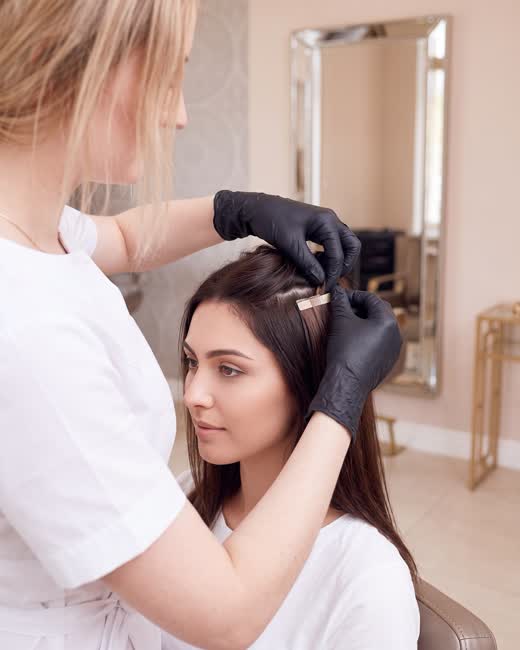
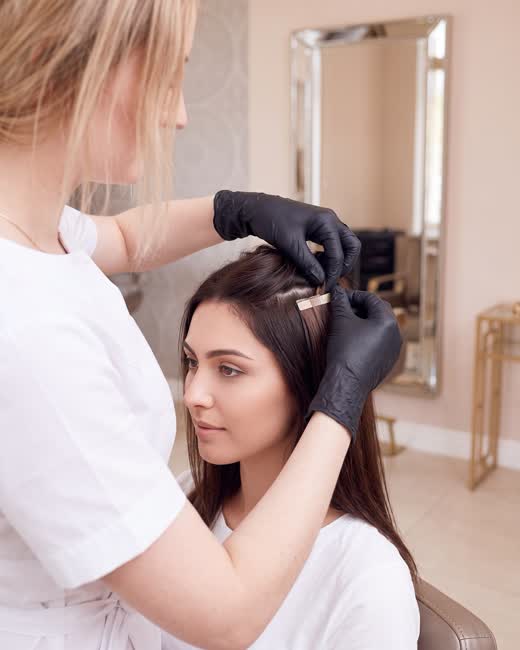
Myth 3: "It's exactly the same in the salon, that's what you're paying the markup for". An original from legal distribution has a documented supply chain: manufacturer → distributor → salon, with an invoice at every stage. Each link is responsible for storage conditions (temperature, light) and the authenticity of the product. In the salon you get not just the bottle, but also the specialist's knowledge of how to use it in combination with your hair type — because Olaplex no. 3, for example, used on unwashed, water-soaked hair at the wrong exposure time may not deliver the expected effect even with the original.
Myth 4: "I happened to get a genuine batch — it worked for me." Possible. The counterfeit market isn't uniform — some sellers operate in a grey zone: sometimes it's a redirected original, sometimes a diluted copy, sometimes a fake. If it worked once, that doesn't mean every batch from the same source will be the same. Products made without standards can vary between batches, and "results" after one bottle might come down to something else entirely — less heat styling, a shampoo change, or hair simply recovering after summer. An anecdote isn't proof that a source is reliable.
Myth 5: "Salon staff scare you off because they sell the products themselves." This claim comes up often — and it's worth unpacking honestly. Yes, the salon earns from product sales. But a hairdresser applying a product to your hair has the opposite incentive to selling a counterfeit: her reputation depends on the result she can see. When she warns you against a cheap copy, she isn't protecting a margin — she's protecting the outcome of her own work. Scepticism towards marketing is healthy, but it's worth aiming it in the right direction: ask about the supply chain of what you're buying, not just who's recommending it.
Myth 6: "Even if it's a fake, worst case it just won't work." This is where the biggest risk of all lies. "It won't work" is the optimistic scenario. A product of unknown composition, made without quality control, may contain ingredients that irritate the scalp, worsen hair loss, build up on the hair shaft, and interfere with future professional treatments. Cases recorded by salons — wet, heavy hair with a strange residue after "home Olaplex from the internet," contact allergies, problems with colour absorption — aren't scare stories. They're a real cost, often difficult to reverse quickly.
How to tell the original from a copy — a few signals
Full verification requires a laboratory, but there are a few indicators worth knowing before you buy. The first signal is a price below the profitability threshold. Premium brands have wholesale price lists, below which selling simply isn't possible without a loss. If the price is significantly lower than the lowest official retail price in Poland, there's a catch somewhere — inflated shipping costs, a diluted product, or a counterfeit.
- Ask for the invoice and batch number — a seller with legitimate goods will show them without any problem
- Check the hologram and serial code — genuine packaging has anti-counterfeit security features that a copy can't reproduce accurately up close
- Pay attention to the texture — the genuine No. 3 is a gel of a specific consistency; a watery or overly thick version is a warning sign
- Watch for a scalp reaction — itching, redness or a burning sensation after applying a product that never caused these symptoms before is a signal to stop immediately
- Ask your hairdresser before applying it — a professional can see and feel the difference between a product she knows and a copy
Why salon results and home results so often differ
Even with a genuine product, there's one variable rarely discussed: exposure time, the order of steps, and the condition of the hair before application. Olaplex works best after the hair has been pre-hydrated, at a specific temperature, and in the right amount adjusted to length and thickness. These details matter for the final result — and they're knowledge a hairdresser holds, but that's hard to replicate from a YouTube tutorial. This isn't an argument against using it at home. It's an argument that a good product plus poor technique equals a surprisingly small effect.
There's one more aspect that doesn't get talked about enough: Olaplex isn't the answer to every type of damage. It works on disulphide bonds — and not every hair problem comes from bond breakdown. Mechanical breakage (too much brushing, too much heat), dehydration (a lack of humectants in your routine), or excessive oil build-up (blocking absorption) — none of these are within Olaplex's remit. Before buying a product, it's worth knowing what your hair actually needs — and a conversation with your hairdresser can tell you more than an hour of research online.

What's really behind the advice "do it yourself at home"
Home care with Olaplex (No. 3, No. 5, No. 8 — these are the ones approved for retail sale) is entirely possible and justified. The brand designed them specifically for home use, as a complement to your routine between visits. The question is not "whether to do it at home" — it is "where to buy so that it is actually the real product". Legal sources (the brand's online store, salons and perfumeries buying from the distributor, with an invoice) provide a certainty that the grey market cannot offer.
Product from an unknown source
lower price, unknown risk
- No guarantee of composition or active-ingredient concentration
- Possible counterfeit, dilution or grey-market product
- No control over storage conditions
- Risk of scalp irritation
- Potential problems with future salon treatments
Original from a legal source
known quality, predictable results
- Documented supply chain from the manufacturer
- Known, tested composition and active-ingredient concentration
- Storage conditions in line with the brand's requirements
- Can be combined with a professional treatment
- A real basis for evaluating the product's effectiveness
Before you reach for another bottle
Olaplex works — but not as magic sealed in a bottle regardless of its contents. It works as a specific chemical molecule, at a specific concentration, on a specific problem within the hair's structure. When one of these elements is off — a different ingredient, too low a concentration, poor technique, or the wrong stage of treatment — there's no result. And that's the most honest answer to why it works for some and not for others. Before writing another "negative review", or making another purchase from a suspiciously attractive offer, it's worth asking yourself a simple question: do you actually know what condition your hair was in, and what you poured onto it?
A hairdresser who knows your hair from the inside — its chemical history, its porosity, how it reacts to treatments — is a kind of compass no online review can replace. Whether you're planning a professional Olaplex protocol or a supportive home routine: start with a conversation, not a shopping cart.