Before we do anything — we need to know what is happening to the follicle
The key to understanding the difference between SMP, mesotherapy and PRP lies in one question: is the hair follicle still alive? This is not a metaphor. A follicle can be in different states. It may actively produce hair. It may be ‘dormant’ (technically: in the telogen phase or undergoing miniaturisation). It then does not produce hair, but still exists and may potentially be reactivated. Or it may be dead — irreversibly replaced by scar tissue or connective tissue, with no possibility of regrowth.
This distinction determines everything. Methods that stimulate hair biology — mesotherapy and PRP — only make sense when the follicle still functions or is in a reversible resting phase. Once the follicle is gone, no stimulation can restore it. In this scenario, SMP, which does not biologically stimulate anything, is paradoxically the only solution. It does not need a living follicle to change the appearance of the scalp.
- 01
Active follicle
Produces healthy, full hair. Prevention and condition — the role of care.
- 02
Miniaturisation
The follicle shrinks and the hair becomes thinner. A window for biological stimulation: mesotherapy, PRP.
- 03
Dormancy
The follicle still exists but does not produce hair. Reactivation may be possible with early intervention.
- 04
Irreversible loss
The follicle has disappeared. Biological stimulation will not help. SMP as an aesthetic solution.
SMP — when the result matters, not biology
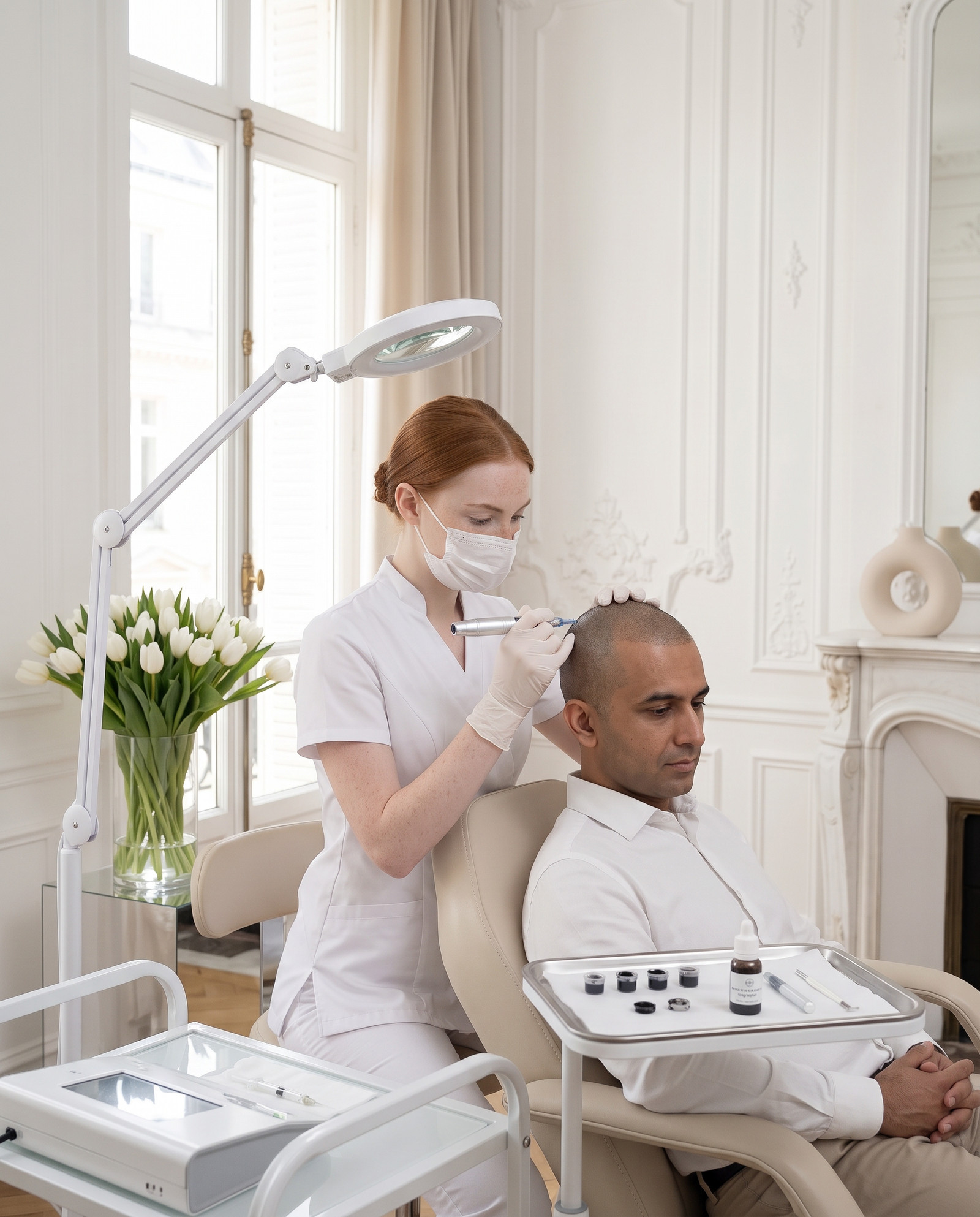
Scalp Micropigmentation is a method that does not affect hair biology — and does not claim to. It is a technique between tattooing and pigmentation. Pigment is introduced into the scalp to imitate closely shaved hair follicles. The result is visual densification or restoration of the hairline — visible immediately after the treatment, regardless of follicle condition.
SMP does not stop hair loss, nourish the follicle or alter any biological process. In a sense, this is its strength: it works regardless of the stage of baldness. For someone with advanced, irreversible baldness, after illness, or with scars following burns or a hair transplant, SMP can radically change the appearance of the scalp. There is no need to wait for treatment results, as biological therapy is no longer an option.
There is also another scenario in which SMP works exceptionally well: as a complement for sparse but existing hair. People with visible scalp between their hair — without distinct bald patches — often choose SMP to reduce the contrast between skin and hair. Here, SMP does not replace a biological method but works alongside it. Mesotherapy or PRP can strengthen existing follicles at the same time, while SMP visually conceals what has not yet been rebuilt.
Scalp mesotherapy — nourishing what is still alive
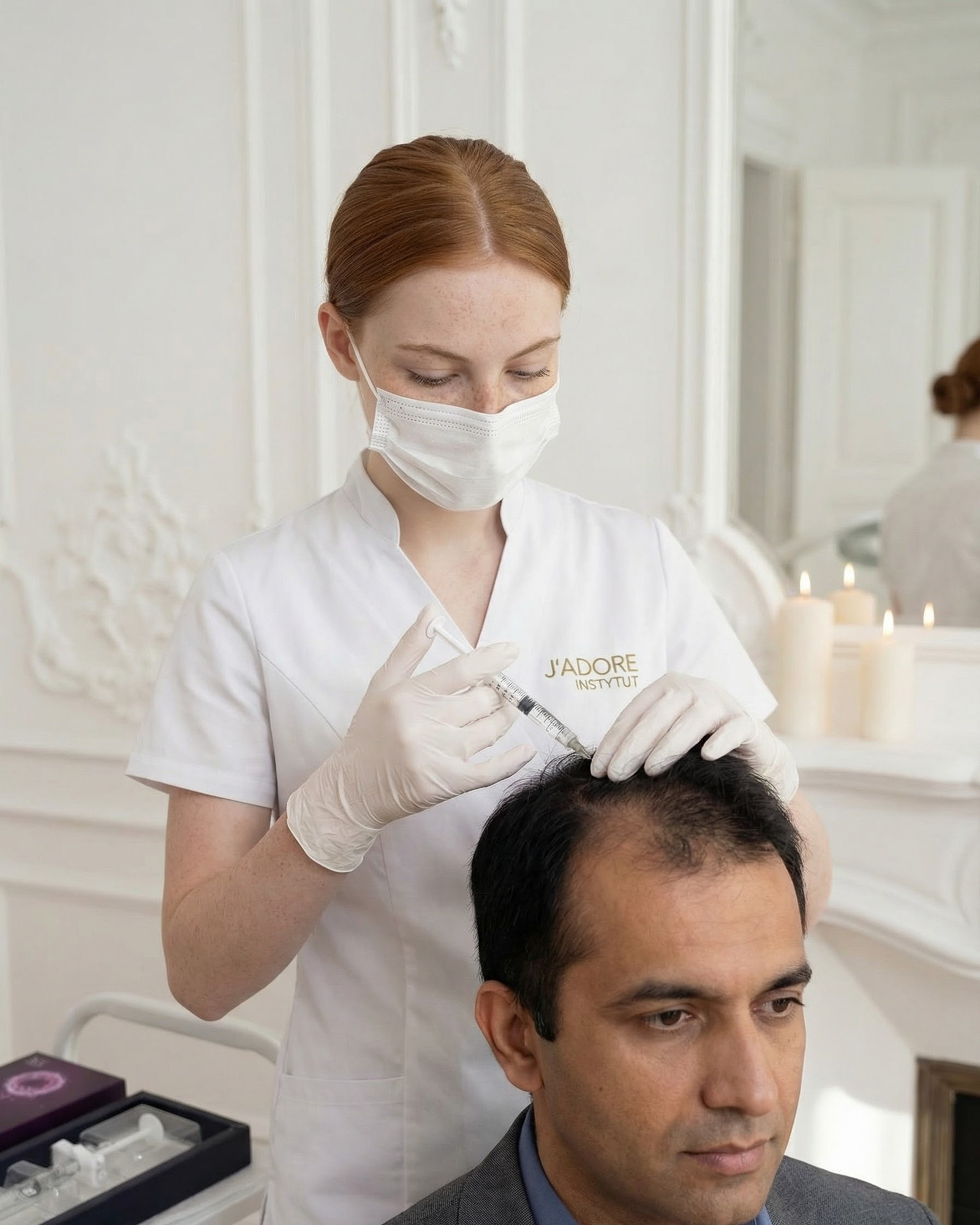
Scalp mesotherapy works entirely differently. It is a technique for delivering active substances directly into the scalp — bypassing the epidermal barrier, which normally limits the absorption of active ingredients. The substances are blends selected by a doctor for a specific concern: vitamins, amino acids, peptides, minerals and biostimulators. They reach the area around the follicles and may genuinely affect their condition.
The logic is simple: a follicle needs the right environment to function. The scalp may have poor blood supply, be undernourished, oily at the roots or overly dry. Each of these conditions disrupts the hair life cycle. Mesotherapy aims to improve the conditions in which the follicle functions. For many people, this results in slower hair loss, stronger existing hair and — where follicles remain active — improved density.
PRP — your own blood as a follicle stimulator
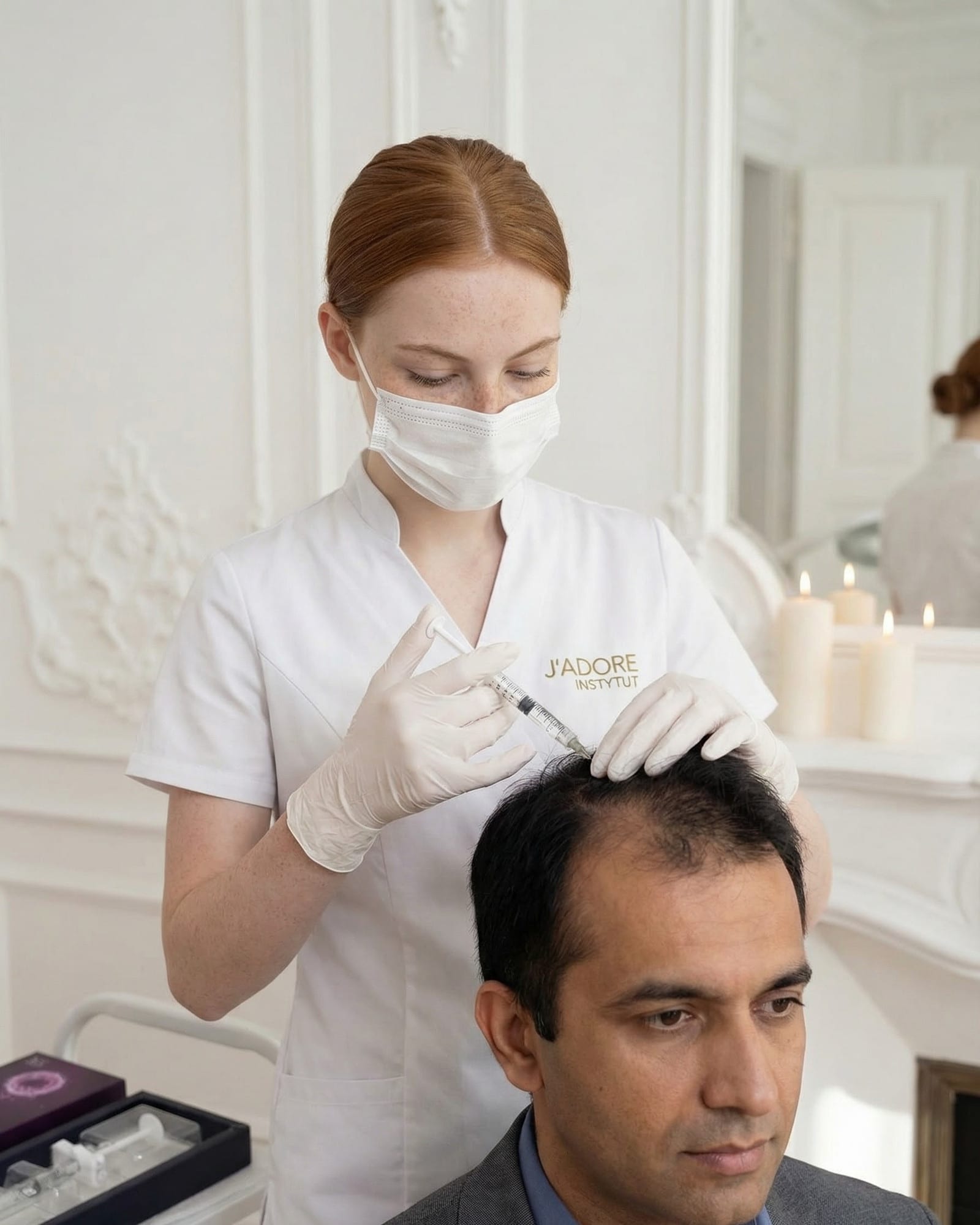
PRP (Platelet-Rich Plasma — platelet-rich plasma) is a method in which the stimulator does not come from a pharmacy or laboratory. It comes from your own blood. The collected blood is centrifuged to isolate the platelet-rich fraction. Once activated, the platelets release growth factors: proteins that naturally appear in the body where tissue repair is taking place.
When concentrated plasma reaches the scalp, growth factors may affect follicles in a similar way to the natural healing process. They can stimulate cell division, extend the active hair growth phase (anagen) and improve blood supply around the follicles. In many people, the observed result is reduced hair loss and improved hair density — particularly in early or moderate androgenetic hair loss and reactive hair loss, following stress, illness or pregnancy.
Mesotherapy
external active ingredients
- A precisely selected blend of vitamins, amino acids and peptides
- The doctor can tailor the formulation to your individual concern
- Nourishment and improved follicle environment
- Indicated for deficiencies and weakened follicles
PRP
your own growth factors
- The substance comes from your own blood — no risk of allergy to the ingredients
- Growth factors from platelets: a strong biological signal for follicles
- Extension of the hair growth phase (anagen)
- Indicated for androgenetic and reactive hair loss
Both methods — mesotherapy and PRP — are often used as complementary or alternating treatments. They work in a similar area, but with different tools. Mesotherapy nourishes the follicle environment, while PRP provides a strong activation signal. The choice — or combination — depends on follicle condition, the stage of hair loss and the history of previous treatments.
How to compare them — three methods, three scenarios
The most common misunderstanding around these three methods is searching for the ‘best’ one, as if they were versions of the same product. In fact, each addresses a different condition and need. None is inherently ‘better’. The right option is the one that matches what is happening on a particular person’s scalp.
- Active follicles or early miniaturisation → mesotherapy and/or PRP make sense as stimulating therapy. The earlier the intervention, the broader the window for results.
- Follicles in advanced miniaturisation but still present → PRP is often the first-choice method because of the strength of its biological signal; mesotherapy provides support.
- Irreversible loss (bald scalp without follicles) → neither mesotherapy nor PRP will restore follicles. SMP is an aesthetic solution — changing the appearance of the scalp regardless of biology.
- Combination: sparse hair + existing follicles → a combined strategy may be possible: mesotherapy or PRP for biology + SMP for visual effect, either simultaneously or in stages.
Time matters — why waiting costs you options
There is one aspect of hair loss that determines how much we can offer: time. A follicle that is miniaturising today may be irreversibly lost within a few years. There is a window for biological stimulation — but it closes. And once closed, it is final.
This is not intended to scare you — it is simply biology. Mesotherapy and PRP work on follicles that are still present. The earlier we identify the problem and decide to act, the more follicles remain within reach of treatment. People who come in with early thinning and ask whether “it is not yet serious enough to do anything” are often at the most favourable stage. The follicles can still respond, and intervention may genuinely extend their activity for years.
PRP + scalp mesotherapy
A classic combination: PRP provides a strong biological signal, while mesotherapy delivers the right environment and nutrients. Together, they can work synergistically — especially where follicles are miniaturising.
Mesotherapy + SMP
A two-track strategy for visible scalp between sparse hair: mesotherapy works on the biology, while SMP reduces optical contrast. The results complement each other.
PRP + SMP (after hair loss has stabilised)
When hair loss is advanced but not complete: PRP strengthens existing follicles, while SMP optically evens out hair-free areas. The plan requires an assessment of follicle condition before deciding on the proportions.