Three players on one stage: sebum, yeast and your skin
To understand dandruff, you need to stop thinking of it as "dirt" and start thinking of it as a small ecosystem conflict on the surface of your scalp. The scalp is a unique environment: densely packed hair follicles, plenty of sebaceous glands, warmth and moisture trapped under hair. These are ideal conditions for microorganisms — and most of them are entirely natural residents. The problem starts when the balance between the three players is disturbed.
- Sebum. Sebaceous glands secrete an oily film that normally protects the skin and hair — moisturising them, sealing the surface, locking in moisture. On its own, it isn't the enemy. Quite the opposite: healthy scalp skin needs it to avoid drying out. The trouble starts when there's too much sebum, or when its composition changes — turning it from a protective layer into a food source.
- Yeast (Malassezia). This yeast-like fungus lives on the scalp of practically every person — it's a normal resident, not an infection. It feeds on components of sebum. When there's plenty of sebum, the yeast has a feast. It multiplies, and while "digesting" sebum, it releases substances that some skin perceives as irritating.
- Your skin (the reaction). And here's the key point: not every scalp reacts the same way. In some people, the by-products of sebum broken down by yeast do nothing at all. In others, the skin responds with inflammation — skin cell turnover speeds up, irritation sets in, itching starts. It's this heightened sensitivity — not the fungus itself — that determines whether someone gets dandruff or not.
So dandruff isn't "something you caught". It's a meeting of three factors at once: sebum, yeast, and skin prone to reacting. Remove any one of these elements, and the problem eases. This also explains why the same shampoo can save one person and do nothing for another — because it acts on different links in this chain.
Dry or oily? Two types of dandruff that need different approaches
The most common mistake when dealing with dandruff is treating it as a single condition. In fact, this word covers two different scenarios, which look different, have different causes and — most importantly — respond to completely different approaches. Before reaching for anything from the pharmacy, it's worth identifying which one you're dealing with.
Dry dandruff
skin tends to be dehydrated
- Fine, white, loose flakes — they "fall off" like flour
- Skin often feels tight, itchy, rough
- Worsens in winter and in dry, heated air
- Flakes are easy to brush off your shoulders
Oily (seborrhoeic) dandruff
oily skin, seborrhoea
- Larger, yellowish, greasy scales — they "stick"
- Scalp gets oily quickly, hair looks flat
- Often accompanied by redness and itching
- Scales cling to skin and hair, harder to remove
The difference matters because it dictates your approach. With dry dandruff, the logic is: minimise irritation, hydrate more, rebuild the barrier. With oily dandruff, it's more about regulating sebum and limiting the yeast's food source. Applying a "dry" strategy to an oily problem (or vice versa) can not only fail to help — it can make things worse. That's why a gentle, hydrating shampoo works for one person, while another needs the opposite: one that "deep-cleans" the skin.
Why it starts — and why it comes back at certain times
If everyone hosts the yeast, and every scalp produces sebum, why does one person never get dandruff while another sees it return like a boomerang? The answer is: because the balance between these three players is easy to disturb, and the factors that throw it off are surprisingly everyday. It's rarely one big cause — more often, it's several small ones stacking up.
- Hormones and age. Sebaceous glands are hormonally controlled. That's why seborrhoea and dandruff intensify during puberty, and can be linked to your cycle, pregnancy or other hormonal shifts — anywhere sebum production changes.
- Stress and fatigue. This isn't a myth. Tension and lack of sleep can disrupt both sebum production and skin reactivity. Many people notice flaking flares up during their worst week at work.
- Weather and season. Dry, heated winter air favours dry dandruff; heat and sweat favour oily dandruff. That's why flare-ups typically peak in autumn and winter.
- Overdoing skincare. Washing too often with a harsh shampoo, hot water, heavy styling, poorly rinsed products, wearing hats constantly on a sweaty scalp — all of this irritates the skin and feeds the vicious circle.
- Individual predisposition. Some of us simply have skin that's more reactive to sebum by-products. This isn't a fault or neglect — it's a trait you work with, not something you "cure once and for all".
What actually helps — from shampoo to the salon
Let's be honest from the start: for a good number of people, dandruff can be managed at home — there's no need to make a drama out of it. A well-chosen anti-dandruff shampoo, used regularly and for long enough (not just once, in a panic), is enough for many. The key isn't a "stronger" product — it's matching it to your type (dry vs oily) and staying consistent.
- 01
Identify your type
First, work out whether it's dry dandruff (fine, loose flakes, tight skin) or oily dandruff (yellowish, greasy scales, quick oiliness). Everything else depends on this — it's not a minor detail.
- 02
Match your care, not the strength
Dry: gentle washing, hydration, less irritation. Oily: sebum regulation and yeast-limiting products. Lukewarm (not hot) water, thorough rinsing, no daily scrubbing "just in case".
- 03
Give it time and consistency
Anti-dandruff products need several weeks of consistent use — not a single wash. The most common mistake is abandoning the treatment halfway through, once things "seem better".
- 04
When it doesn't clear up — diagnosis
If, despite several weeks of home care, you still have itching, burning, redness or hair loss, that's a sign it's worth examining your scalp up close — not switching to a tenth shampoo.
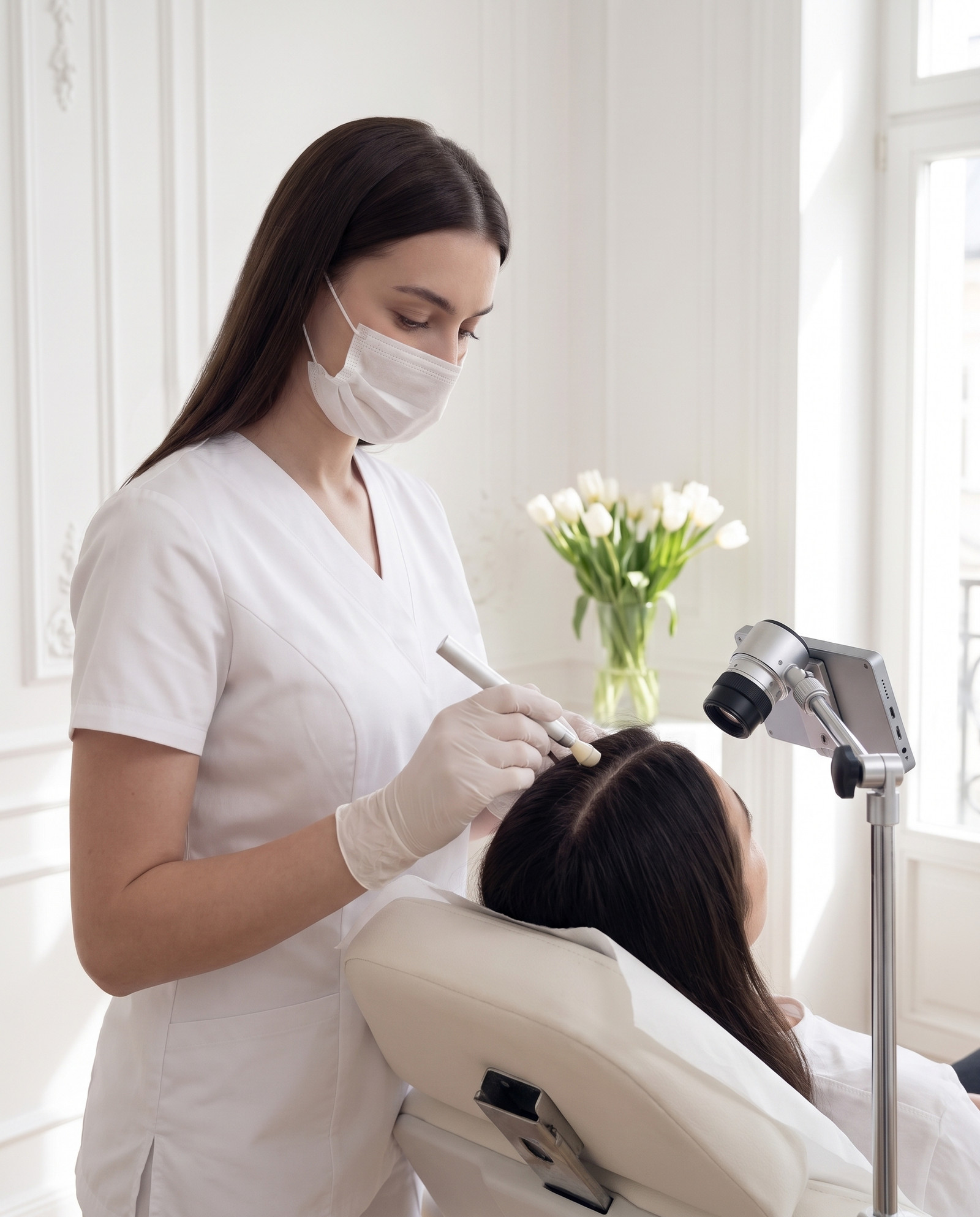
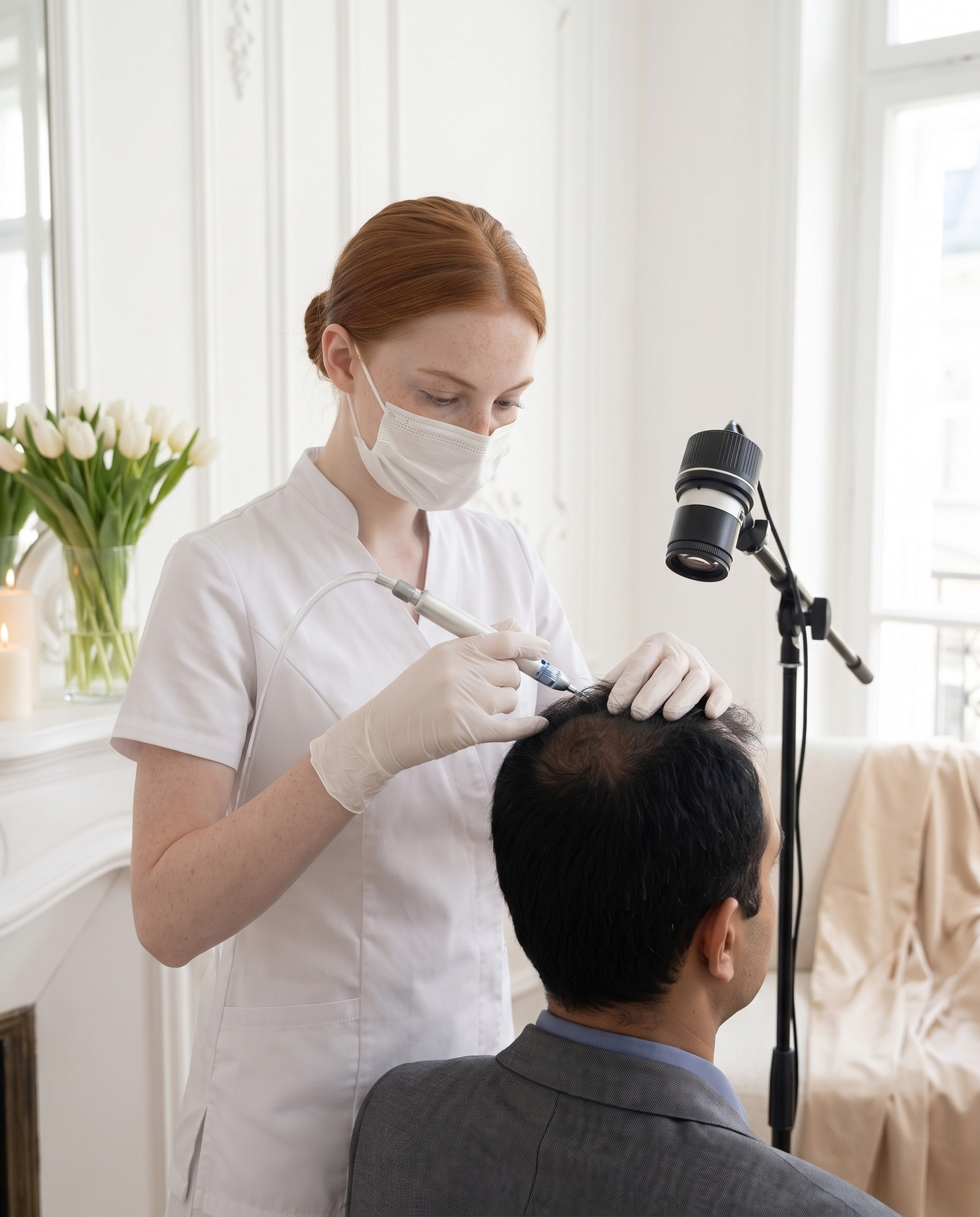
This is where a layer no home shelf can replace comes in: professional scalp diagnosis. Under a trichoscope camera, you can see what the naked eye can't — the condition of follicle openings, the level of flaking, signs of inflammation, the amount of sebum. This means that instead of guessing ("probably dry?"), you work with facts. This is the moment when "fighting dandruff" stops being a shampoo lottery and becomes a plan.
Once the diagnosis is clear, the salon has tools you can't recreate in the bathroom: deep, controlled scalp cleansing that removes built-up sebum and scales without harsh scrubbing, nourishing, regulating treatments that calm the skin and restore its balance, and — for more stubborn cases — therapies that support scalp and follicle condition. This isn't a substitute for home care. It's a stronger extension of it, for when shampoo alone isn't enough.
In short: dandruff is manageable, not something to be ashamed of
If there's one thing to take from this article, let it be this: dandruff is a condition, not a verdict on your hygiene. It's the result of an imbalance between sebum, yeast and how reactive your skin is — and that's exactly why it can be controlled, once you understand which link is failing. "Dry" and "oily" are two different stories, and "more often and harder" is almost never the right answer.
For most people, the path looks like this: identify your type, choose gentle and consistent care, give it time. And if that's not enough, or worrying symptoms appear — don't buy another shampoo and hope. Examine your scalp up close and put together a plan. Below, we've grouped our treatments exactly along this logic: first understand what's happening, then act.