A flat attachment is the foundation of discretion and comfort
Choosing a hair extension method often comes down to the question of what you will feel under your fingers after leaving the salon. The Hairtalk system is based on the tape-in technique, which involves connecting strands using flat, double-sided tapes. This solution was designed from the start with maximum discretion in mind. When the stylist runs their fingers through your hair, they show how the tape lies almost flush with the scalp. Because the attachment is not raised, the whole thing becomes almost imperceptible to the daily touch.
Hairtalk attachments
- Flat, flexible tape
- Distributed strand weight
- Imperceptible to the touch
- Natural hair movement
Point-based methods
- Raised bonds or rings
- Point-based hair load
- Clearly noticeable attachments
- Possible tangling at the roots
Unlike point-based methods, where each strand is clamped over a small section, Hairtalk uses the surface of the entire strip. The mechanics are simple: your natural hair is enclosed between two tapes, which makes the weight of the attached strands distribute evenly. There is no pulling at a single point, which is often a problem with other techniques. It is this flat construction that makes the hair retain its natural lightness and move freely, without creating stiff clumps.
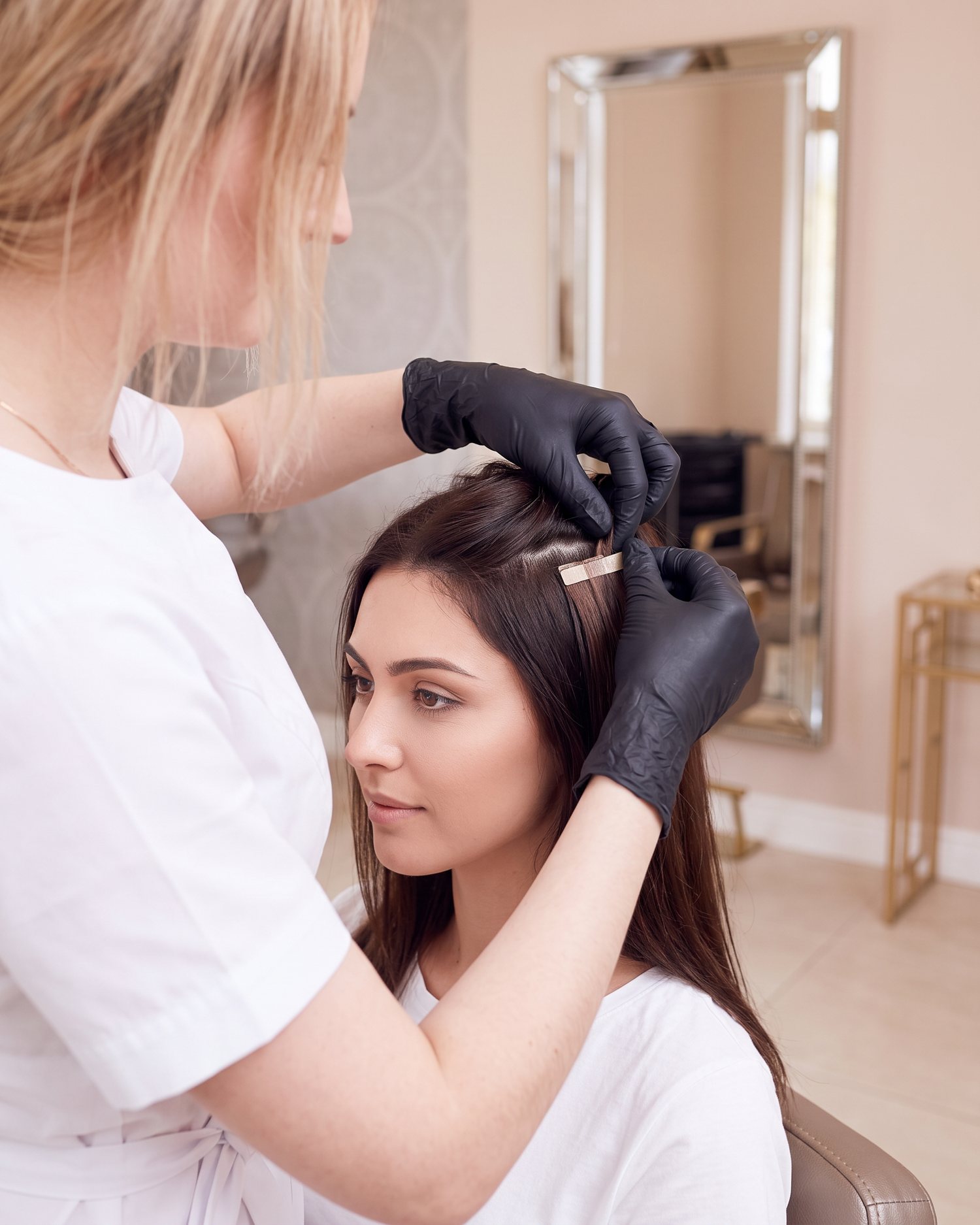
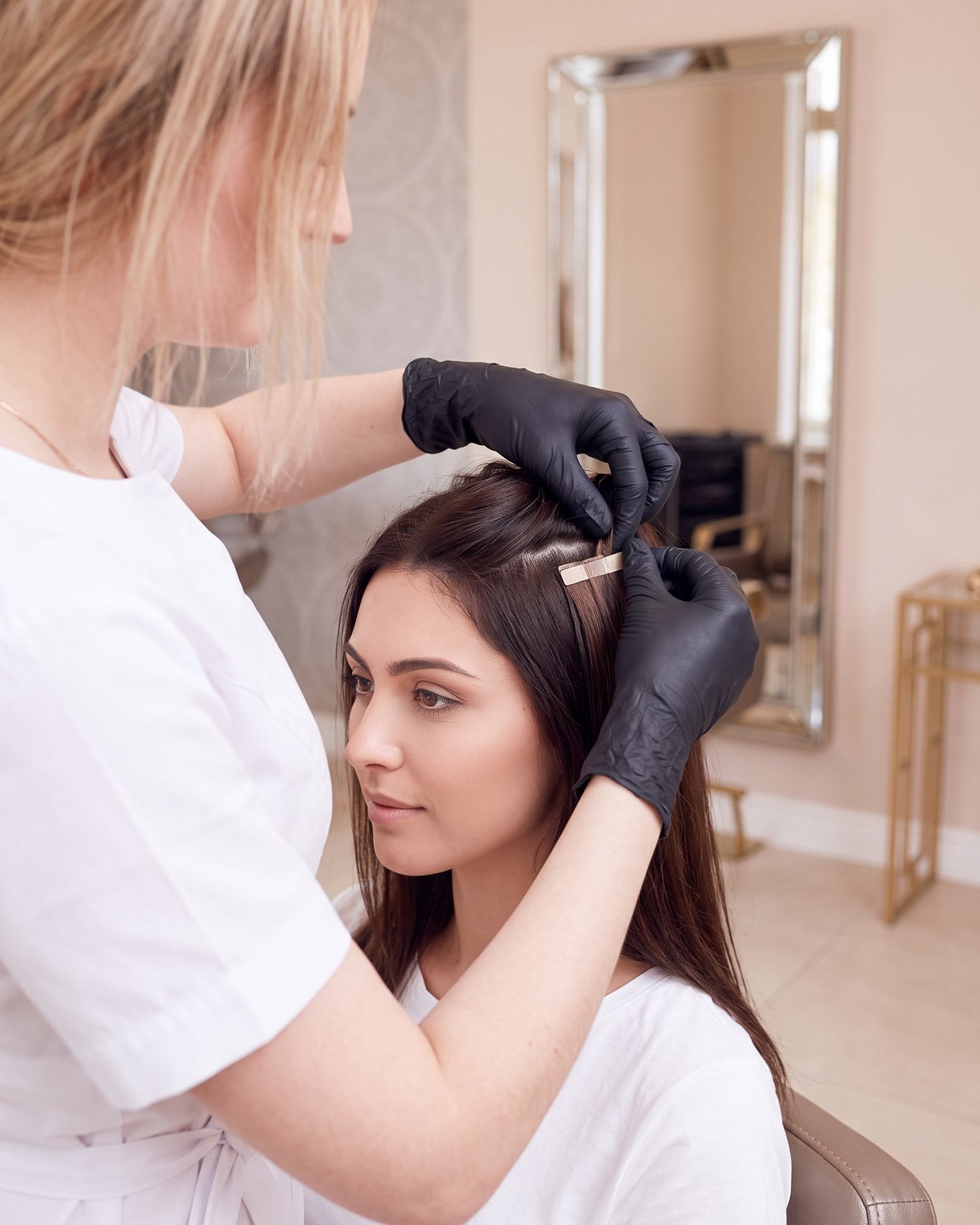
Illustrative photo showing an example of the treatment process, during which the stylist precisely arranges the tapes in sections. You can see how the Hairtalk strands blend smoothly into the structure of your hair. It is this lack of noticeable bonds that makes many people choose this system when looking for a solution that will not limit their daily care habits.
The consultation is a moment for an honest assessment of hair condition
A visit to the salon begins with an assessment that goes beyond choosing the colour or length of the strands. A hair extension stylist must first check whether your own hair is able to support the additional load. During the consultation, the specialist carefully moves the strands aside, checking the density of the hair at the nape and around the temples. It is in these places that the attachments must be placed most precisely so that they remain invisible during daily brushing or tying your hair into a ponytail.
There may be a situation where the specialist suggests a visit to a trichologist first, instead of applying the tapes immediately. If your hair is very thin, excessively falling out, or your scalp shows signs of weakness, attaching the Hairtalk system could do more harm than good. In such a case, an honest assessment of the current state is more important than the service itself. The priority remains the safety of your natural hair, which is why it is sometimes worth holding off on extensions to first strengthen the hair structure from the roots.
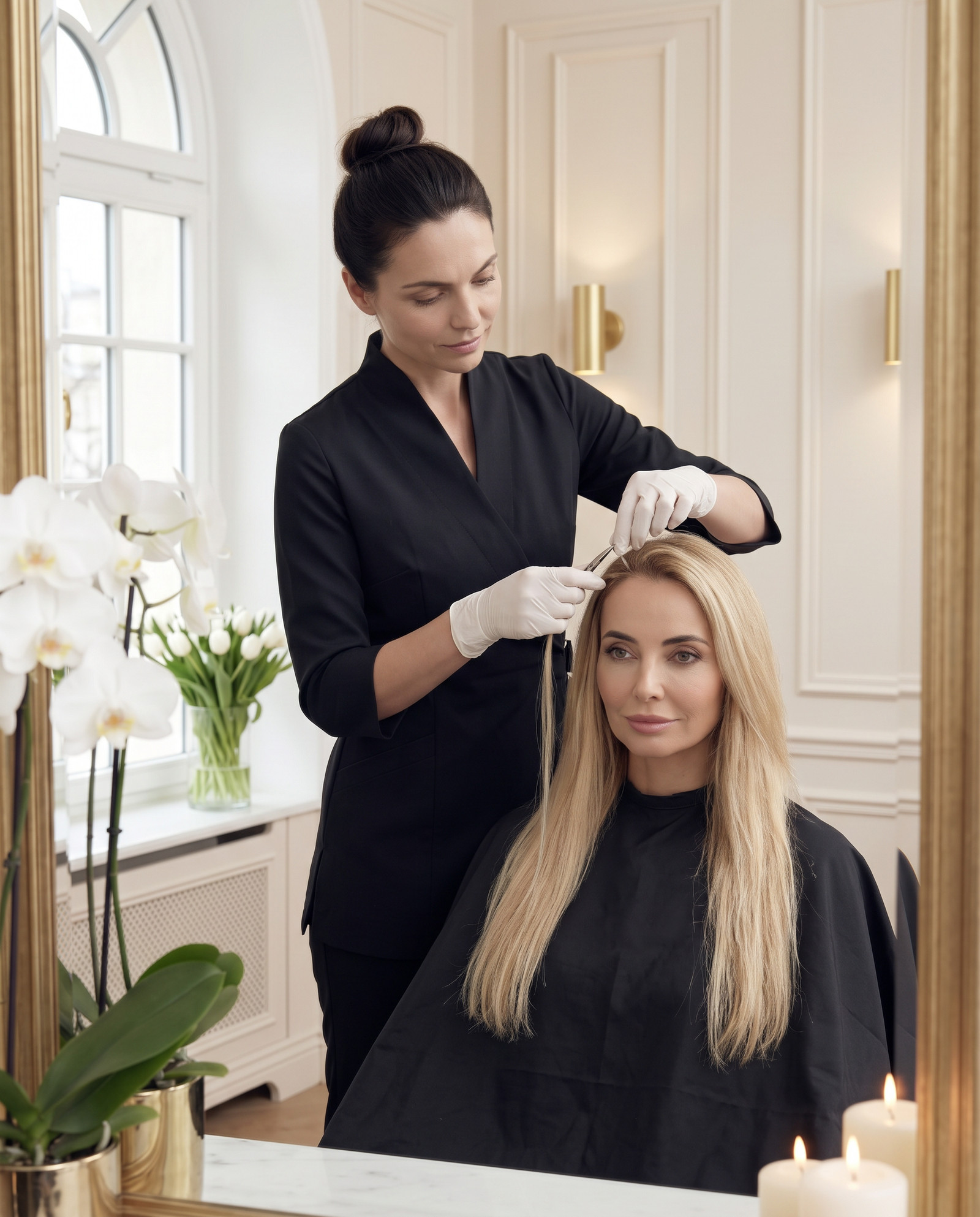
- Illustrative photo showing an example of the treatment process.
- The consultation allows us to determine if your hair is ready for tape application.
- In case of hair loss problems, we first focus on regeneration.
Glue does not like grease, which is why the washing technique changes
The key to the durability of the Hairtalk system is understanding that tape-in attachments do not tolerate oily substances. The glue that holds the strands to your hair reacts to oils, silicones, and emollients contained in cosmetics. If these ingredients get directly into the attachment area, the tape may start to slide or lose its adhesion much faster than the manufacturer anticipates.
- Use only sulfate-free shampoos that gently cleanse the scalp without weakening the glue structure.
- Apply conditioners, masks, and oils only from the mid-lengths of the hair downwards, keeping a safe distance from the roots.
- Avoid applying any care products in the immediate vicinity of the attachments.
In the first few days after application, the scalp may react to the presence of the tapes with slight itching. This is a natural reaction to the change in load and the presence of a foreign element at the roots. It is important to stay calm at such moments and not scratch the skin where the attachments are located. Mechanical friction can not only irritate the epidermis but also compromise the stability of the freshly applied strands.
The correct washing technique is a habit you will develop after just a few visits to the bathroom. During washing, focus on gently massaging the scalp between the tapes, avoiding scrubbing the attachments themselves. Water should flow freely through the hair, taking impurities with it, without the need for intense rubbing of the strands against each other. Thanks to this, the attachments will remain flat, and you will avoid unnecessary tangling of the hair near the roots.
Correction with regrowth is the natural life cycle of tapes
In the world of tape-in hair extensions, a correction is not a sign that something needs fixing. It is a natural stage of use, resulting from the biological growth rate of your hair. Once the strands are on your head, they become part of your daily life, but over time, the attachments that were initially close to the skin begin to move downwards.
- 01
Application
Hairtalk strands are precisely attached close to the roots, creating flat, almost imperceptible attachments.
- 02
Hair growth
After 6–8 weeks, the attachments move with the regrowth, which becomes visible and noticeable during brushing.
- 03
Correction
The stylist removes the tapes, cleans them, and prepares them for re-attachment closer to the scalp.
The correction process is crucial for maintaining good hair condition. During the visit, the stylist gently dissolves the glue using a specialised preparation, which allows for the safe removal of the strands without damaging the structure of your own hair. This is the moment when we assess the condition of the Hairtalk strands. Thanks to their high quality, after thorough cleaning and the application of a new tape, they are ready for reuse.
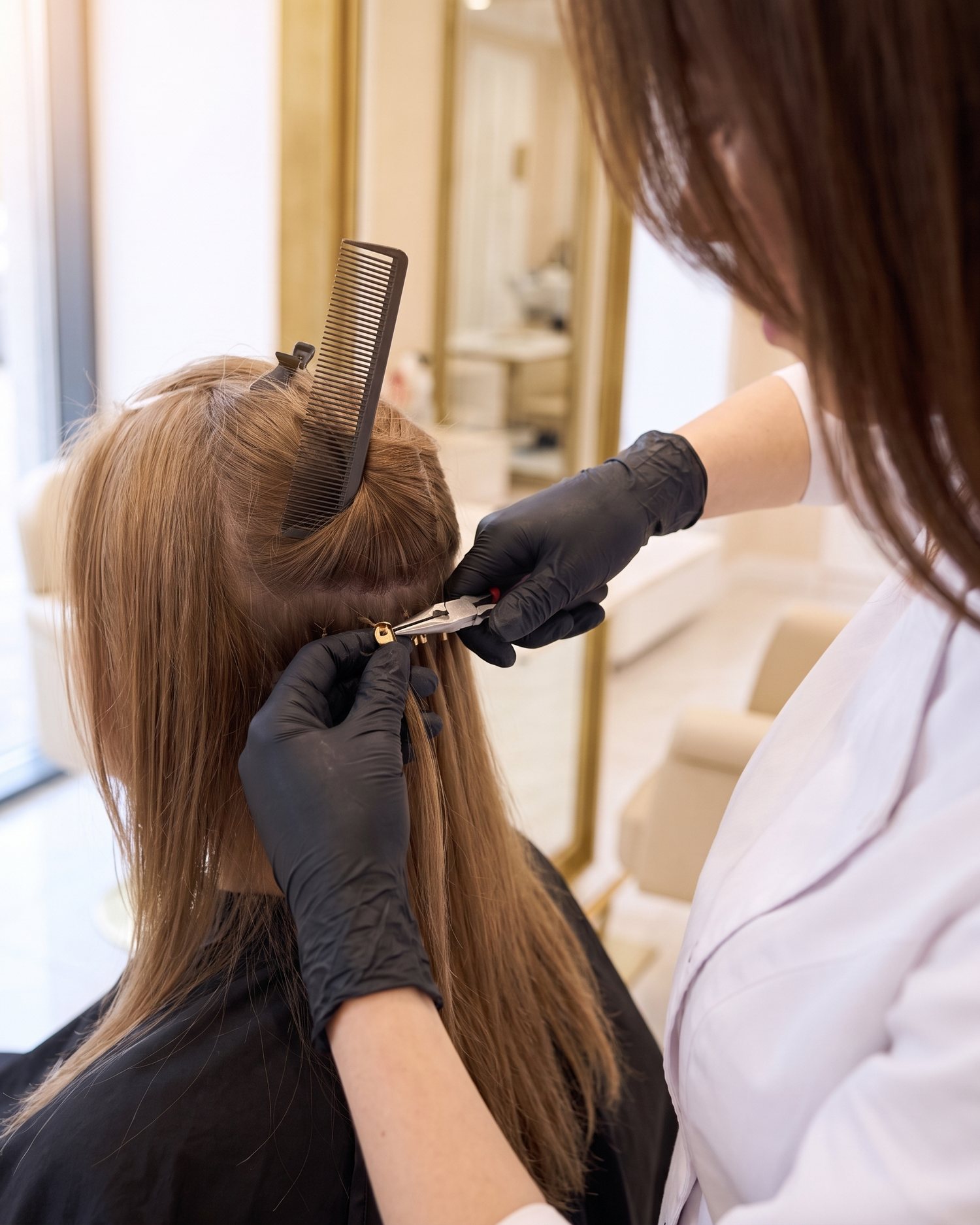
Illustrative photo showing an example of the treatment process. Regular visits to the salon allow not only for refreshing the hairstyle but also for checking the condition of your own hair. Because the tapes are removed and reapplied, you can be sure that the whole thing remains in harmony with the growth rate of your hair, while maintaining the natural movement and lightness for which this system is famous.
Selecting strands is an art of matching colour and structure
Selecting Hairtalk strands is a stage where technique meets aesthetics. The stylist does not choose the colour based on a colour chart in artificial lighting. It is crucial to hold several shades of strands directly against your hair in daylight. This shows how the extensions react to natural light and whether their structure and highlights create a cohesive whole with your hairstyle.
- Verifying the shade at the roots, along the lengths, and at the ends to achieve a natural transition effect.
- Checking the hair structure — whether the strands are straight or have a delicate wave that will better match your hair type.
- Assessing the density of the ends, which helps avoid the effect of an artificial "cut-off" length.
The next step is to determine the number of strands. This is the moment when we decide on the goal of the visit. If your priority is only thickening, the stylist will focus on filling in volume gaps while maintaining the current length. In the case of a full extension, the number of tapes must be higher to properly weigh down the hairstyle and ensure natural hair movement along the entire length.
Choosing the right number and colour of strands is a process that takes time. It is not about attaching as much hair as possible, but about creating an effect that will look natural in daily movement. The stylist always takes into account the condition of your hair so that the load is distributed safely, ensuring comfort of wear for the coming weeks until the first correction.
The first few days after application require patience
The moment you leave the salon with a new hairstyle is only the beginning of the relationship between your hair and the Hairtalk system. Although the tape-in technique allows for an immediate return to daily activities, the first 48 hours after application are a time when the attachments require special attention. During this period, the glue on the tapes must fully stabilise on the strands, creating a durable and safe connection.
- Avoid visits to the swimming pool and sauna, where high humidity and temperature can weaken fresh bonds.
- Give up intense workouts during which the scalp sweats heavily, which could affect the adhesion of the tapes.
- Limit hair washing for the first two days to give the glue time to fully bond with your hair.
A key element of caring for extended hair is also the way you rest. During sleep, hair is exposed to friction against the pillow, which, with freshly applied tapes, can cause unnecessary tension on the attachments. Introducing simple habits from the very first night significantly affects the comfort of wearing the system.
Patience in the first few days after a salon visit pays off. Once the glue has properly hardened, the attachments become almost imperceptible, and the hair gains the natural movement that is the hallmark of the Hairtalk system. Remember that how you treat the tapes in this initial period directly translates into their durability in the following weeks.
Home care determines whether the strands will return to your head
Investing in branded Hairtalk strands is only the beginning of the journey to a long-lasting effect. How long you will enjoy a thick hairstyle depends almost entirely on your daily habits. Home care for tape-in tapes differs from the standard routine because you must protect not only the hair structure but, above all, the durability of the attachments.
- Use only sulfate-free shampoos that do not weaken the glue on the tapes.
- Apply conditioners and masks only from the mid-lengths of the hair downwards, avoiding the attachment points.
- Use a silk pillowcase to minimise friction during sleep.
- Always protect the ends with a light heat-protectant mist before using a hairdryer.
A key element of caring for extended hair is the right tool for brushing. Classic brushes with hard pins can catch on the attachments, leading to their mechanical weakening or pulling out of the strands. A soft-bristled brush is much better, as it gently separates the hair without disturbing the structure of the tapes at the roots.
Remember that oily substances contained in some cosmetics are the greatest enemy of the glue. Any contact with an oily conditioner at the roots can cause the tape to start sliding or peeling off before the planned correction. Keeping the attachments clean is the simplest way for Hairtalk strands to be safely re-attached during subsequent salon visits.
Combining treatments allows for a cohesive final result
A final result that looks natural is rarely a matter of chance. In the case of the Hairtalk system, visual consistency depends on how well the attached strands blend into your natural hairstyle. Therefore, planning the visit often goes beyond just applying the tapes. It is crucial that the colour of your own hair and its condition form a solid base for the system.
Colouring
Matching the shade of your own hair to the extensions allows you to avoid visible transitions. If you are planning a colour change, we perform it before applying the tapes to achieve a uniform final result.
Olaplex regeneration
A treatment that strengthens the hair structure from within. A healthy base better withstands the load of the tapes, which translates into greater comfort of wearing the system.
Combining treatments allows the stylist to have full control over the final look. Instead of matching the hair to the current state, we create a cohesive whole that retains natural movement and shine. Remember that extensions do not change the structure of your hair, which is why taking care of its quality before attachment is so important.
- Performing colouring in advance helps achieve a harmonious transition between your own hair and the Hairtalk strands.
- Applying Olaplex regeneration before application prepares the hair to receive the attachments, increasing its resistance.
- A consistent care strategy combined with proper base preparation allows you to enjoy the thickening effect for longer.
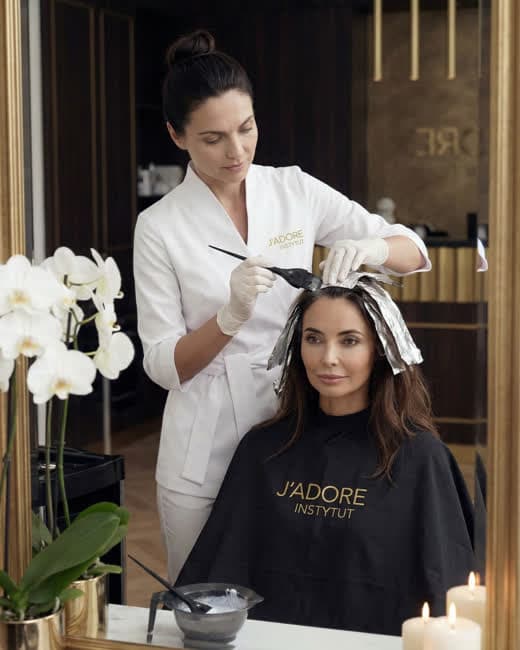
Illustrative photo showing an example of the treatment process, in which the stylist selects strands to match the client's hair colour. Such attention to detail ensures that the attachments remain discreet even in updos, and the entire hairstyle looks naturally thick and healthy.
Most common doubts before the first visit
Before you decide to visit, it is natural that questions arise about daily functioning with extensions. Most doubts concern whether the Hairtalk system will allow you to freely tie your hair into a ponytail or bun. Because the attachments are flat and flexible, they lie against the head much better than traditional methods based on thick knots or rings. If the stylist places the strands with an appropriate margin from the hairline, the attachments will remain hidden under your natural hair even in a high updo.
- Will Hairtalk tapes be visible when I tie my hair into a ponytail?
With correct application, the attachments are almost imperceptible and flat. The key is to keep an appropriate section of hair at the nape and temples that will cover the attachment points. The stylist always checks this during the visit, adjusting the placement of the strands to your favourite hairstyles.
- Why does not every extension method fit every hair type?
Every technique, including tape-in, puts a different kind of load on the hair. Very thin or weakened hair may not support the weight of the tapes, which could lead to mechanical damage. That is why the stylist assesses in person whether your hair structure is suitable for the chosen system.