Before anything starts — diagnosis
Every proper trichology programme begins with a step that isn't treatment yet — diagnosis. It might seem like a formality before the real work starts, but it's actually the most important point in the whole process. "Hair loss" isn't a diagnosis — it's a symptom. Completely different mechanisms can sit behind the same symptom, and a programme matched to the wrong mechanism won't work, however well it's carried out.
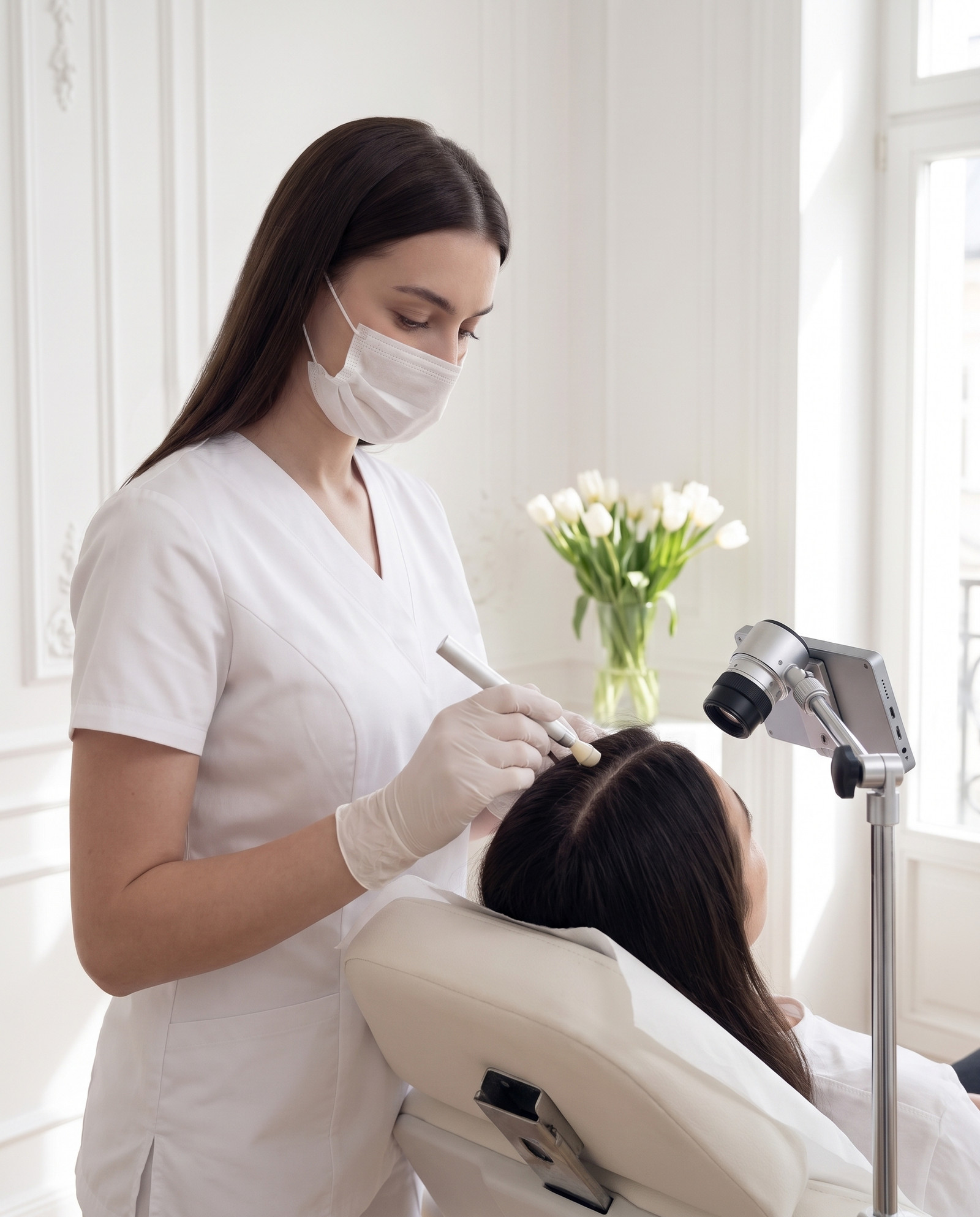
Modern trichology diagnosis combines a consultation — lifestyle, stress, diet, hormonal history, medication, past illnesses — with a trichoscopy examination: detailed imaging of the scalp and follicles under high magnification. Your trichologist assesses follicle density, the phase of the hair cycle, the state of scalp blood vessels, and any signs of inflammation or excess sebum. This builds a picture of what's actually going on — and what should happen next.
Stage 1 — cleansing and preparing the scalp
Before the scalp can absorb nourishing and stimulating substances, it has to be able to receive them. It sounds obvious — yet this stage is routinely skipped in home routines, which significantly reduces their effectiveness. A scalp clogged with sebum, dead skin cells, product build-up or inflammation is like soil covered with a hard crust: even the best fertiliser can't reach the roots.
Professional scalp cleansing may involve exfoliating treatments — mechanical or enzymatic — that remove excess dead skin and excess sebum. Depending on the diagnosis, it might also mean calming inflammation or excess sebum before active stimulation begins. A clean, "open" scalp is a prerequisite — without it, the following stages work at half strength.
Stage 2 — stimulating and nourishing the follicle
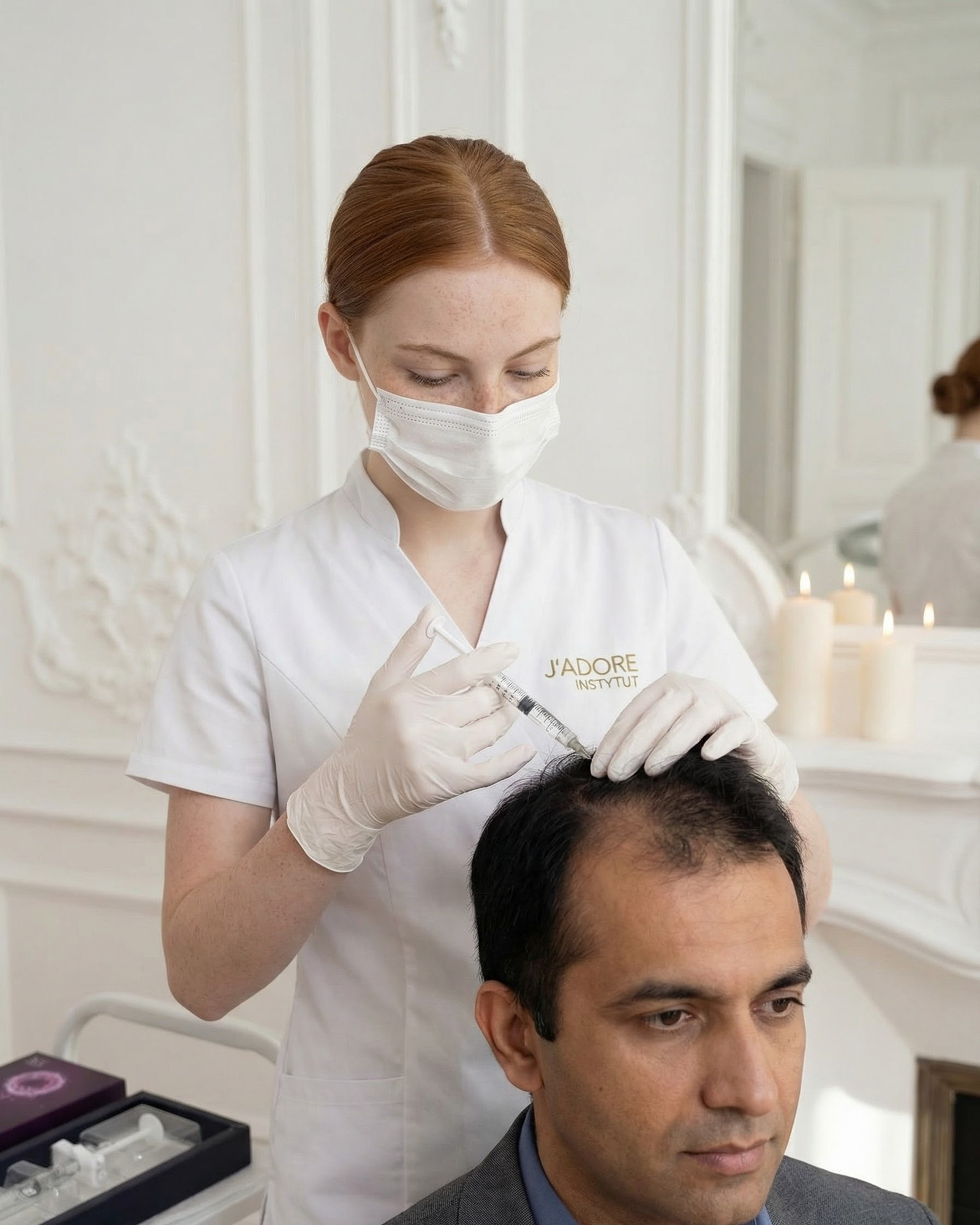
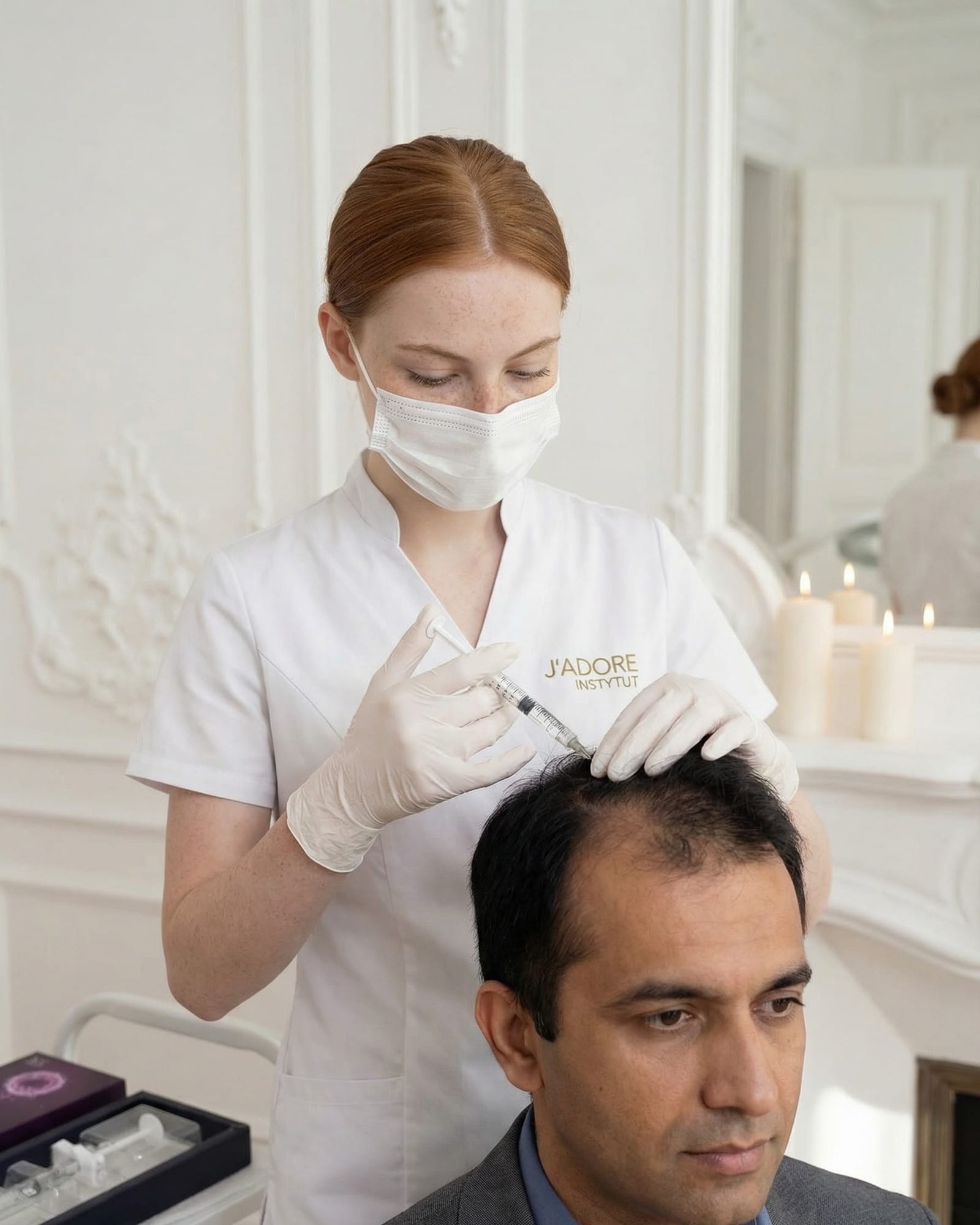
This is the central point of a trichology programme — and where most questions arise about "what goes into the needle" or "which device is used". But the mechanism matters more than the tool. The aim of this stage is to supply hair follicles with what they're missing and prompt them to work more actively.
The hair follicle is a living, metabolically active structure. It needs good blood flow, oxygen and the right nutrients to produce a healthy, thick hair. When anything disrupts that supply — stress, deficiencies, inflammation, hormonal factors — the follicle slows production or stops sustaining it altogether. Trichological stimulation aims to reverse that trend.
- 01
Microcirculation
The treatment improves blood flow in the scalp — without good circulation, the follicle doesn't get what it needs to produce hair.
- 02
Active substances
Stimulating and nourishing ingredients — peptides, vitamins, amino acids, minerals — are delivered straight to the follicles, where they can actually work.
- 03
Regulating the growth cycle
The goal is to extend the anagen phase (hair growth) and shorten the telogen phase (rest and shedding). This doesn't happen overnight — it's the result of several sessions.
- 04
Reducing inflammation
If scalp inflammation is behind weakened follicles, the stimulation stage goes hand in hand with calming it.
Stage 3 — supporting repair and strengthening the hair shaft
A healthy follicle is a necessary condition, but not a sufficient one. The hair that grows from it must travel the full length of the shaft in good condition — without excessive brittleness, breakage, shedding or dullness. That's why a mature trichology programme doesn't stop at follicle stimulation — it also includes work on the hair's structure itself.
The hair shaft is made of keratin and covered by a cuticle layer. When the cuticle scales lie flat and evenly, hair looks smooth, reflects light and resists mechanical damage. When the scales lift or break — from heat, chemicals, environmental factors or deficiencies — hair turns dull, breaks, and looks thinner than it actually is. The shaft-repair stage works at exactly this level.
Follicle (root)
the foundation of a trichology programme
- Produces new hair
- Needs blood flow, oxygen, active substances
- Responds to in-salon stimulation
- Changes visible after several growth cycles
Shaft (hair)
the condition of hair already grown
- Its state is visible in the mirror straight away
- Responds to strengthening and repairing treatments
- Improves faster than the follicle
- Affects visual density and shine
Stage 4 — maintenance and preventing relapse
A trichology programme, however effective, doesn't work in a vacuum. Hair lives on a body that lives in the world — exposed to stress, deficiencies, hormonal changes, pollution. Without a maintenance stage, results fade faster than they were achieved. That's not a flaw in the programme — it's the nature of every biological process.
The maintenance stage runs along two parallel tracks. The first is regular follow-up visits — less frequent than at the peak of the programme, but still scheduled — which let your trichologist monitor the follicles and respond to early signs of decline. The second is home care, which your trichologist selects specifically for your diagnosis — not necessarily expensive, but matched to the problem.
How long the whole programme takes and when results appear
This question comes up at almost every first consultation — and the honest answer is: it depends. That's not evasion. The length of the programme and the timing of results depend on the diagnosis, the cause of the problem, where the hair sits in its growth cycle, and individual response.
- First results on the shaft (shine, bounce, less brittleness) can appear relatively quickly — often after a few sessions.
- A change in shedding — noticeable for many people after 6–10 weeks from the start of follicle stimulation, though response varies individually.
- Thickening and regrowth — the hair growth cycle lasts months, so a clear change in density is often visible after 3–6 months of regular work.
- Maintenance programme — for most trichology issues, this is an ongoing element, not a finite course.
What sabotages a programme — the most common mistakes
A trichology programme can be perfectly planned and badly executed — by you, between visits. This isn't a criticism. It's simply a list of the places where a good programme most often "breaks down" despite a good start.
- Gaps in the programme — missed visits disrupt the stimulation schedule; the follicle needs regular impulses, not one-off ones.
- Continuing care that doesn't match the diagnosis — anti-sebum products on a dry scalp, or the reverse, actively hinder the programme.
- Ignoring general health factors — a trichology programme doesn't work in isolation from the body; untreated iron deficiency or thyroid disorders limit its effectiveness.
- Expecting results after 2–3 weeks — giving up on the programme too early because of a lack of visible results is one of the main reasons it fails.
- Adding your own products "just in case" — combining too many active substances on the scalp can produce the opposite effect to the one intended.
Trichology programmes and treatments — what to combine with what
Trichology increasingly combines different methods — not because one method isn't enough, but because different tools address different stages or different layers of the problem at the same time. A well-matched combination can shorten the programme and strengthen results. A poorly matched one just piles up stimuli without purpose.
Mesotherapy + scalp cleansing treatments
Combining scalp cleansing with follicle stimulation straight after lets active substances reach deeper — a cleansed scalp absorbs better and responds better.
Follicle stimulation + oral supplementation
In-salon treatments and well-chosen supplementation (iron, biotin, zinc, amino acids) often work synergistically — one doesn't replace the other, but together they can give a clearer effect for many people.
Trichology + dermatological or endocrinological care
When hair loss is caused by hormonal disorders or dermatological changes in the scalp, the best results come from trichology work running alongside treatment of the underlying cause by the right specialist.