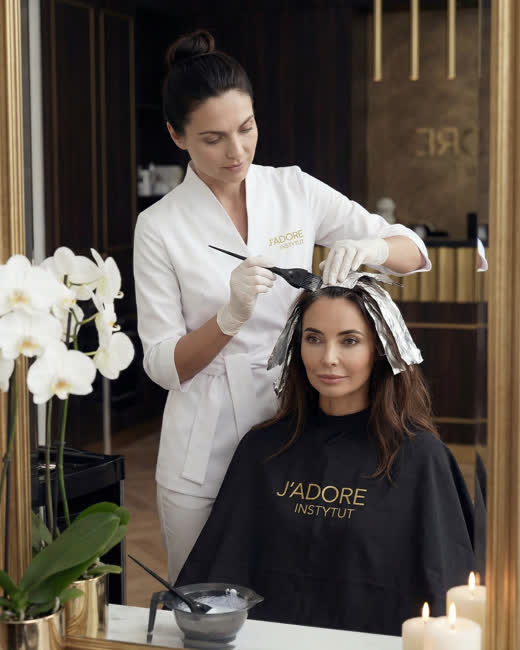
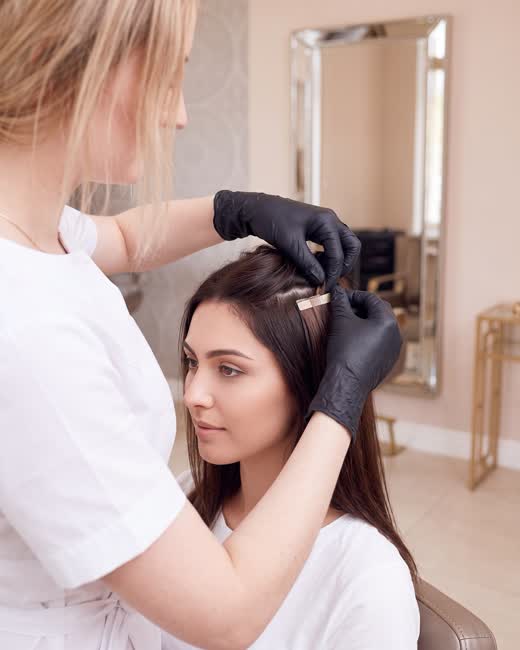
A treatment room at J'adore
SCALP & HAIR
Increased hair loss, thinning along the parting, receding hairline, seborrhoea or persistent dandruff — these are symptoms, not a diagnosis. Each may have a completely different cause.
The same “hair loss treatment” may help one person and be a waste of time and money for another. A trichology consultation with trichoscopy is the starting point for all trichology care — the moment when, instead of guessing, we examine your scalp and hair under magnification and establish what we are addressing. It is a conversation without judgement or embarrassment. Hair loss is a common human concern, and the earlier you receive a diagnosis, the better the prognosis. At J'adore Instytut, consultations are provided by an trichologist or experienced cosmetologist. Below, you will find everything worth knowing before your first visit.
1 diagnostic consultation + follow-up checks during treatment
SCALP & HAIR
Hair loss is a symptom, not a disease in itself. Completely different mechanisms may sit behind the same phrase, “my hair is falling out” — and each requires a different plan. A trichology consultation is the point at which we stop guessing. We examine your scalp and individual hairs under magnification, take your history and make decisions only on this basis.
Without this stage, every hair treatment is a gamble. You may get it right. But you may also spend months doing something that could not have worked in your case. Diagnosis is not an “add-on to the treatment” — it is the foundation that makes treatment meaningful.
Did you know? A healthy scalp loses several dozen hairs each day, and this is completely normal — hair has its own cycle and is simply replaced by new growth. Hair “loss” worth addressing is not an occasional hair on your pillow. It is a change in proportion: increasingly more thin, short and miniaturising hairs compared with thick ones. This is what the camera shows and what you cannot see in the mirror.
How it works
The basis of this visit is trichoscopy — examining the scalp with a camera at high magnification. On screen, we can see what is invisible to the naked eye: hair follicle openings, the number of hairs growing from each opening, their thickness, the condition of the epidermis between them, as well as flaking or excess sebum. We combine the image with your consultation history — when the change began, what came before it, your diet, sleep, products or medicines you take, and your family hair history. The camera shows what is happening on your scalp. The consultation suggests what may have triggered it.
This assessment is about proportion, not a single hair. We compare how many hairs are thick and fully grown, and how many are thin, short and miniaturising. We also assess whether this is evenly distributed across the scalp or concentrated in one area. The pattern itself indicates a direction. Diffuse thinning behaves differently from changes concentrated along the parting or at the temples. It is important to say this clearly — a trichologist does not make a medical diagnosis or treat alopecia. They assess the condition of your scalp and hair, then select suitable care and supporting treatments. If the image suggests a systemic cause or skin disease, we refer you to a dermatologist or another doctor — and that is the right outcome of such a visit, not a failure.
Did you know? The word “trichology” comes directly from Greek — thríx, with the genitive trichós, simply means hair, while lógos means study. The same root appears in “trichoscopy”: literally, examining hair. The name reflects the limits of this field well — it concerns hair and the scalp, not the whole body. This is why, where a systemic cause is suspected, a trichologist refers you onwards.
Ideal for
Early diagnosis genuinely improves the prognosis. A follicle that is only beginning to weaken is easier to support than one that has already disappeared. This is why the worst decision is: “I will wait, perhaps it will go away on its own.”
Women’s zone and men’s zone
In women, hair loss is most often diffuse — hair thins evenly, particularly along the parting and around the crown, while the frontal hairline usually remains intact. Systemic factors are very often involved (thyroid conditions, iron and ferritin deficiencies, the post-partum period, diet, stress). This is why trichology consultation for women is largely about unravelling the causes — trichoscopy combined with a thorough medical history.
What we work with
In men, the androgenetic pattern is most common — receding temples and thinning at the crown, usually with a preserved band of hair at the occiput. The key sign visible on camera is miniaturisation: hair in affected zones becomes progressively finer and shorter before it disappears. This is why trichology consultation for men is most valuable early on — when the follicle is still active.
What we work with
Regardless of the zone, the principle is the same: first identify the type of hair loss, then select the treatment. Trichoscopy helps distinguish androgenetic from telogen (diffuse) shedding, identify miniaturisation and assess whether seborrhoea or scalp inflammation is involved.
Safety and honesty
In trichology, the value of the whole process depends on the quality of diagnosis and honesty in setting boundaries. These are the questions worth asking in every salon:
An assessment “by eye” and advice to “buy this shampoo” are not a diagnosis. At J'adore, the basis is a medical history plus camera assessment of the scalp and hair under magnification — only this allows different types of hair loss to be distinguished.
A good consultation sometimes ends with a referral to a dermatologist or endocrinologist — where a scalp condition, hormonal issue or deficiencies are suspected. This is not avoidance. It is the right order of care.
Not a “package for everything”, but treatments selected according to what the camera has shown — with an honest explanation of what you can expect from them.
A red flag: hair-loss treatment without diagnosis · The most common mistake is buying a “miracle treatment” or booking a course of treatments before anyone has examined the scalp with a camera. It is a shot in the dark: the same symptom can have different causes, while an unsuitable treatment means lost weeks, money and — worse still — time during which the process progresses. If hair loss is severe, sudden, or accompanied by skin changes, itching or pain, see a dermatologist or trichologist first, not the basket of ampoules.
SCALP & HAIR · Trichology consultation + trichoscopy
From the trichologist’s salon
The most valuable statements during consultation are made in the medical history, not under the camera. “Six months ago I went on a strict diet”, “I changed my tablets”, “I have an underactive thyroid” — these are often the key to the whole puzzle. Please bring your test results if you have them. Do not leave out things that may seem “unrelated”.
Contraindications
The consultation itself, including trichoscopy, is non-invasive and involves no needles, so there are few restrictions. A few situations are worth considering. They mainly affect image quality or require a different pathway first.
From the trichologist’s salon
I most often ask for one thing: come with a clean scalp, without oils or heavy styling products. It may sound ordinary, but a thick layer of product can hide what matters most. A clearer image = a more confident diagnosis = a more accurate plan.
This is not a complete list. We will discuss your conditions, medicines, test results and history individually during the consultation. If the issue goes beyond the cosmetology salon, we will say so directly and refer you to the appropriate specialist.

What to expect
Consultation does not “fix” your hair — it sets the direction. You will leave with an assessment and a plan, not a finished result. That is good news: instead of acting blindly, you know exactly what to do and why.
Important and honest: trichological treatments support the condition of the scalp and hair — they do not reverse advanced hair loss in a single step. Where the follicle is still active, much can be gained. Where it has long been inactive, we say so directly and look for realistic solutions, such as scalp micropigmentation or a medical consultation.
Portfolio
A record of the work in our salons — the place where we publish treatment frames and, after photo sessions, results.
A record of results — in preparation. We publish photographs of our clients only with their consent.
Hair and your lifestyle
The scalp and hair reflect what is happening throughout your body. The consultation itself requires no preparation or recovery time. However, how you live between visits has a real impact on the results of therapy.
Full blood count, ferritin, iron, thyroid function (TSH), vitamin D — if you have recent results, bring them to your consultation. Many types of hair loss have deficiency-related or hormonal causes. In these cases, treatments are only one piece of the puzzle.
Strict diets and protein deficiencies affect hair with a delay — hair loss often only becomes visible several weeks later. If you are planning weight loss, do it sensibly; hair rebuilds slowly.
Following diagnosis, we select a shampoo and products for your scalp, such as different options for excess sebum and dryness. This is the daily foundation that works between treatments.
Severe, chronic stress can push hair into the shedding phase (telogen). This is not an excuse — it is a real mechanism we consider when planning your therapy.
Tight hairstyles, aggressive straightening and hot drying close to the scalp are best limited when hair is weakened. They do not cause hair loss, but they are an additional strain you do not need.
Hair grows slowly, so therapy results are assessed over months, not days. Consistency outperforms “miracle one-week treatments”. Follow-up trichoscopy will show whether we are moving in the right direction.
Trichology consultation + trichoscopy
These three elements do not replace one another — they follow a logical order. Diagnosis is always the starting point. Everything else follows from it:
identifies the cause
does not itself provide therapy or change the condition of the hair
provides further context
does not replace trichoscopy or blood tests — it is a supplementary test
support and strengthen
without diagnosis, it is a shot in the dark — they may not suit the cause
What next
A consultation is a crossroads leading to specific paths. The trichologist decides on the choice, order and intensity based on what the camera shows. Diagnosis most often leads to:
A simple principle I repeat to everyone: diagnosis first, then the tool. A consultation explains what is happening. Hair mineral analysis can help clarify the background. Treatments are the response — but only when they answer the right question.
Supportive methods
After diagnosis, you do not choose a treatment ‘off the shelf’ — the trichologist selects it based on your type of hair loss, follicle condition and history. Here are the most commonly selected options and when they are suitable:
Nourishing and strengthening ingredients delivered directly into the scalp, close to the follicles.
Dla kogoWeakness and thinning, when follicles are still active and need nourishment.
Growth factors obtained from your own blood, which stimulate the follicle environment.
Dla kogoRegenerative support for early and moderate thinning.
Modern carriers of regenerative signals for the scalp.
Dla kogoIntensive regenerative support, often combined with other methods.
A planned course of treatments spread over time, rather than a single session.
Dla kogoSituations requiring consistent, longer-term work on hair condition.
Fact: This is not a ‘better/worse’ ranking — these are different tools for different situations. Some people follow one pathway, while others combine several in a planned sequence. The camera image and your history determine what to use and when, not the popularity of a particular treatment.
Price list
Checking free hours…
Gift voucher
Buy a voucher for this treatment in the J'ADORE online boutique — an elegant gift, redeemable at the salon of your choice.
Voucher pricePLN 200
Buy the voucher (opens in a new tab)Purchase and payment take place in the J'ADORE online store. The voucher is valid for 12 months from purchase and covers the selected treatment variant.
From the magazine
Editorial pieces on how this treatment works in practice — what happens during the session, how to prepare, where the limits are and what the first days after look like.
See also
The result laststreatment plan tailored for the coming monthsJ’adore Instytut
Information. A trichology consultation with trichoscopy is a trichological and cosmetological examination supporting an assessment of scalp and hair condition. It is not a treatment for alopecia or a medical procedure, and does not replace dermatological or endocrinological diagnostics. If hair loss is severe or sudden, consult a dermatologist or trichologist. The above text is for information purposes only. Indications and contraindications are determined by a trichologist or experienced cosmetologist during a consultation with trichoscopy.
Home care
Cosmetics matched to what your skin needs after a treatment — so the clinic effect lasts longer.
 hair lossDSD de LuxeVasogrotene GF Activator 011 50mlView in the shop(opens in a new tab)
 scalpSesdermaSEBOVALIS Medicinal Shampoo 200 mlView in the shop(opens in a new tab)
 hair lossDermoMedicaGrowth Hair Serum 60mlView in the shop(opens in a new tab)
 scalpestGenBalancing ShampooView in the shop(opens in a new tab)
 hair lossDSD de LuxeCrexepil Lotion Forte 3.4.1 100mlView in the shop(opens in a new tab)
 scalpKV-13.2 Oily Dandruff Lotion 100ml – Anti-Dandruff BalmView in the shop(opens in a new tab)
 hair lossDermoMedicaGrowth Factor Scalp Mask 200mlView in the shop(opens in a new tab)
 hair lossMesoesteticTricology ShampooView in the shop(opens in a new tab)