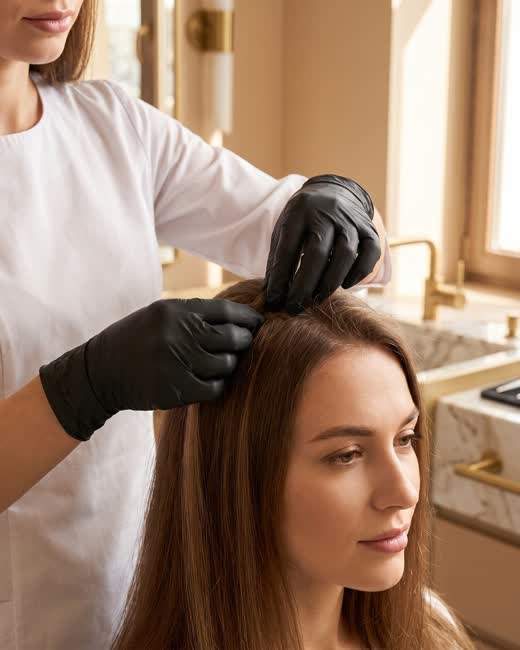
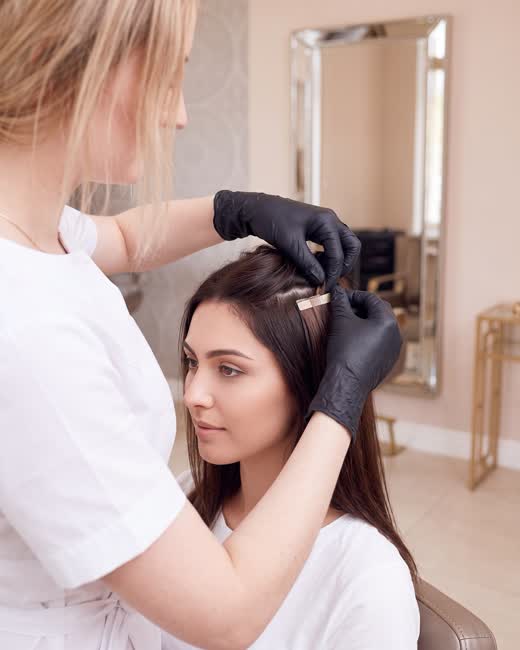
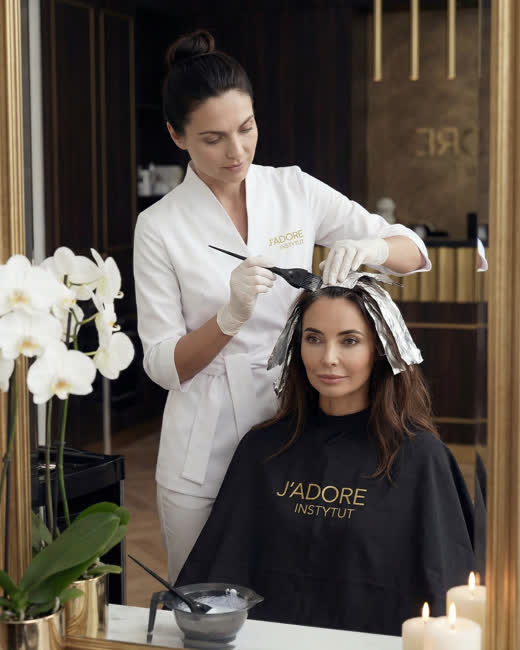
A treatment room at J'adore
SCALP & HAIR
Oily roots, white "powder" on your shoulders, itching and a tight, "clogged" feeling on the scalp — this is daily life for many people who keep trying different shampoos with no result. The problem usually isn't the hair.
It's the scalp: dead skin cells, built-up sebum and flakes clog follicle openings, creating conditions that favour dandruff and excess oil production. Scalp cleansing and exfoliation is a trichology treatment that gently exfoliates and cleanses the scalp. It removes dead skin, excess sebum and flakes, unblocks follicle openings and lets the scalp breathe again. This isn't a strong medical facial peel — the goal here is gentler and more about "tidying up": calming excess oil production, reducing dandruff and preparing the scalp so subsequent treatments and home care work better. That's why in trichology, scalp exfoliation is very often step one of the whole treatment programme — a clean, "unclogged" surface absorbs active ingredients far more effectively. At J'adore Instytut, it's performed by a trichologist or experienced cosmetologist. Below you'll find everything worth knowing before your first visit.
single session or series — often used as step 1 of a treatment programme
How it works
The scalp exfoliates and produces sebum in the same way facial skin does — except beneath a dense covering of hair, it's easier for dead skin cells and excess sebum to build up. Over time, follicle openings become "clogged," leading to dandruff, itching and a heavy feeling of hair that turns oily quickly. Scalp exfoliation is a controlled exfoliation and cleansing of this layer: it removes dead skin cells, dissolves and washes away excess sebum, lifts flakes and unblocks the follicle openings through which each hair grows.
Depending on scalp condition, we use an enzymatic peel (gentler — enzymes "digest" dead skin cells), an acid-based peel (mild exfoliating acids that also regulate sebum production), or a mechanical peel (fine particles that physically remove hardened skin cells). The effect works two ways: the scalp regains balance (less excess oil and dandruff, less itching), while at the same time absorbing whatever comes next far better — active ingredients penetrate deeper into clean, unclogged skin than into skin blocked by flakes and sebum. This is why scalp exfoliation is so often the first step of a full trichology treatment programme.
Ideal for
Which type of exfoliation, and whether a series is needed — this is decided after a scalp assessment. A different approach suits excess oil production than dry dandruff or sensitive skin, so there is no single "one-size-fits-all" peel.
Women's zone and men's zone
Scalp peeling for women most often quickly solves the problem of rapidly greasy hair, dandruff and loss of volume at the roots. Thick, long hair can "cover up" a clogged, greasy scalp — peeling restores its breath, and the hairstyle stays fresh and light for longer. It is also often a great opening to a nourishing treatment when thinning is at play.
What we work with
Scalp peeling for men is primarily about oily scalp, seborrhoeic dandruff and comfort — sweat under a cap, frequent washing, itching after a workout. Under short hair, a clogged, greasy scalp is more visible and more troublesome. To be honest here: peeling clears the scalp and improves comfort, and can also be a preparatory step before treatment for thinning — but in itself it is not a "hair regrowth" treatment.
What we work with
Did you know: we often care for the scalp least of all — we wash "hair," not the skin beneath it. Yet the scalp is exactly the foundation from which every hair grows. Trichologists like this comparison: it's like preparing a garden — first you tidy and aerate the soil, and only then does anything grow better on it.
Safety and hygiene
Scalp exfoliation is a gentle, needle-free treatment, but "exfoliation" always calls for judgement — cleansing the scalp without irritating it. A few things are worth asking about at any salon:
At J'adore, exfoliation is carried out by a trichologist or experienced cosmetologist after a scalp assessment — this determines whether to choose the enzymatic, acid-based or mechanical version, and how much exfoliation to apply.
A different peel suits an oily scalp with excess sebum than a dry, sensitive one prone to dandruff. "Stronger" doesn't mean "better" — for sensitive skin, gentleness is an advantage, not a compromise.
This is the scalp, not a deep medical facial peel — we aim for cleansing and balance, not intensive exfoliation of the skin.
We work with reputable trichology products for the scalp, matched to the problem — not a random "peel from the internet."
Red flag: a weeping, inflamed, or intensely itchy scalp · If your scalp burns, weeps, has wounds, pustular patches, thick adhered flakes or pronounced inflammation — this isn't the moment for exfoliation. It's a signal for a dermatologist to assess it first. Seborrhoeic scalp dermatitis, psoriasis or fungal infections need treatment, not exfoliation. Exfoliation can support the process later, once the scalp calms down — but exfoliating irritated, inflamed skin only makes things worse.
SCALP & HAIR
Contraindications
Scalp exfoliation is gentle and needle-free, but there are situations where we postpone the treatment — usually until the scalp has calmed down. Some contraindications are permanent, others temporary.
From the trichologist's chair
A commonly confused point: "I have dandruff, so I need exfoliation even more — and a strong one straight away." In fact, with an inflamed, weeping scalp, exfoliation causes harm rather than help. In that case, we calm the skin first (sometimes with a dermatologist's help), and exfoliation comes later, once the inflammation has passed.
This isn't a complete list — your medications, health conditions, scalp condition and previous treatments are reviewed individually at your consultation with trichoscopy.

What to expect
Most importantly, you'll usually feel relief and "lightness" in your scalp right away, but regulating excess oil and dandruff is a process — for pronounced problems, a series works best, not a single treatment. Exfoliation on its own cleanses in the moment; lasting balance is built through regularity and good home care.
The most common misunderstanding: "I'll get an exfoliation and the dandruff will disappear forever." A tendency toward excess sebum and dandruff is a skin characteristic that's managed, not erased with a single treatment. Exfoliation does a huge amount of work as a "reset" and preparation, but the real difference shows when it's combined with the right shampoo and regularity.
The result isn't permanent "once and for all" — the scalp exfoliates and produces sebum again over time. That's why, for excess oil and dandruff, we repeat exfoliation at sensible intervals, with home care doing the work between visits.
Portfolio
A record of the work in our salons — the place where we publish treatment frames and, after photo sessions, results.
A record of results — in preparation. We publish photographs of our clients only with their consent.
Scalp exfoliation and your lifestyle
This is a gentle, needle-free treatment, so restrictions are minimal — the main point is to avoid irritating a freshly cleansed scalp during the first few hours and give it time to regain balance.
Your scalp is already cleansed — wash it normally next time, with a gentle shampoo suited to your concern. Avoid vigorous rubbing or scratching with your nails.
A freshly exfoliated scalp can be a little more sensitive to sun. In the first few hours, especially in summer, protect it with headwear.
Intense sweating and chlorinated water right after exfoliation can irritate the scalp. Plan the sauna and pool for the next day instead.
Don't combine hair colouring, toning or aggressive styling with exfoliation on the same day. Exfoliated skin reacts more easily to irritation — schedule these separately.
Gentle scalp massage and normal combing are fine. Just avoid harsh scratching with a comb on freshly cleansed skin.
You return to work and your daily activities immediately — scalp exfoliation leaves no visible marks or recovery period.
Scalp cleansing / peel
The terms "exfoliation," "cleansing" and "oxygen infusion" for the scalp are often confused, because all of them aim to unblock and refresh the scalp. They do it, however, with different tools, and suit slightly different situations — and in a treatment programme, they often complement each other:
exfoliates and regulates (enzymes / acids / mechanical action)
doesn't use needles and doesn't "nourish" the follicle — this is cleansing and preparing the foundation
cleanses with a jet stream and micro-exfoliation
still a surface-level cleansing — won't replace nourishing treatments for hair loss
nourishes follicles at the source
this isn't cleansing — it works best only on a clean, unblocked scalp
Combine with
Scalp exfoliation works best as the foundation of a treatment programme: it cleanses and unblocks the scalp, so subsequent treatments and home care work more effectively. The combination, sequence and intervals are decided by your trichologist at consultation, but the general logic stays the same: cleanse the scalp first, then nourish and stimulate it, carried out over time.
The question "exfoliation or scalp oxygen infusion?" comes up often — the answer depends on scalp condition and your goal. What matters more, though, is sequence rather than choosing one over the other: we cleanse and prepare the foundation first, then nourish the follicles. Exfoliation is rarely "the whole treatment" — it's a good starting point for it.
Types of scalp exfoliation
The term "scalp exfoliation" covers several types of exfoliation, differing in how they work and what they're for. You don't choose them "off the shelf" — your trichologist selects them to match scalp condition, the severity of excess oil or dandruff, and sensitivity. Here are the main approaches we use:
Enzymes gently "digest" and loosen dead skin cells without harsh abrasion — the gentlest route to cleansing.
Dla kogoA sensitive scalp prone to irritation, dry dandruff, first-time exfoliation.
Mild acids exfoliate the skin and help regulate excess oil production and reduce dandruff, "unclogging" follicle openings.
Dla kogoAn oily scalp, excess sebum production, oily dandruff.
Fine particles and massage physically remove hardened skin cells and layered products from the scalp.
Dla kogoPronounced skin build-up, layered styling products, a "resetting" detox.
Fact: Where do the differences come from? From a different mechanism and intensity — one type cleanses most gently, another regulates excess oil more strongly, and another physically removes build-up. What matters is matching it to your scalp, not "strength" for its own sake. The exact type, and whether a series is needed, is determined by your trichologist after a scalp assessment.
Price list
Checking free hours…
From the magazine
Editorial pieces on how this treatment works in practice — what happens during the session, how to prepare, where the limits are and what the first days after look like.
See also
The result lastsresults last a few weeks; for excess sebum or dandruff, repeat sessions work bestJ’adore Instytut
Note. Scalp cleansing / exfoliation is a trichology and cosmetology treatment that supports scalp and hair condition. It is not a treatment for hair loss, is not a medical procedure, and does not replace dermatological or endocrinological diagnosis. If you experience severe or sudden hair loss, consult a dermatologist or trichologist. The text above is for informational purposes. Indications and contraindications are determined by a trichologist or experienced cosmetologist during a consultation with trichoscopy.
Home care
Cosmetics matched to what your skin needs after a treatment — so the clinic effect lasts longer.
 scalpSesdermaSEBOVALIS Medicinal Shampoo 200 mlView in the shop(opens in a new tab)
 hair lossDSD de LuxeVasogrotene GF Activator 011 50mlView in the shop(opens in a new tab)
 scalpestGenBalancing ShampooView in the shop(opens in a new tab)
 hair lossDermoMedicaGrowth Hair Serum 60mlView in the shop(opens in a new tab)
 scalpKV-13.2 Oily Dandruff Lotion 100ml – Anti-Dandruff BalmView in the shop(opens in a new tab)
 hair lossDSD de LuxeCrexepil Lotion Forte 3.4.1 100mlView in the shop(opens in a new tab)
 scalpKevin MurphyScalp.Spa BrushView in the shop(opens in a new tab)
 scalpOlaplexNᵒ0.5 Scalp Longevity Treatment 50mlView in the shop(opens in a new tab)