
A neck that doesn't forgive — where does this sensitivity come from?
To understand why the neck ages faster, we need to start with biology. The skin on the neck is significantly thinner than facial skin. It has fewer sebaceous glands, less fat tissue underneath, and weaker natural hydration mechanisms. This means it loses moisture more easily. It also regenerates more slowly after damage, and loses elasticity faster.
Then there's constant movement. The neck is one of the most mobile areas of the body. We bend it in every direction dozens of times a day. Every downward tilt, every turn of the head, leaves micro-stress in the skin. Skin without adequate collagen support gradually starts to fix these folds as permanent wrinkles.
The third factor is smartphones and computers. We tilt our heads down to look at screens — for many hours a day. This is a new kind of strain that human physiology hasn't evolved to handle. Dermatologists increasingly describe a phenomenon informally called "tech neck" — the accelerated development of horizontal neck grooves in people younger than ever before. The neck bends under the weight of screens, literally and figuratively.
Venus rings — what they actually are, and where the name comes from
Venus rings aren't a metaphor — they're a specific medical term describing horizontal grooves on the neck that run roughly parallel to each other, around the neck's circumference. The name comes from ancient depictions of the goddess Venus, whose neck was portrayed as slender and smooth, with delicate horizontal lines once considered a mark of beauty. The irony is that today we treat the same lines as an aesthetic problem.
The mechanism behind them is multi-layered — and this is the heart of the whole story. First, the neck has natural anatomical folds — places where skin gathers when the head bends. In younger people these are barely visible, because collagen and elastin quickly "smooth" the skin after every movement. With age, this springback weakens. Second, neck skin loses subcutaneous volume — the thin fat cushion shrinks, leaving nothing to "tighten" against. Third, the collagen fibres themselves degrade faster than on the face, precisely because of the thinner skin and smaller natural reserves in this area.
Facial expression lines
different mechanism, different treatment
- Formed by repeated contraction of facial muscles
- Vertical or diagonal — following the direction of muscle movement
- Depth increases with frequency of expression
- Affect areas of the face with active expression
Venus rings (neck)
structural mechanism, not muscular
- Formed by loss of collagen and elastin in the skin
- Horizontal — following the neck's anatomical folds
- Depth increases with age and neglect of the area
- Worsened by tilting the head down ("tech neck")
Collagen — why it decides everything
At the centre of this story is collagen — the protein that forms the skin's scaffolding. It's responsible for elasticity, density and the skin's ability to "bounce back" after deformation. Its loss is the main mechanism behind both deepening Venus rings and general neck skin laxity.
Collagen is produced by fibroblasts — cells found in the deeper layers of skin. Their activity declines with age, and collagen itself breaks down increasingly fast under the influence of enzymes, oxidative stress and UV radiation. In neck skin, this process is especially harsh because — as mentioned — there's less collagen there to begin with.
- Type I collagen — the most abundant in skin, responsible for mechanical strength. It forms the thick "ropes" of the scaffolding. Its loss makes the skin thin and reduces its ability to stay taut.
- Type III collagen — thinner, more elastic, present mainly in young skin. It gives that characteristic plumpness and softness. With age, its proportion decreases in favour of stiffer type I collagen — skin becomes denser but less springy.
- Elastin — not collagen, but an inseparable partner in the scaffolding. It determines the skin's ability to return to shape after stretching. Elastin production essentially stops after the age of twenty — whatever you have must last a lifetime. Its degradation is one reason wrinkles deepen irreversibly without intervention.
This biology leads to one important practical conclusion: topical cosmetics have very limited ability to influence the collagen scaffolding. Collagen molecules in creams are too large to penetrate the epidermis — they act more like humectants, holding water at the surface. That's a useful effect, but a different one from "rebuilding collagen from within". To genuinely influence the neck's skin scaffolding, you need impulses that reach the fibroblasts — and that's a job for treatments, not jars.
What actually helps — the treatment logic
Since the problem lies in the deeper layers of neck skin — in a collagen deficit, weak elastin fibres and loss of subcutaneous scaffolding — the logic of choosing treatments should follow this mechanism. It's not about acting "from the outside", but about giving the skin stimuli it will respond to by rebuilding from within.
Treatments that work well on the neck usually act on one or more of three fronts: stimulating new collagen production, replenishing components that support tissue quality, or lifting and strengthening loose skin. Often the best result comes from combining approaches, because the problem is rarely a single one.
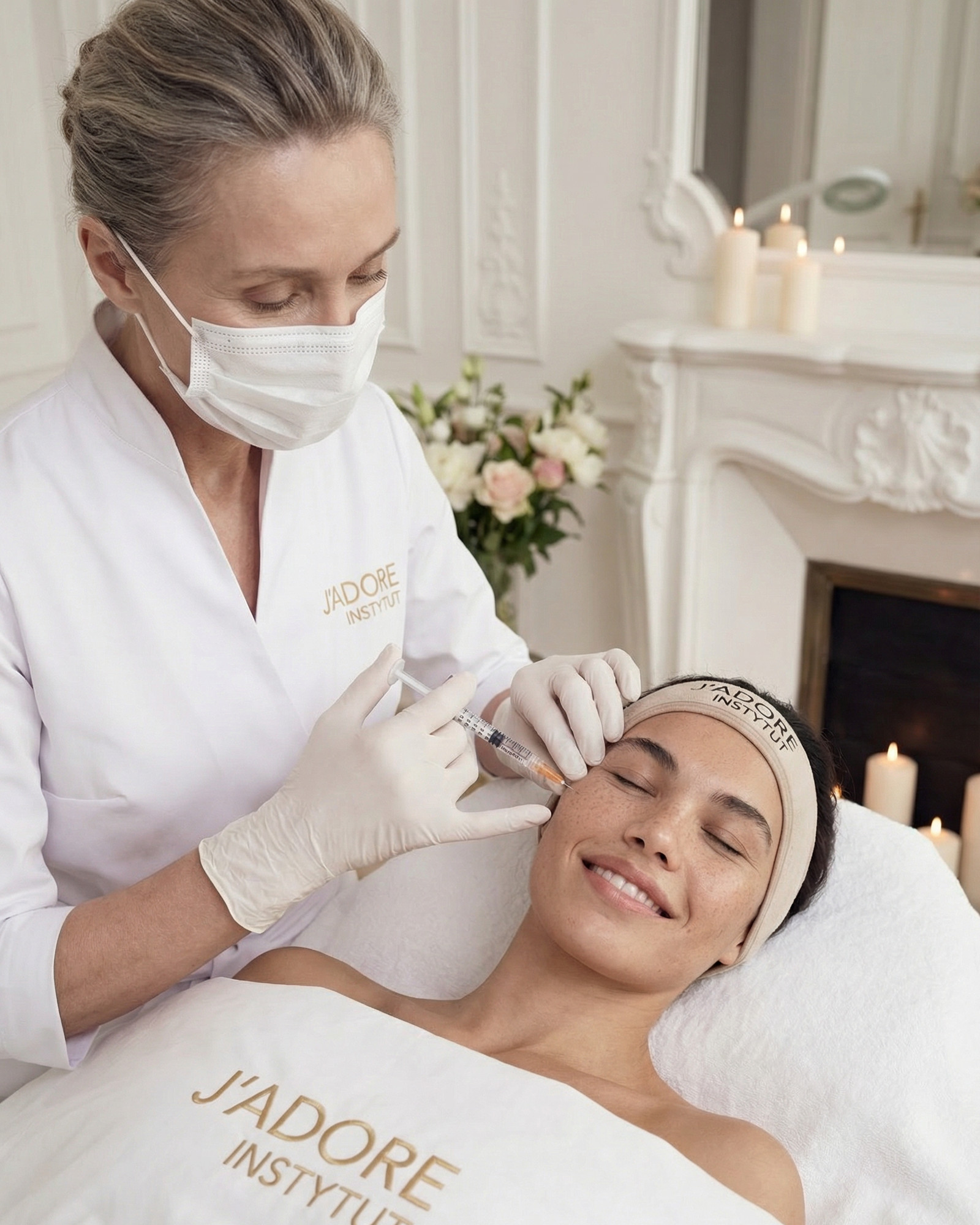
- Collagen stimulation. Treatments that "disturb" the skin in a controlled way — through microneedling or energy-based devices — trigger the body's natural repair response. Fibroblasts activate and produce new collagen. This isn't about adding something from outside — it's about convincing your own cells to do work they do less and less often with age.
- Biostimulation and deep hydration. Delivering active substances into the skin — injectable hyaluronic acid, polynucleotides, bio-building peptides — nourishes the environment where fibroblasts work. Better-hydrated skin produces collagen more efficiently; think of it as improving the soil rather than the plant itself.
- Tissue restructuring. When grooves are pronounced and the skin has clearly lost firmness, stimulation alone may not be enough. Lifting threads, biocollagen injected directly along the line of the groove, or more intensive restructuring treatments work to reorganise the tissue — not just its quality, but its geometry.
It's also worth mentioning what's not worth doing — because the internet is full of home remedies for Venus rings, from neck exercises to collagen masks and ultrasonic phone-attachment massagers. None of these have proven effects on the deeper layers of skin. They may improve hydration and briefly improve appearance — but if the problem lies in the collagen scaffolding, home accessories simply can't reach that far. It's the same principle as a face cream and the jawbone.
Prevention — the only thing that truly stays ahead of the problem
If Venus rings are just starting to appear — or you want to make sure they don't show up too early — prevention is genuinely effective. This is one of the rare cases where the simplest steps can matter the most.
In summary: the neck follows its own biology — thinner skin, less collagen, more movement, and years of neglect all take their toll. Venus rings aren't a whim or an unrealistic aesthetic expectation — they're a specific mechanism that can be understood and addressed. But to do this effectively, this area needs to be seen as separate, with its own protocol — not simply as an extension of facial care that stops at the jawline.