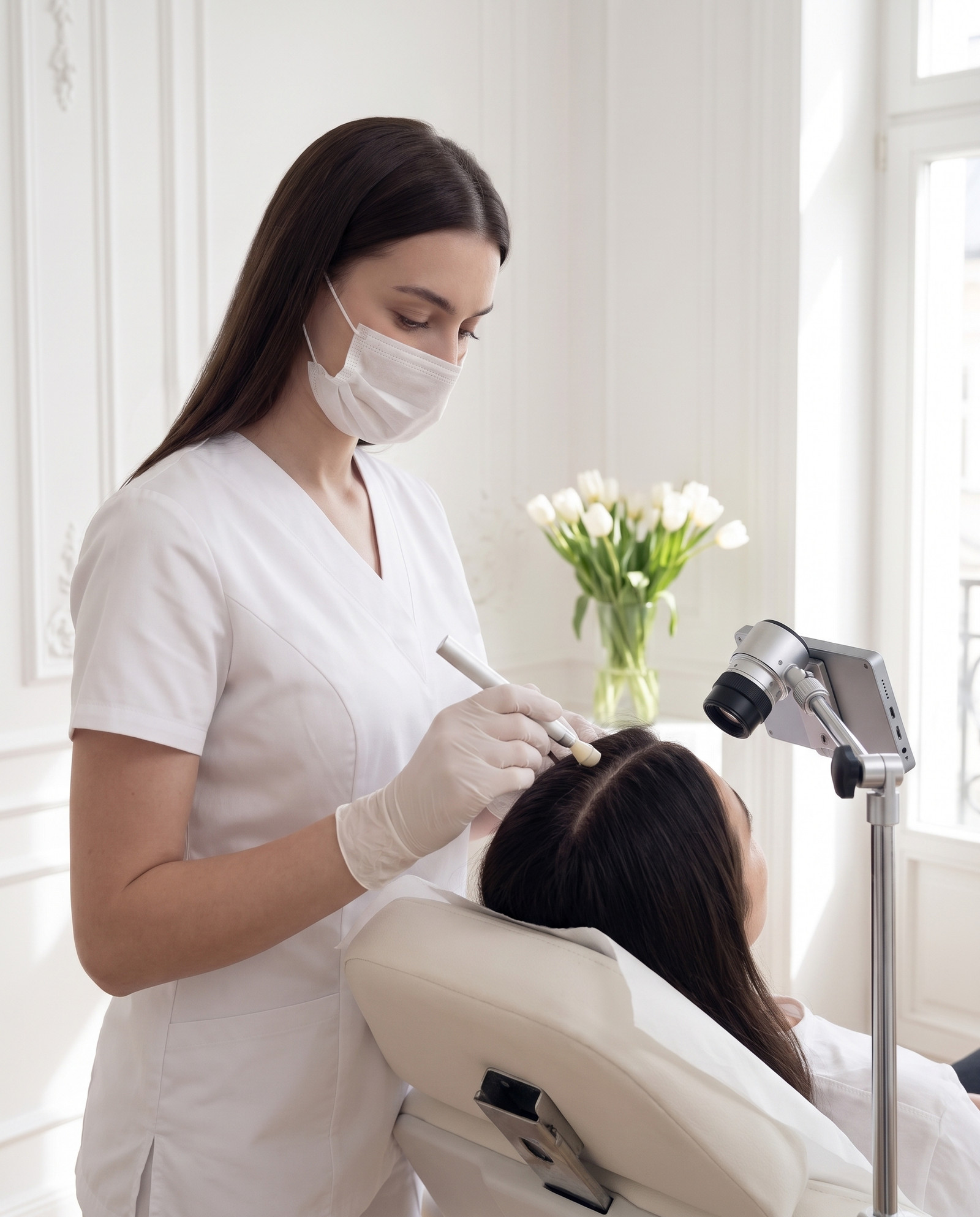
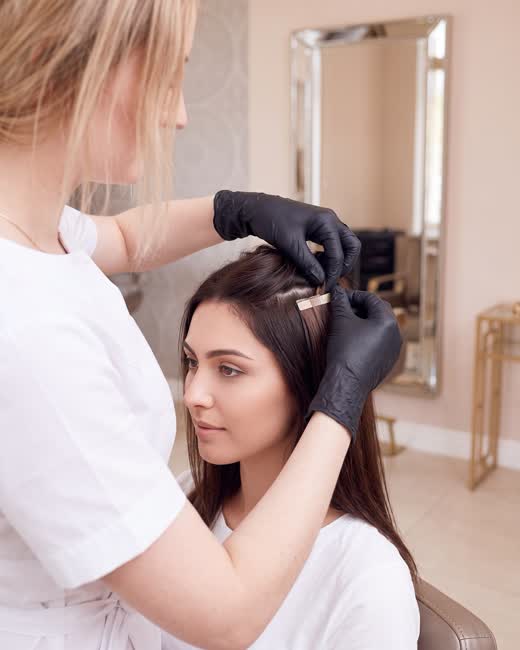
The scalp — it is not like the face
The first thing to understand is that the scalp is not simply skin with hair on top. It has its own specific physiology, which distinguishes it from the skin on your face or the rest of your body. Sebaceous glands are much more densely distributed here and more active than in most other zones. They secrete sebum at a rate that leads to rapid greasiness for many people — regardless of whether they have facial skin problems.
In addition to sebum, there is regular exfoliation: dead cells shed constantly, though often unnoticed. Under normal conditions, this is a healthy, natural process. The problem arises when these elements — sebum, dead skin, residues of styling products and shampoo — begin to layer and wedge around the hair follicle openings. This creates what can be called a biological plug: an impenetrable or poorly permeable layer that physically blocks access to the skin.
Then there is another element: care and styling products. Conditioners, hair serums, mousses, sprays — all leave residues on the scalp. Some ingredients are molecularly heavy and do not penetrate the skin; instead, they settle on its surface, creating an additional insulating layer. For mesotherapy — which by definition aims to reach as deep as possible — this is a real obstacle.
What happens beneath the scalp — and what mesotherapy seeks
To understand why cleansing matters, it is worth looking one level deeper — at what mesotherapy aims to achieve. The hair follicle lives in the hair follicle, which reaches deep into the dermis. It is surrounded by blood vessels, fibroblasts and local immune cells. The condition of these structures determines whether the hair grows strong, thin, or at all.
Scalp mesotherapy delivers active substances directly into the vicinity of these structures — bypassing the epidermal barrier. In theory, this is an elegant solution: instead of waiting for an ingredient to penetrate the skin on its own (which often fails), we deliver it where it needs to work. But "directly" does not mean "without obstacles" — there is always some tissue between the needle and the follicle, and the quality of that path matters.
- 01
Layer of products and sebum
The outermost obstacle: cosmetic residues, sebum, dust. Often invisible to the naked eye, but chemically and physically real.
- 02
Dead skin
A layer of exfoliated cells, thicker in cases of dandruff or dermatitis. It can mechanically block or scatter the injection.
- 03
Living epidermis
The barrier that the needle overcomes — but previous layers affect the precision and depth of penetration.
- 04
Dermis and the follicle area
This is where the active substance is meant to work: blood vessels, fibroblasts, hair papilla cells.
When the scalp is cleansed, the needle reaches the planned depth with greater precision. When it is not cleansed, the injection may encounter resistance or change its angle unpredictably. This is not theory — it is simple mechanics: passing through a thicker, more compact layer changes the behaviour of both the needle and the substance being administered.
Bacteria, microbiome and inflammation — a silent risk factor
There is one more dimension often forgotten in conversations about cleansing: the scalp microbiome. The skin of a healthy person is inhabited by billions of microorganisms — bacteria, fungi, viruses. In balance, they form a protective barrier and do not cause problems. But when the scalp is greasy, with accumulated dandruff or inflammation, the microbiome can shift towards species that pose a risk during treatment.
This is particularly important for people with oily dandruff (pityriasis steatoides), seborrhoeic dermatitis of the scalp or AGA (androgenetic alopecia), where the skin condition is already different from the norm. In these cases, cleansing is not a cosmetic introduction — it is a condition for the safety of the treatment.
Cleansing as a primer — not just removing dirt
It is worth changing your perspective: cleansing the scalp before mesotherapy is not "washing just in case". It is active preparation of the surface for absorption. It works like a primer before painting a wall — it not only removes what gets in the way, but creates a more uniform, receptive surface.
Uncleaned skin
state before preparation
- Layer of sebum and products on follicle openings
- Accumulated dead skin around the follicle
- Possible micro-irritation or inflammation
- Irregular absorption in different zones of the head
Cleansed skin
after preparation
- Open follicle openings, reduced mechanical resistance
- Even, uniform injection surface
- Reduced number of microorganisms on the skin
- More predictable penetration and distribution of the substance
The effect of cleansing is also physiological: a gentle massage and cleansing preparations increase local circulation. A better-perfused scalp means better-nourished follicles and faster distribution of the administered substance via capillaries. This is not a marketing effect — it is a simple consequence of the fact that heat and mechanical stimulation of the skin dilate blood vessels and accelerate metabolite exchange.

When cleansing is particularly critical
Although cleansing is standard before every scalp mesotherapy, there are situations where its importance increases disproportionately. These are not edge cases — these are quite common conditions with which clients come for treatment.
- Intensive styling and products building up on the skin. Hairsprays, mousses, silicone serums — each of these products leaves a residue that several days of regular use can thicken into a layer impossible to remove with water alone. Enzymatic or gently exfoliating cleansing may be necessary here.
- Oily skin and dandruff. Excessive sebum not only creates a mechanical barrier — it also changes the micro-environment on the skin's surface. For people with an oily scalp, cleansing is often deeper and takes longer than for those with dry skin.
- Long time between washing the head and the visit. It is standard to recommend arriving with a clean head, but not immediately after washing (the skin needs a moment to rebuild its natural protective layer). The optimal state is a clean head washed a few hours earlier — then the cleansing in the clinic is simpler and more precise.
- Active irritation or itching. A red, flaky or itchy scalp is a signal that inflammation is active. In such cases, the specialist assesses whether the treatment should take place at all — and if so, cleansing is even more important as a risk-reduction step.
Cleansing and the final result — does it have a measurable impact?
This is a question worth asking directly: does skipping cleansing really change the result? It is difficult to give a simple answer because mesotherapy is a complex procedure. Results depend on many variables at once — the protocol, the substance composition, the frequency of treatments, the state of the hair follicles and the overall condition of the body. There is no study that isolates the "cleansing yes/no" variable alone.
However, the mechanics are clear: a substance delivered to a precise depth, into well-vascularised tissue, through clean skin, has a chance for full bioavailability. A substance delivered through a layer of accumulated sebum, with more difficult needle penetration and poorer blood supply, does not necessarily have this chance. In treatment series, where each session builds on the previous one, the difference in the quality of each injection can accumulate in a visible way over the months.
It is also worth looking at this from the perspective of a series. Scalp mesotherapy rarely brings spectacular results after one session — its strength lies in regularity. If each of the several or more treatments begins with properly prepared skin, the cumulative difference is greater than the number of sessions alone would suggest. This is one of those elements that is difficult to measure after one treatment, but becomes visible over the course of a six-month therapy.