
What's really under the skin — and why it isn't paint
Intuition suggests a tattoo is something like a drawing applied to the skin's surface — layers of pigment sitting somewhere on top. That isn't the case. The tattoo needle deposits pigment into the dermis, the layer beneath the epidermis, far deeper than most creams or cosmetics ever reach. And once there, the pigment doesn't simply "sit" freely — it's literally trapped inside cells.
When the needle pierces the skin, the immune system reacts immediately. Macrophages — the immune system's scavenger cells — try to "clean up" the foreign material. They engulf pigment particles, but they're too small to digest them. Instead, they seal the particles inside themselves and remain in the skin permanently. A tattoo lasts a lifetime precisely because the pigment sits trapped inside cells — not because the skin has "absorbed" it.
Pigment particle size matters enormously. The smaller the particles, the more easily they exit through the lymphatic system once broken down by laser. Old, faded tattoos often clear more easily — not because there's less pigment, but because the particles have already partly broken down and shrunk. A fresh, intense tattoo is a dense cluster of large particles — a much harder task for laser treatment.
How laser breaks down pigment — selective photothermolysis, explained simply
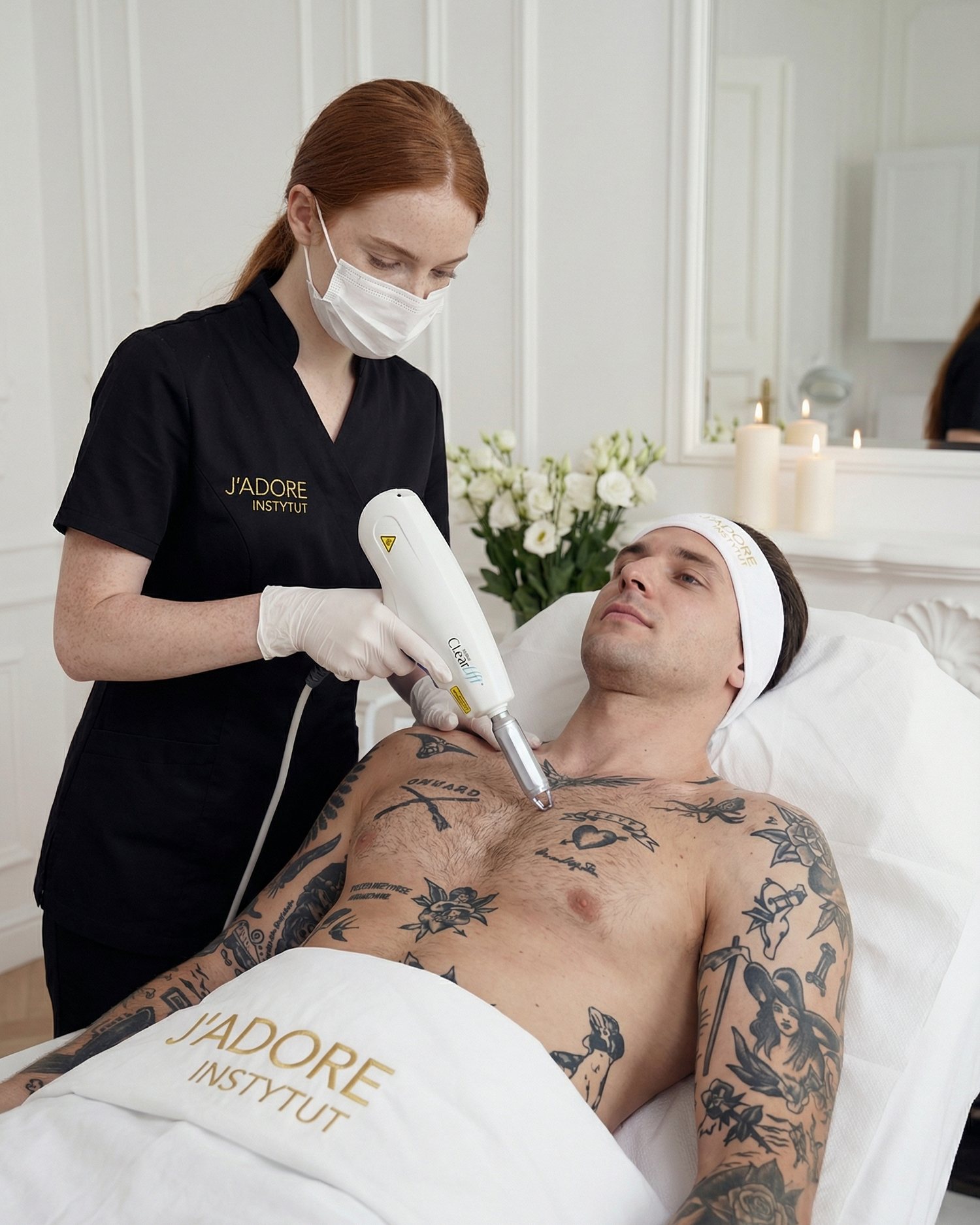
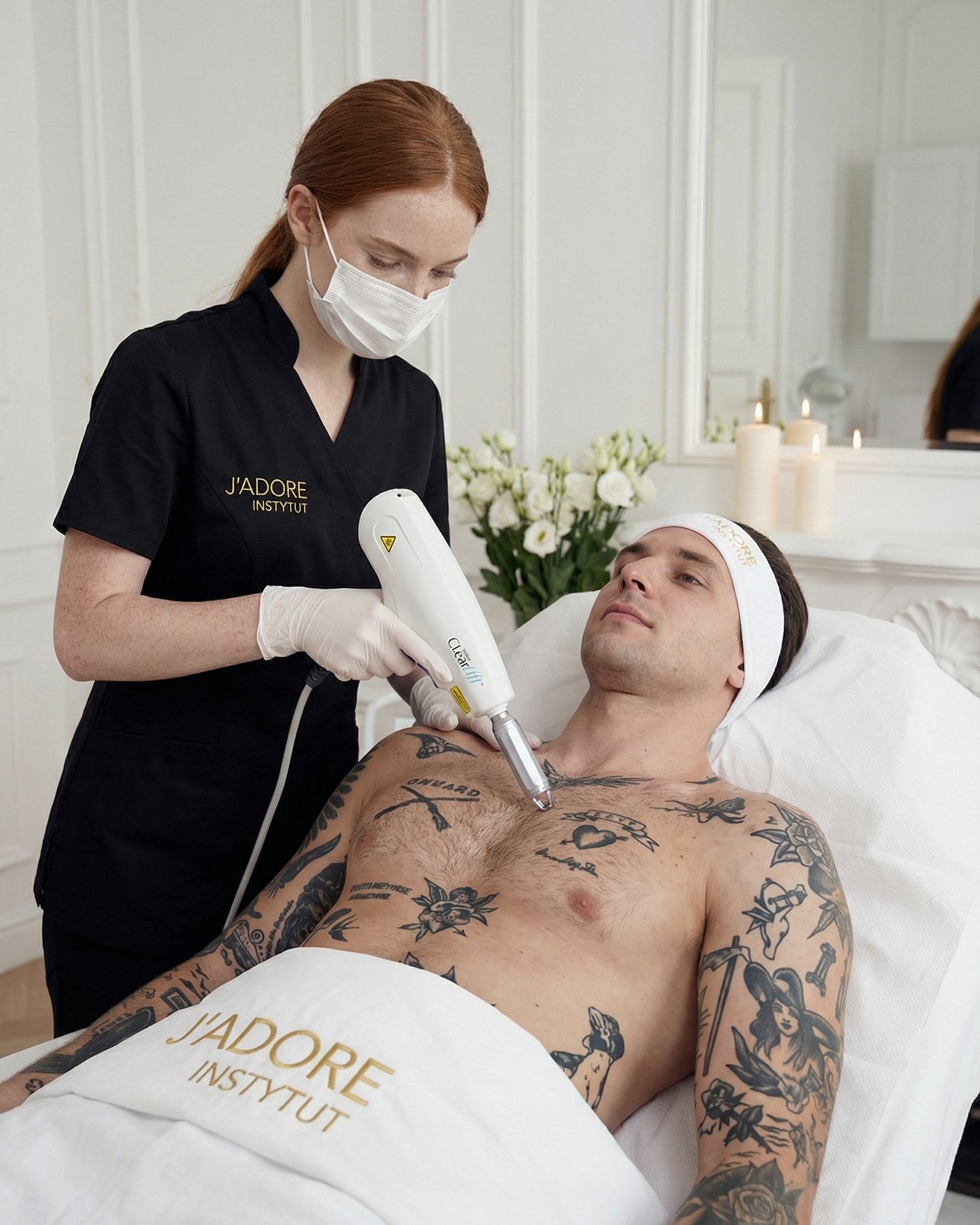
Laser tattoo removal doesn't "burn" pigment away or dig it out. It works far more precisely: the laser emits a very short pulse of light energy, which the pigment particle absorbs and instantly converts into heat. The temperature inside the particle rises so sharply that a micro-explosion occurs — the pigment shatters into much smaller fragments. Macrophages then step in, this time large enough to engulf the fragments and carry them away through the lymphatic system.
But here's a fundamental limitation: no single laser can remove every colour. Each colour absorbs different wavelengths — what works on black pigment may not react with green or yellow at all. That's why professional removal of multicoloured tattoos requires either a device that emits several wavelengths, multiple sessions with different settings, or both at once.
Difficulty ranking — from easiest to hardest
If you were to rank tattoo colours from easiest to hardest to remove, it would look roughly like this — though every case is different, and the final result also depends on depth, tattoo age, pigment type and individual skin response.
- 01
Black and dark grey
Absorbs laser energy almost regardless of wavelength. For many people, it responds after just a few sessions. The best candidate for full removal or significant lightening.
- 02
Navy and dark blue
Optically close to black — these respond fairly well, though they usually need more sessions than pure black. A deep shade is an advantage: the darker the pigment, the more effective the energy absorption.
- 03
Dark red and brown
These respond to different wavelengths than blue tones. With the right equipment, they clear reasonably well, though uneven pigment blends in artistic inks can behave unpredictably.
- 04
Blue and purple (medium saturation)
Often need multiple sessions. Blue pigments can be a mix of different chemical compounds, and each one may respond differently — hence the variability in results.
- 05
Green
One of the hardest colours. It absorbs a narrow range of wavelengths, and the availability of the right wavelength depends on the specific device. Green pigments tend to persist for a long time and may need far more sessions than adjacent black areas.
- 06
Light red, orange, pink
Light warm tones absorb less energy than dark ones. They respond, but more slowly. Pink can paradoxically darken during early sessions before it starts to fade — this is caused by pigment oxidation.
- 07
Yellow, light green, white
The hardest three. Yellow and light green reflect most wavelengths, absorbing very little energy. White pigment — often containing titanium dioxide — can paradoxically darken after laser sessions instead of fading. These are colours where realistic expectations are absolutely essential.
Green — why it's such a challenge
Green deserves special attention, because it's a good example of how much a pigment's chemical composition can complicate what seems like a straightforward task. Green tattoo inks are often a mix of several different compounds: organic pigments, metallic pigments, and sometimes phthalocyanines — industrial dyes known for their exceptional durability.
The problem is that each of these components has a different light-absorption curve. What works on one component of the mix may not react with another at all. In practice, this means a green tattoo can fade unevenly after several sessions — part of the pigment responds, part persists. This is especially visible in tattoos with fine detail: black outlines clear efficiently, while green fill remains, forming an unattractive "skeleton" of the design for a long time.
White pigment — a special case
White in tattoos is its own category of problems — and it's worth knowing about before deciding on removal. White pigments often contain titanium dioxide or zinc oxide — substances widely used in paints, sunscreens and cosmetics. They're exceptionally chemically stable and almost fully reflect visible light.
When laser hits white pigment containing titanium dioxide, a reaction can occur that neither the client nor, sometimes, a less experienced operator expects: instead of lightening, the pigment darkens. Titanium dioxide reacts with laser energy, reducing to a darker chemical form. Instead of disappearing, a white tattoo can turn grey-brown or graphite-coloured. Further sessions may partially reverse this change, but not always, and not completely.
What else affects the result — beyond colour
Pigment colour is the main factor, but not the only one, in determining how much time and how many sessions tattoo removal will take. Several other variables can speed up the process or complicate it significantly.
- Tattoo age. Older tattoos can be easier to remove — over the years, pigment particles partly break down and become smaller. A "fresh" tattoo is a dense mass of large particles the laser has to work on from scratch.
- Pigment depth. Tattoos placed deeper in the skin need more energy to penetrate, and the breakdown products have a harder time leaving. Different tattoo artists work at different depths — hence the variability in results even for identical colours.
- Amount of pigment. Saturated, dense fills simply mean more material to remove. Fine lines or light shading can respond faster than dense blocks of colour, even in the same shade.
- Ink chemical composition. Tattoo ink manufacturers don't disclose their formulas, and compositions vary widely. The same "green" from two different manufacturers can behave completely differently under laser. This accounts for some of the unpredictability in removal.
- Skin tone. Melanin — the pigment giving skin its colour — competes with tattoo pigment for laser energy absorption. The darker the skin, the greater the care needed to avoid hyperpigmentation or discolouration. Choosing the right settings for darker skin tones is far more demanding.
- Location on the body. Areas with good lymphatic circulation (for example, near lymph nodes) clear pigment fragments more efficiently. Limbs, especially their far ends, may respond more slowly, since tissue metabolism there is lower.
Lightening instead of removing — when it makes sense
Not everyone walks into a laser clinic wanting "no trace at all." Some clients want to lighten a tattoo enough to cover it with a new design — a separate strategy that often needs fewer sessions and allows more flexibility than aiming for complete clearance.
For colours that are hard to fully remove — green, yellow or mixed shades — lightening can be a far more realistic goal. After a few sessions, pigment loses enough intensity that a new tattoo can cover it without showing through. You don't need to wait for 100% removal to move forward. This approach is worth discussing directly during consultation — a specialist can suggest the optimal number of sessions for your specific goal, rather than an abstract ideal.
Laser + consultation with a dermatologist
Especially for sensitive skin, darker skin tones, or tattoos with unknown pigment composition — a dermatological assessment before a series of sessions gives extra assurance about the protocol and the risk of discolouration.
Series of laser sessions + regenerative mesotherapy
After several removal sessions, skin may need support — hydrating and regenerative mesotherapy can help restore skin condition between sessions, particularly over larger areas.