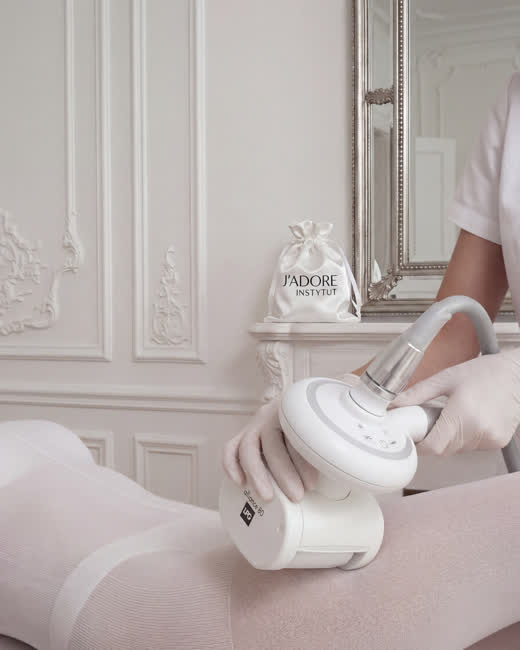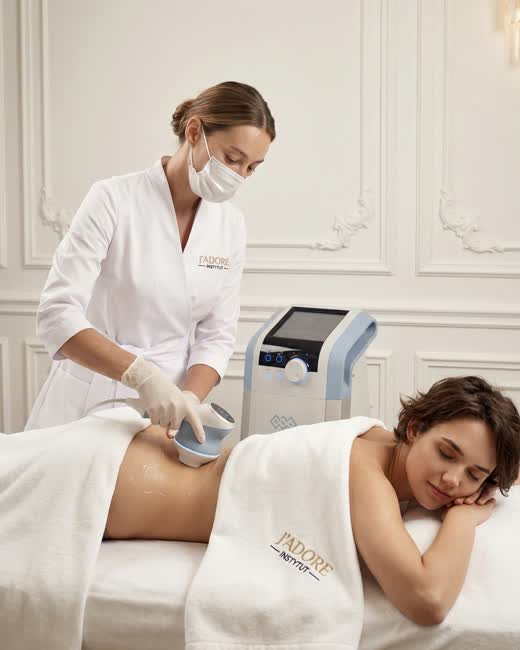
 A treatment room at J'adore
BODY CONTOURING & SLIMMING
Cellulite that won't budge despite diet and training. Stretch marks after pregnancy, or after a rapid change in weight, that have stayed for good.
Dark circles you cover with concealer every day. Skin on the arms or inner thighs that loses elasticity year after year. No cream can solve these problems — because they happen deeper, at the level of microcirculation and subcutaneous tissue. Carboxytherapy works exactly there: through controlled micro-injections, we introduce medical carbon dioxide (CO₂) under the skin, which wakes up circulation, oxygenates tissue and stimulates the skin to produce its own collagen. This isn't slimming, and it isn't a substitute for exercise — it's support for contouring and skin quality, built gradually, session by session. At J'adore Instytut, carboxytherapy is performed by an experienced cosmetologist. Below you'll find everything worth knowing before your first visit.
series usually 4–12 sessions, every 1–2 weeks
How it works
Carboxytherapy is controlled delivery of medical carbon dioxide (CO₂) just under the skin using a very fine needle. It's not "injecting cream" and it's not a filler — the gas under the skin is invisible and absorbs on its own. The entire effect comes from the reaction CO₂ triggers in the tissue.
The mechanism is called the Bohr effect: when more CO₂ appears in a given area, the body "thinks" that oxygen is lacking there — and reacts immediately. Blood vessels dilate, fresh, oxygenated blood flows in, and the skin receives an infusion of nutrients. The same process stimulates fibroblasts to produce collagen and elastin, encourages the formation of new fine capillaries (a more lasting improvement in microcirculation) and supports the breakdown of local fat deposits.
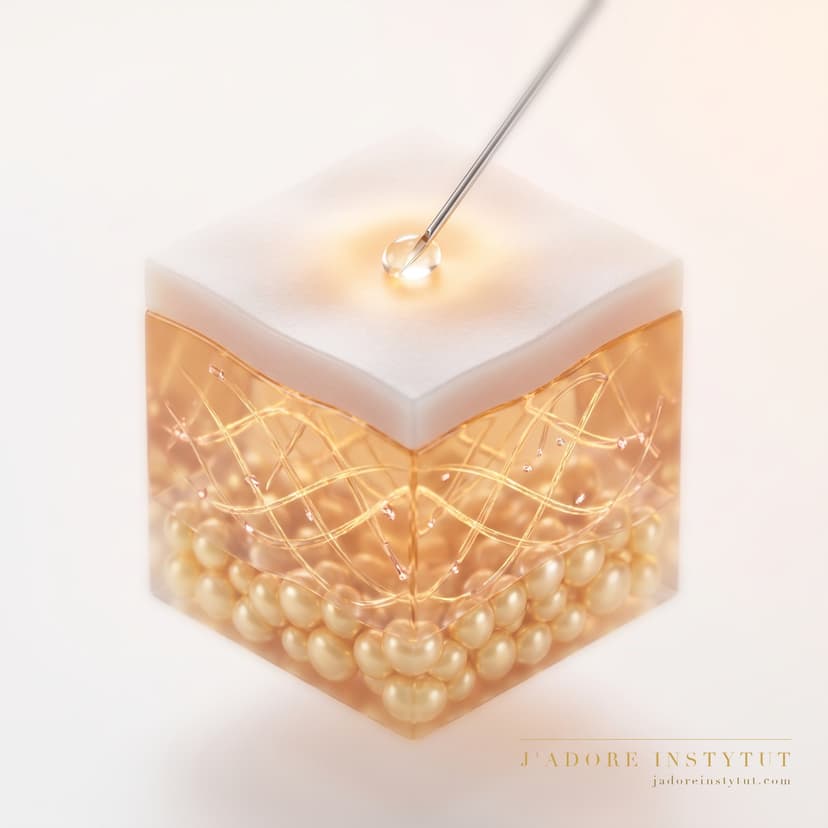
CO₂ is a natural metabolite of your body — produced in every cell and quietly expelled through the lungs. That's why carboxytherapy is well tolerated and has been used in salons for decades.
BODY CONTOURING & SLIMMING
Carboxytherapy is one of those treatments that work on multiple fronts — the same oxygenation and collagen stimulation helps with very different problems:
Interesting fact: it's the same gas you exhale with every breath. Carboxytherapy uses a simple physiological "trick" — a local excess of CO₂ tricks the tissue into thinking it lacks oxygen, so the body itself sends more blood, oxygen and building material to that spot. We're not adding anything foreign — we're activating your own repair mechanism.
Female zone and male zone
In women, carboxytherapy most often addresses cellulite, stretch marks and skin quality. Thin skin, subcutaneous tissue prone to an "orange-peel" texture, stretch marks after pregnancy or weight fluctuations — these are the classic indications. It's often also the first treatment women turn to for dark circles, once concealer stops being enough.
What we work with
In men, carboxytherapy most often targets localised fat and contour — a "spare tyre" on the abdomen, love handles, a double chin — and also tired-looking eyes (dark circles). Add to that acne scars, lax skin after significant weight loss, and the scalp in cases of thinning hair. Cellulite occurs in men too, especially on the abdomen.
What we work with
Regardless of the area, the cosmetologist selects the parameters individually — injection depth, gas volume and point distribution — based on the problem, tissue thickness and your response. There's no single scheme for everyone.
Safety
Carboxytherapy is well tolerated, but like any treatment that breaks the skin, it requires hygiene, experience and individual selection. You have every right to ask about these three things at any salon:
Micro-injections under the skin aren't a treatment done "on the side" of a manicure. At J'adore, it's performed by an experienced cosmetologist, and the first session is always preceded by a consultation and a check for contraindications.
We use high-purity medical CO₂ and certified equipment with adjustable settings; the gas is warmed to body temperature for comfort. That's not the same as random "gas from a cylinder".
Depth, gas volume and injection points are chosen to match the area and your tissue — that's why there's no "one price for one scheme", only a plan built around you.
Red flag: "a miraculous minus 10 cm in one session" and a suspiciously cheap package · Carboxytherapy doesn't slim you down in one go and doesn't replace diet — anyone promising spectacular centimetres after the first visit, or selling a large series as a "bargain" package without a consultation or a check on contraindications, either doesn't understand the treatment or is counting on you not knowing better. A good salon asks about your health and medications first, and only then proposes a plan.
Contraindications
Some contraindications are permanent, others temporary — in the latter case, we simply postpone the treatment until the situation resolves. Carboxytherapy breaks the skin with a needle, so the general rules for such treatments also apply.
Many people think, "I only get herpes on my lips, and the treatment is on my thighs — that shouldn't matter." It does. An active virus is a risk regardless of where it appears, and breaking the skin can "wake it up". It's better to postpone by a few days than to treat a flare-up afterwards.
This isn't a complete list — we'll go through your medications, chronic conditions and previous treatments individually during your free consultation.
The visit

Consultation
the cosmetologist assesses the area and the stage of the problem, discusses your expectations and rules out contraindications; a plan and number of sessions in the series are set.
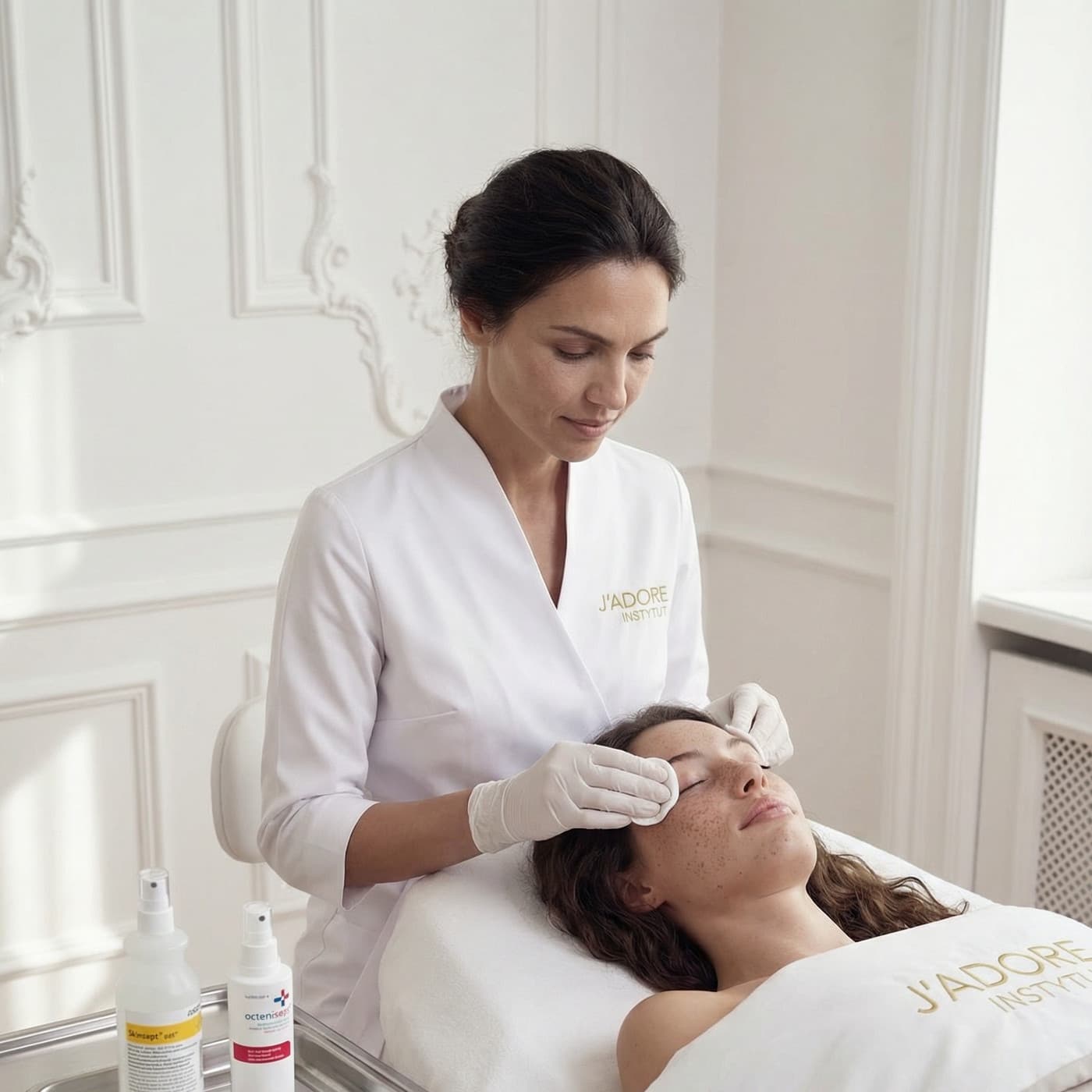
Preparing the area
the skin must be clean, free of creams and oils; the cosmetologist disinfects the area and marks the injection points.

CO₂ micro-injections
a very fine needle delivers the gas just under the skin. You'll feel slight pressure or tingling, which fades within a few minutes as the gas absorbs.

Ongoing adjustment
the cosmetologist adjusts gas volume and depth depending on the area and your response.

Leaving with no downtime
no bandages, usually no visible marks; you return straight to your daily activities.
What to realistically expect
This is a series-based, cumulative treatment — you won't see results after one injection, and each session builds on the last. That's an honest advantage, not a drawback: we're building a real change in the tissue, not a one-off "effect for one evening".
The most common disappointment comes from expecting "fewer centimetres after one session". Carboxytherapy doesn't work that way — and that's a good thing, because it means we're working with physiology, not a temporary swelling. After the first session, I'm pleased when a client says her skin feels "somehow more alive" — that's a sign circulation has kicked in. The rest builds through the series.
How long the effect lasts depends largely on you: hydration, movement and a diet rich in protein and vitamin C support what the treatment does. Carboxytherapy provides the fuel, but lifestyle determines how long the effect stays.
Portfolio
A record of the work in our salons — the place where we publish treatment frames and, after photo sessions, results.
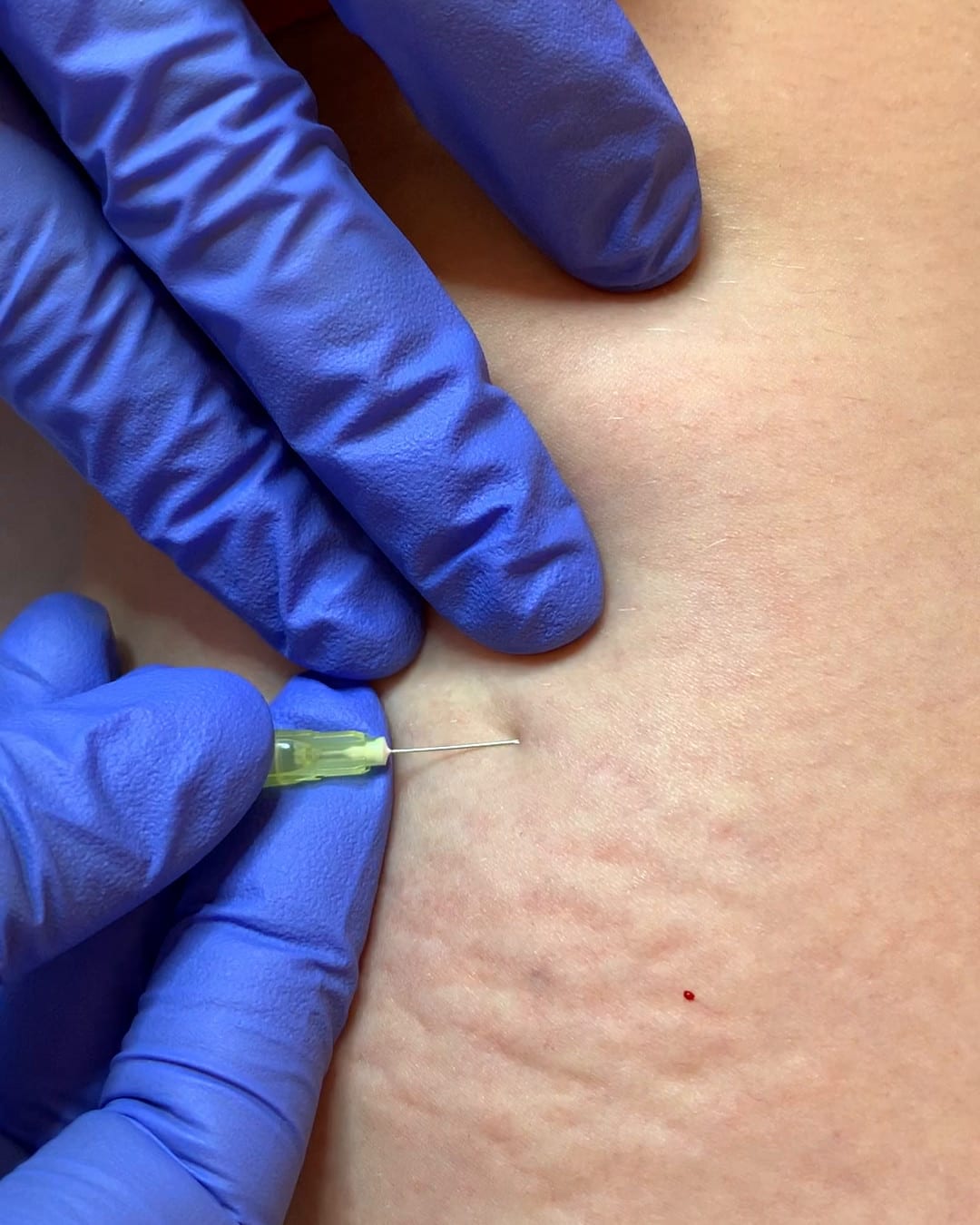
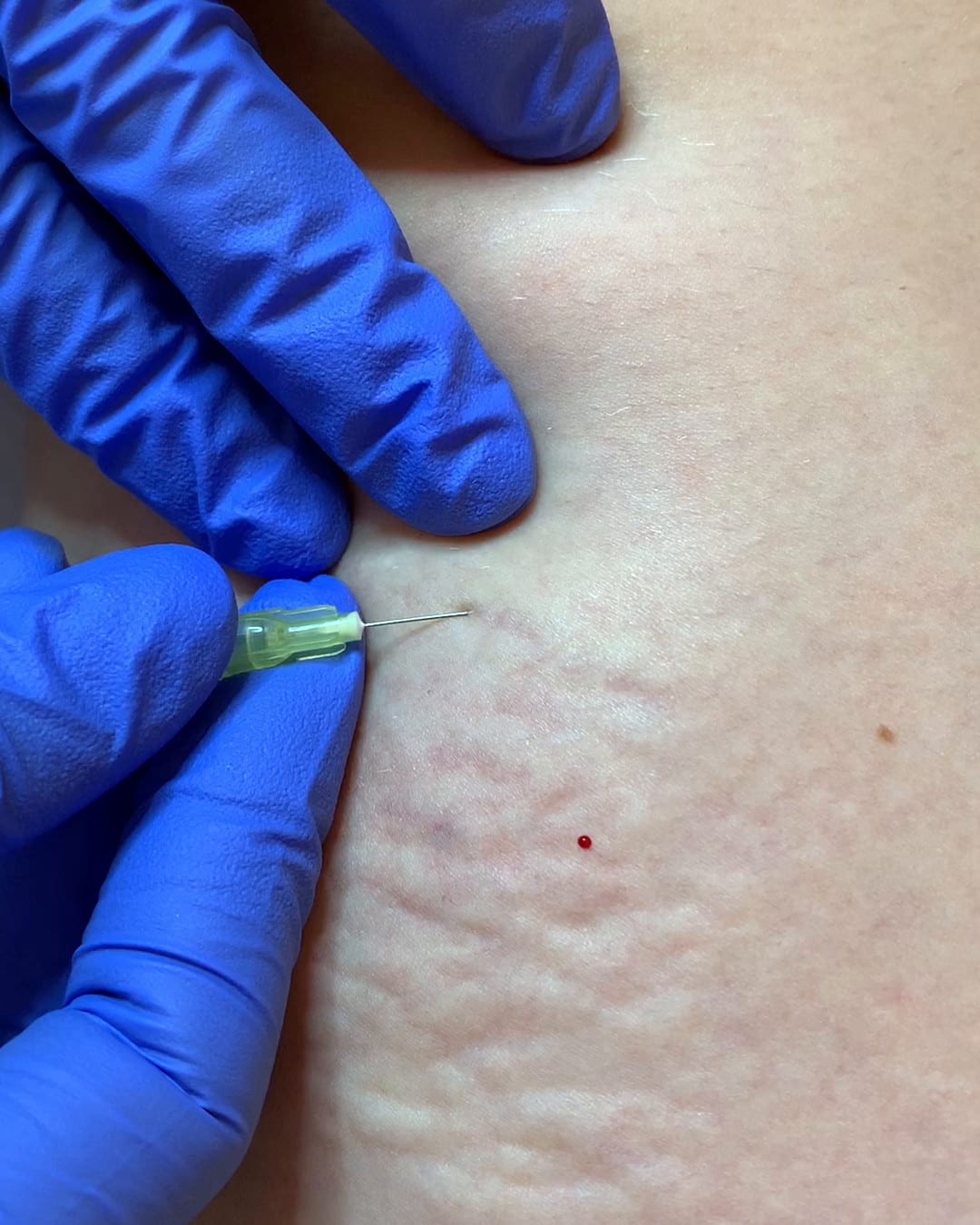
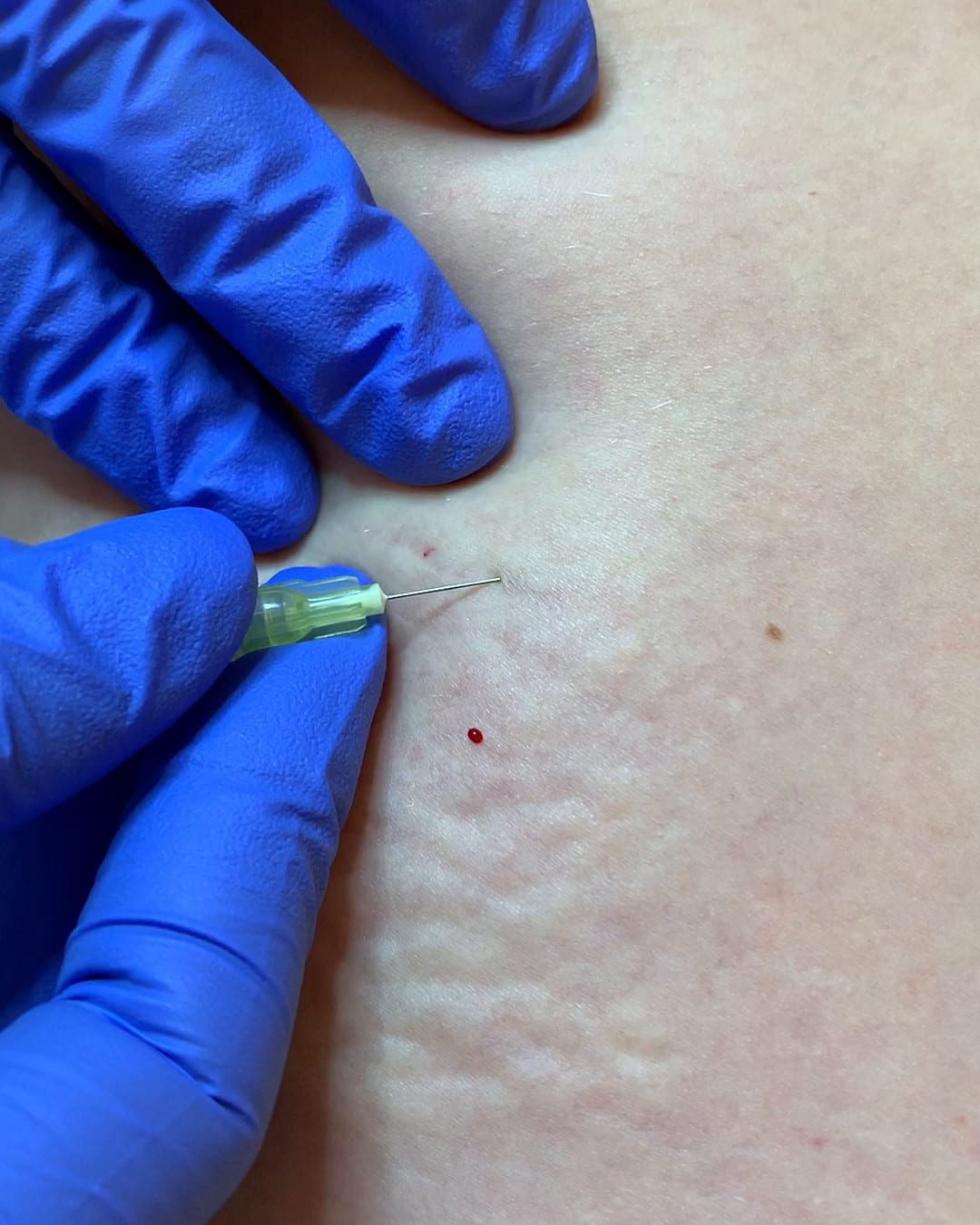
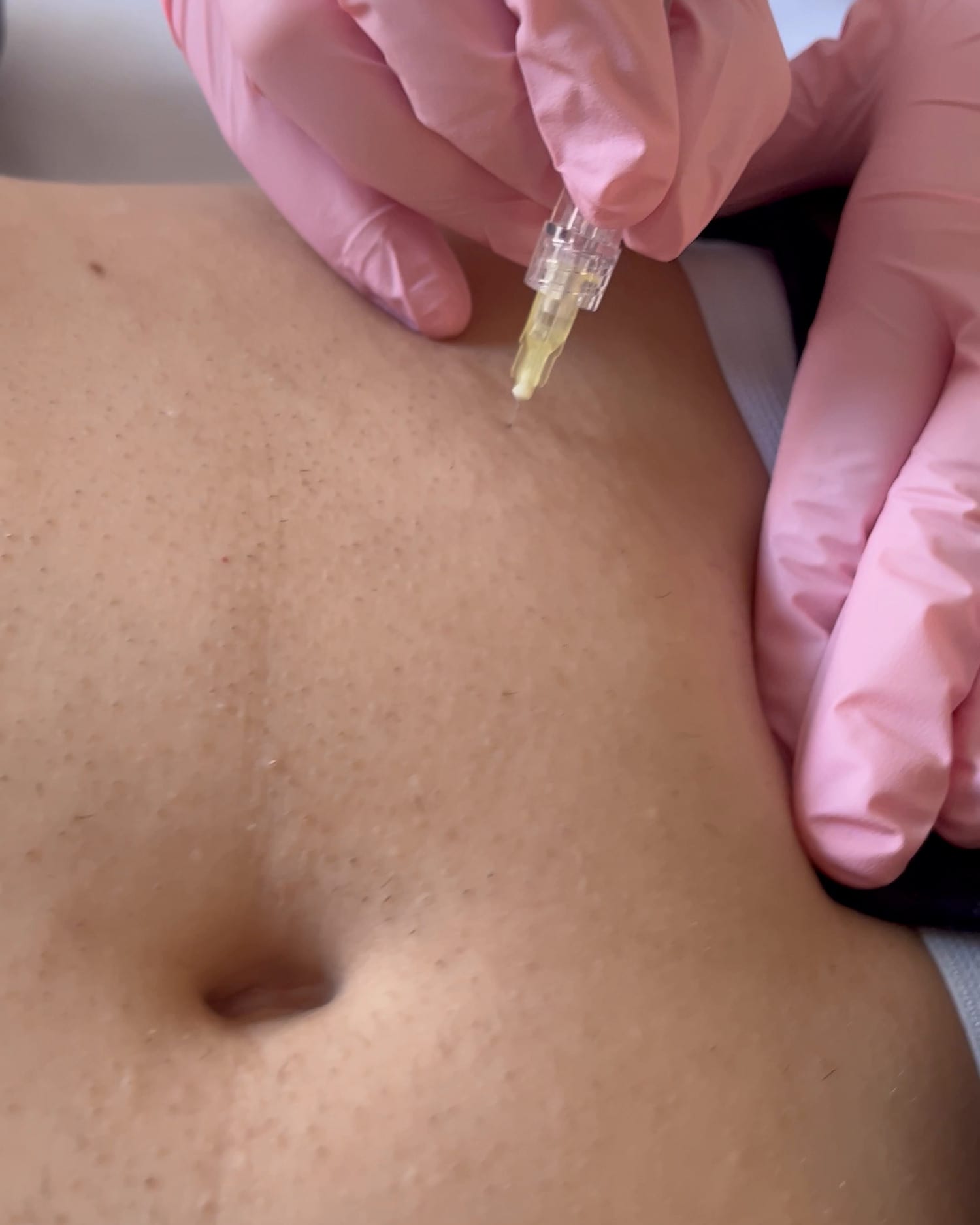
A record of results — in preparation. We publish photographs of our clients only with their consent.
Carboxytherapy and your lifestyle
The most common questions aren't about the injection itself, but about what comes after: training, sauna, sun, the pool, a glass of wine. The rule is simple — for the first 24 hours, we want to avoid making redness, swelling or bruising worse, and the area needs protecting from infection after the skin has been broken.
On the day of the session, skip intense exercise — significantly accelerated circulation encourages swelling and bruising. From the next day, no restrictions; activity actually supports the effect on cellulite and localised fat.
High temperature dilates blood vessels and worsens swelling. Sauna, hammam, jacuzzi and hot baths — best left for a day.
After a session on the face or décolletage, skip intense sun exposure and sunbeds for a few days, then apply SPF 50+ daily — especially on exposed areas.
The skin has been broken by a fine needle — chlorinated water in the first 24 hours can irritate it. Let the injection points close calmly.
Alcohol dilates blood vessels and increases the risk of bruising — best avoided on the day of the session, especially when working around the eyes.
This one's actually recommended: good hydration supports the elimination of metabolites and helps the skin respond to the treatment. Makeup (after a facial treatment) — from the next day.
Carboxytherapy (CO2)
There are several methods for "cellulite and localised fat", and it's easy to mix them up. They work slightly differently, and often work best together, not instead of each other:
oxygenates, stimulates collagen and microcirculation
not a slimming treatment; won't remove a large volume of fat "instantly"
reduces a localised fat fold
doesn't work on stretch marks, dark circles or the quality of thin skin
mechanical stimulation and drainage
on its own, rarely delivers what oxygenation and collagen from carboxytherapy do

What to combine it with
Carboxytherapy combines excellently with other treatments. The order and intervals are decided by the cosmetologist during the consultation, but the general logic is fixed: first clear and oxygenate, then refine and consolidate.
The simplest guidance: if the problem is skin quality, stretch marks, dark circles or water-retention cellulite — aim for carboxytherapy. If it's a distinct, stubborn fat fold you can pinch in your hand — consider cryolipolysis. And most of the time, we combine them anyway: carboxytherapy plus drainage/endermology delivers more against cellulite than either on its own.
Technology and variants
The term "carboxytherapy" covers several treatment-area variants that differ in depth, gas volume and purpose. Here you do not choose an "off-the-shelf product" — the cosmetologist selects the variant to suit the concern, tissue thickness and your treatment history.
A metabolite natural to the body; warmed to body temperature for comfort and delivered at a controlled flow through the device.
Dla kogoThe common thread running through all variants — from face to body.
Gentle, shallow injections into thin skin; the focus is on microcirculation and brightening, not lipolysis.
Dla kogoDark circles, facial revitalisation, facial contour, neck and décolletage.
A larger area and deeper delivery; works on microcirculation, drainage and the breakdown of localised deposits.
Dla kogoCellulite (thighs, buttocks, abdomen), love handles, localised fat.
Precise administration within the stretch mark or scar; emphasis on remodelling and collagen synthesis.
Dla kogoStretch marks (fresh ones respond faster), acne and post-surgical scars.
Fact: Why do prices differ between areas? It comes down to the size of the area, working time and the number of sessions in the series — the face requires different work than the thighs and buttocks. You'll find area-specific pricing in the Price list section and at reception; with a series package, the price per session is lower.
Price list
Checking free hours…
From the magazine
Editorial pieces on how this treatment works in practice — what happens during the session, how to prepare, where the limits are and what the first days after look like.
See also
The result laststhe effect of the series lasts for many monthsJ’adore Instytut
Note. Carboxytherapy is a cosmetology device-based treatment with a care and contouring purpose; it is not a medical treatment and does not replace medical treatment, diet or physical activity. The text above is for informational purposes only and does not constitute medical advice. Indications, parameter selection and contraindications are determined by an experienced cosmetologist during an individual consultation.
Home care
Cosmetics matched to what your skin needs after a treatment — so the clinic effect lasts longer.
 body firming and celluliteDiego Dalla PalmaSCULPTOREA Thermoactive Anti-Cellulite Cream 250 mlView in the shop(opens in a new tab)
 body careSkeyndorCannabis Massage Cream – Spa SensesView in the shop(opens in a new tab)
 body firming and celluliteVagheggiFuoco — RE-shaping Thermal Cream 200 mlView in the shop(opens in a new tab)
 body careMesoesteticBodyshock Essential CreamView in the shop(opens in a new tab)
 body firming and cellulitePurles141 Lipolytic CreamView in the shop(opens in a new tab)
 body firming and celluliteDermoMedicaRetinoid Firming Body Lotion 200 mlView in the shop(opens in a new tab)
 body firming and celluliteSelvert ThermalRetinol Body Treatment. Stretch Mark and Even SkinView in the shop(opens in a new tab)
 body firming and celluliteDermalogicaBody Hydrating Cream 295 mlView in the shop(opens in a new tab)