Telogen effluvium — why hair falls out in autumn
Your hair doesn't grow all at once. Each of the 100,000–150,000 hair follicles on your head is in one of three cycle phases:
- Anagen (growth phase) — lasts 2–7 years; around 85–90% of hair is in this phase at any given time
- Catagen (transitional phase) — lasts 2–3 weeks; 1–2% of hair
- Telogen (resting and shedding phase) — lasts 2–4 months; 10–15% of hair
The problem? These phases partly synchronise with the seasons. A study published in the British Journal of Dermatology (Kunz et al.), based on a sample of 823 women, found that hair loss peaks in autumn — September, October and November. Why?
In summer, more follicles enter the telogen phase — likely a protective mechanism against UV exposure, since denser hair shields the scalp. After 2–4 months, this hair sheds en masse. The result: an autumn tsunami on your hairbrush.
This is called seasonal telogen effluvium, and it's physiologically normal. It usually lasts 6–8 weeks, then shedding returns to normal.
How many hairs a day is normal — and how many is too many
The mythical "100 hairs a day" is actually the upper limit of normal. More precisely:
- 50–100 hairs/day — normal
- 100–150 hairs/day — acceptable in autumn, if it doesn't last more than 8 weeks
- Over 150 hairs/day — a warning sign, regardless of season
- Thinning visible to the naked eye — definitely too much
- Visible scalp (especially along the parting or on the crown) — time to see a specialist
But who actually counts their hair? Nobody. That's why simpler tests exist.
The pull test — try it at home
Take a bundle of around 40–60 hairs between your thumb and forefinger (at several points on your head). Pull gently but firmly from root to tip. Count how many hairs remain in your hand.
- 0–2 hairs from the bundle — normal
- 3–5 hairs — increased shedding, worth monitoring
- 6+ hairs — active shedding, worth getting checked
Repeat on 3–4 areas of your head (crown, temples, back). If the results differ — for example, 6 hairs on the crown but only 1 at the back — this suggests pattern hair loss rather than diffuse shedding.
Causes of hair loss — beyond autumn
Seasonal shedding resolves on its own. But if hair has been falling out for months, or the shedding is severe, something else is pulling at your hair.
Stress (stress-induced telogen effluvium)
Severe physical or emotional stress can push large numbers of follicles from the anagen phase into telogen all at once. The effect appears with a delay of 2–4 months after the stressor. Moved house in June? Shedding hits in October. Lost a loved one in August? Hair falls out in December.
Nutritional deficiencies
Ferritin — this isn't the same as iron. Ferritin is a protein that stores iron, and its level is a better indicator of hair health than haemoglobin alone. The optimal level for hair: above 40 ng/ml (some trichology sources cite 70 ng/ml). Laboratory "normal ranges" start at 10–15 ng/ml — but that's a haematological norm, not a trichological one. At ferritin 20 ng/ml, you don't have anaemia, but your hair can still shed heavily.
Zinc — a cofactor for over 300 enzymes, essential for cell division within the hair follicle. Zinc deficiency means slower growth and increased shedding.
Vitamin D — VDR (Vitamin D Receptor) sites are present in hair follicles. Studies correlate low D3 levels (<30 ng/ml) with increased shedding and alopecia areata.
Biotin (B7) — true biotin deficiency is rare, but with supplementation (2.5–5 mg/day), many women report improvement. Note: biotin can distort thyroid test results. Stop taking it 3–5 days before a blood test for TSH.
Thyroid
Hypothyroidism (Hashimoto's) is one of the most common culprits behind chronic hair loss in women. Hair becomes dry, brittle and sheds diffusely — often evenly across the whole scalp. TSH, fT3, fT4 and anti-TPO should be standard tests when diagnosing hair loss.
Postpartum hair loss
A classic case. During pregnancy, oestrogen keeps hair in the anagen phase — hence the so-called "pregnancy glow" of thick hair. After birth, oestrogen levels drop sharply, large numbers of follicles shift into telogen, and shedding follows 3–6 months after delivery. It's physiological, but alarming. It typically resolves on its own by 12 months postpartum.
After COVID-19
Post-COVID telogen effluvium is a phenomenon confirmed by dozens of studies. Hair starts shedding heavily 2–4 months after infection. The mechanism: systemic inflammatory stress, combined with a possible direct effect of the virus on the follicles. For most people, it resolves within 6–9 months, though some require trichological intervention.
When to see a trichologist — specific signs
Not every case of hair loss needs a specialist visit. But these situations do:
- Shedding lasts longer than 3 months — seasonal shedding should resolve within 6–8 weeks
- Alopecia areata — round, smooth bald patches (autoimmune, requires treatment)
- Receding hairline — especially at the temples and forehead
- Widening parting — visible scalp along the parting line
- Hair as thin as fuzz — follicle miniaturisation (androgenetic alopecia)
- Itching, flaking, redness of the scalp — may indicate seborrhoeic dermatitis, psoriasis or fungal infection
- Shedding after starting a new medication — many drugs (beta-blockers, anticoagulants, contraceptives) can cause hair loss
- Shedding combined with other symptoms — fatigue, weight gain, dry skin (thyroid?), irregular periods (hormones?)
Trichoscopy — microscopic diagnostics
A trichologist doesn't guess. We use a trichoscope (a dermoscope with 20–70x magnification) for precise analysis:
- Hair thickness — diameter measurement (miniaturisation indicates androgenetic alopecia)
- Density — hairs per cm² (normal range: 100–150 in European women)
- Anagen:telogen ratio — if telogen exceeds 25%, shedding is active
- Scalp condition — blood vessels, scaling, inflamed areas
- "Yellow dots" — empty follicles filled with keratin (androgenetic alopecia)
- "Exclamation mark hairs" — short, tapered hairs indicating alopecia areata
It's pain-free, takes 15–20 minutes and gives objective data. No guesswork — just numbers, measurements and comparative photos.
Treatment — what actually works
Scalp mesotherapy
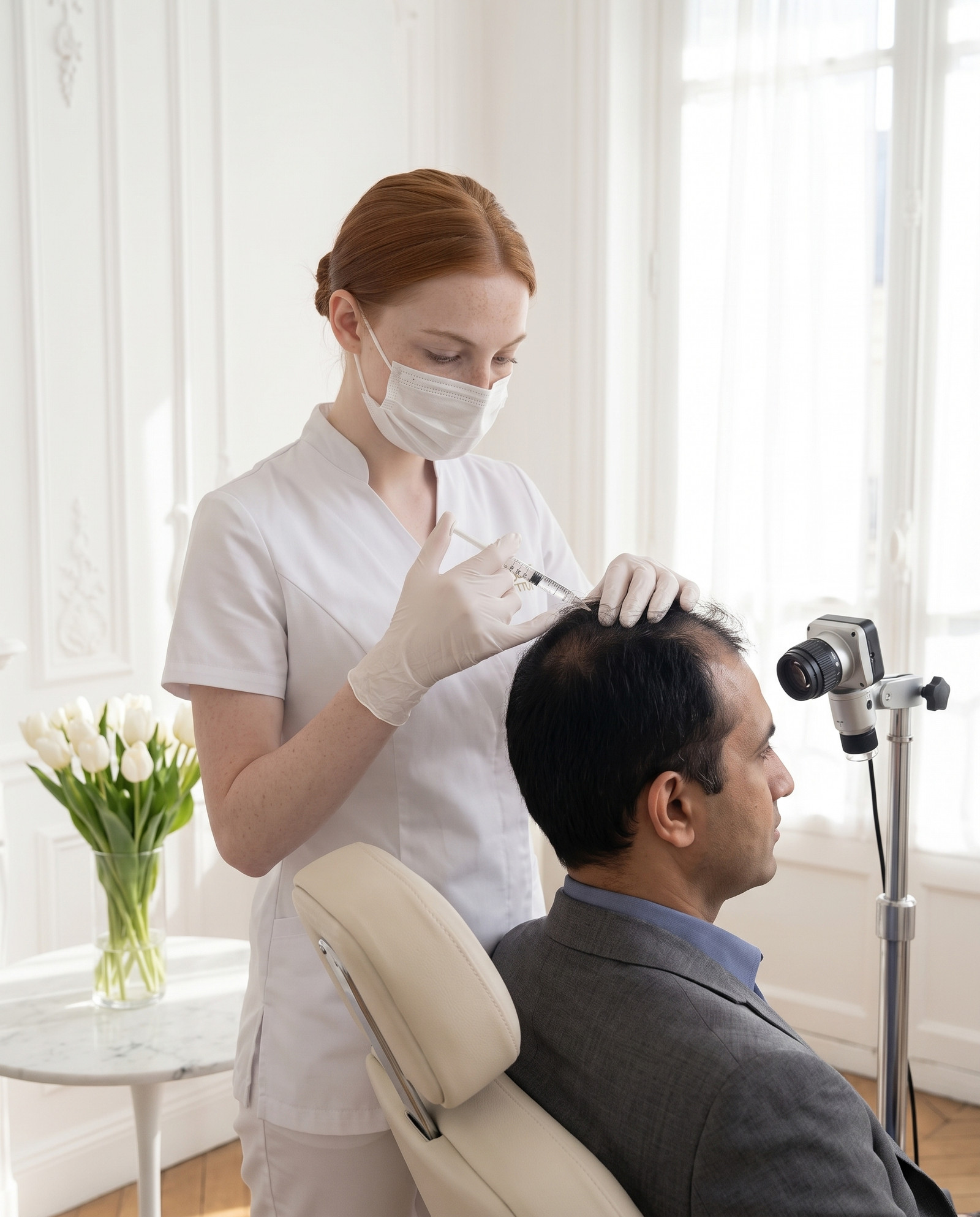
Micro-injections directly into the scalp — a cocktail containing biotin, dexpanthenol, zinc, amino acids, hyaluronic acid and B vitamins. This delivers the substances exactly where they're needed — directly to the hair follicle.
Protocol: a series of 6–10 sessions every 1–2 weeks, followed by maintenance sessions every 4–6 weeks. Results: reduced shedding after 3–4 sessions, visible regrowth after 2–3 months.
PRP (Platelet-Rich Plasma) for the scalp
This uses your own blood, spun down and concentrated to increase platelet content — platelets contain growth factors including PDGF, TGF-beta, VEGF and EGF. It's injected into the scalp. These growth factors stimulate angiogenesis (new blood vessels mean better-nourished follicles) and encourage proliferation of dermal papilla cells.
A meta-analysis in Dermatologic Therapy (2023, 19 studies) found that PRP significantly increases hair density and shaft thickness compared with placebo. Protocol: 3–4 sessions every 4 weeks, then 1–2 sessions a year.
Minoxidil
The only OTC (over-the-counter) medication with proven efficacy against hair loss. It stimulates angiogenesis around the follicle and prolongs the anagen phase. Available in 2% (women) and 5% (men, or women following consultation) concentrations. Results appear after 4–6 months of regular use. Note: once you stop using it, hair returns to its original state.
Finasteride (only under medical supervision)
A 5-alpha reductase inhibitor — it blocks the conversion of testosterone into DHT, the hormone responsible for follicle miniaturisation. For women: only after menopause, or combined with contraception, since it's teratogenic. Used under strict dermatological supervision.
Targeted supplementation
Not a generic "drugstore multivitamin", but targeted supplementation based on blood test results:
- Ferritin below 40: iron supplementation (iron bisglycinate is best tolerated)
- Vitamin D below 30 ng/ml: 4000 IU/day for 3 months, then 2000 IU
- Zinc below 70 μg/dl: zinc picolinate, 15–30 mg/day
- Biotin: 2500–5000 μg/day (stop before thyroid testing)
"Miracle anti-shedding shampoos" — marketing versus reality
Let's be direct: no shampoo will stop hair loss. Shampoo sits on the scalp for 60–120 seconds before being rinsed away. That's far too short a time for any active ingredient to reach the follicle and make a real difference.
Caffeine shampoo? Caffeine stimulates follicles in vitro. But the concentration in shampoo and the short contact time aren't enough to translate into a clinical effect. It won't harm you, and it smells nice — but it won't treat hair loss.
Shampoo can cleanse the scalp (which matters), reduce excess sebum and calm inflammation (if it contains ketoconazole or zinc pyrithione). But it can't "repair" a follicle that has stopped producing hair.
Your hair deserves a diagnosis, not a guess
Autumn shedding will pass. But if it doesn't, don't wait for it to "sort itself out" — every month of delay is a month in which follicles can miniaturise irreversibly.
At J'ADORE INSTYTUT, we offer full trichological diagnostics — trichoscopy with digital analysis, a consultation with a specialist, and a personalised treatment plan. We perform scalp mesotherapy and PRP treatments that deliver real, measurable results, confirmed with follow-up trichoscopy.
Your first visit includes: 45 minutes, trichoscopy, analysis of your blood test results (if available), and a plan of action. We don't guess — we measure. And we measure again after 3 months, so you can see your progress in numbers, not promises.
Visit our salons in Warsaw (Żelazna 59, Mińska 29A) and Krakow (Karmelicka 45). Book online at jadoreinstytut.com.