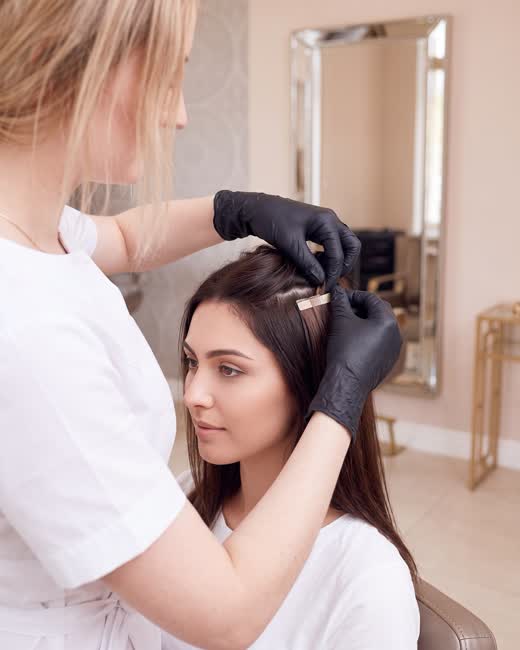
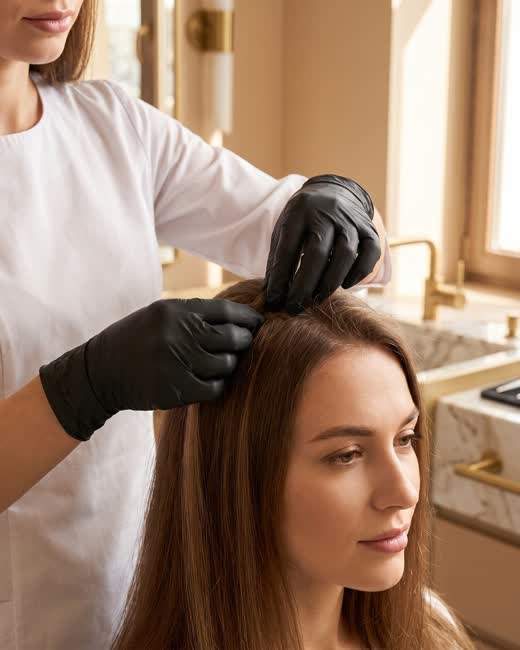
A treatment room at J'adore
SCALP & HAIR
Hair thinning does not happen overnight. It is a process that begins long before you notice more hair on your brush.
Follicles do not die immediately. First, they 'fall asleep'. The hair grows thinner, shorter, and weaker, and the hair papilla's microenvironment loses condition. ASCE exosomes are one of trichology's latest answers to this problem. These are microscopic signal vesicles derived from stem cells (carrying proteins, peptides, and mRNA), which we deliver into the scalp using gentle microneedling. Their role is to 'transmit instructions' to dormant follicles, improve blood supply and nourishment, and support the hair's growth phase. We are honest about this: exosomes support and strengthen, but they do not reverse advanced baldness in a single treatment. They work best when used early, after diagnosis, and as part of a series. This is the same technology we use on the face (**exosomes**), here directed at the scalp. Below, you will find everything you need to know before your first visit.
A series of treatments + maintenance — the trichologist establishes a plan after trichoscopy.
How it works
Exosomes are signal vesicles. These are microscopic 'information packets' secreted by cells, including stem cells. Inside, they carry proteins, peptides, and mRNA molecules, which are a set of instructions cells use to communicate with each other. In trichology, we use them to 'transmit a message' to weakened, dormant hair follicles and their surroundings.
We deliver them into the scalp with gentle microneedling. The micro-channels facilitate the absorption of the preparation where it needs to act, close to the hair papilla. The goal is not to 'glue' hair on, but to improve the microenvironment: better blood supply and nourishment, silencing unfavourable signals, and supporting the follicle in transitioning to the growth phase (anagen). Therefore, the effect is not immediate. It builds up in line with the hair cycle, not overnight.
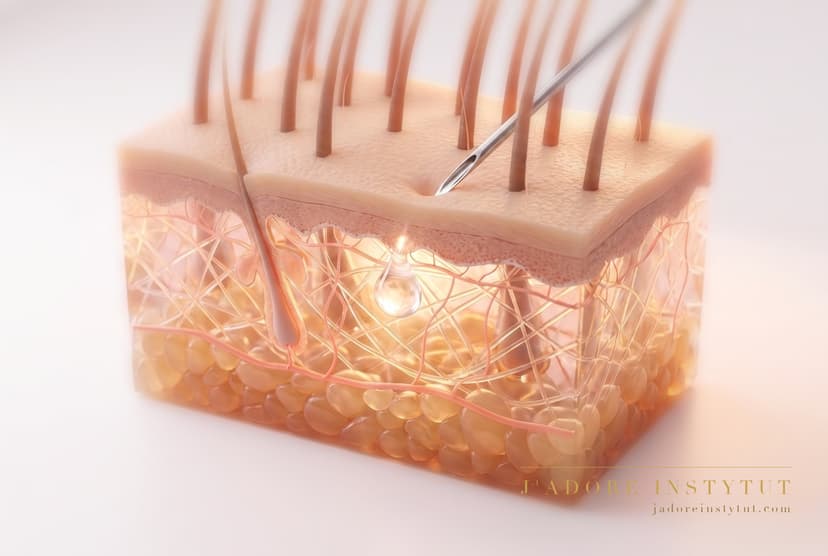
Exosomes are not the same as PRP. PRP uses growth factors from your own blood, while exosomes are a ready-to-use, standardised signal preparation. Both support follicles, but through different pathways. They are often used as complementary elements of a treatment plan.
Ideal for
Interesting fact: Exosomes were first discovered not in cosmetology, but in cell biology. For years, they were considered 'waste' discarded by cells. Only later did it become clear that they are a sophisticated communication system, with cells sending instructions to each other through them. Trichology simply uses this natural 'mail service' to communicate with the hair follicle.
Female and Male Zones
In women, hair loss rarely means a receding hairline. More often, it is diffuse thinning along the parting and loss of volume, strongly linked to hormones, thyroid issues, iron/ferritin deficiencies, or stress. ASCE exosomes for women support follicles and improve scalp condition, but first, we honestly look for the underlying cause.
What we work with
In men, male pattern baldness predominates — a receding hairline and thinning on the crown, usually appearing earlier and more 'graphically'. ASCE exosomes for men make the most sense when follicles are weakened but still present. This means early on, before the area 'shines' with smooth skin devoid of follicles.
What we work with
Regardless of gender, the starting point is a consultation with trichoscopy. This will show whether exosomes are the right choice, or if another treatment from our scalp offerings would be more suitable.
What Exosomes Will NOT Do
Trichology is an area where it is easy to have hopes that exceed the treatment's capabilities. That is why we state clearly where the limits are:
🚩 If your hair has started falling out suddenly, in handfuls, or if patches of smooth skin, redness, flaking, itching, pain, pustules, or scars have appeared, this is a sign that dermatological diagnostics are needed first, not an aesthetic treatment. Alopecia areata, fungal infections, or scarring diseases require treatment, not strengthening. Exosomes can wait until a diagnosis is made.
SCALP & HAIR
From the Trichologist's Salon
⚕️ A 'before' trichoscopy photo is the best friend of honest evaluation. After a few weeks, memory can be unreliable — 'I think it's better, but I'm not sure'. Comparing the image from before the series with the image afterwards tells the truth instead of relying on impressions.
Contraindications
Since the treatment disrupts the skin (microneedling), some contraindications are permanent, while others are temporary. In temporary cases, we simply reschedule your visit until the situation resolves.
🚩 Active herpes is a contraindication regardless of location. Even if it is 'only on your lips' and the treatment concerns your scalp. Disrupting the skin with an active virus poses an unnecessary risk. It is better to postpone by a few days.
This is not an exhaustive list. We will individually review your medications, illnesses, test results, and scalp condition during your trichoscopy consultation.
What to expect
Most importantly: you will not see the effect immediately — and this is normal. Hair grows slowly, and the follicle needs time to enter the growth phase. The first sign is usually not a 'new head of hair', but less hair on your brush and improved scalp condition.
⚕️ Some people report after their first visit that 'nothing is happening'. This is not a failure; it is the hair cycle at work. Exosomes work 'in the background', and the effect becomes apparent over weeks. That is why we do not evaluate a series after one treatment, and we do not promise a miracle in two weeks.
Portfolio
A record of the work in our salons — the place where we publish treatment frames and, after photo sessions, results.
A record of results — in preparation. We publish photographs of our clients only with their consent.
Exosomes and Your Lifestyle
After microneedling, your scalp is more sensitive for the first few hours and days. We want to avoid irritating it and allow the preparation to work undisturbed. There is one rule: treat your scalp gently for the first 24 hours.
It is best not to wash your hair on the same day. Allow the micro-channels to close. The next day, wash gently with lukewarm water and a mild shampoo, without vigorous rubbing.
Postpone intense exercise and heavy sweating of the scalp for 24 hours. Sweat and increased circulation can irritate fresh punctures.
Sauna, hammam, hot baths, and swimming pools (chlorine) can irritate and promote infection of fresh scalp skin. Refrain for 1–2 days.
Postpone intense sun exposure for a few days. If you have thinner hair, remember to protect your partings, as fresh scalp skin can easily discolour.
Hair colouring, high-temperature straighteners, and aggressive styling cosmetics should only be used after your scalp has healed. Ask your trichologist for the exact timing.
Continue to use any recommended serums, ampoules, or oral preparations. These enhance the treatment's effect between visits. A treatment without home care yields less.
ASCE scalp exosomes
We have several tools for hair loss, and they often complement each other rather than being mutually exclusive. Your trichologist will decide on the selection and sequence after trichoscopy. Below is the general logic:
ready-to-use signal preparation
will not recreate dead follicles, will not replace diagnosis of the cause
growth factors from your blood
requires a blood draw; effectiveness depends on your plasma
nourishing cocktail into the scalp
different mechanism than exosome signalling; often combined, not interchangeable
Combine with
Scalp exosomes work best as part of a broader plan, not as a single 'shot'. Your trichologist will decide on the sequence and intervals during your consultation, but the general logic is consistent:
⚕️ The most common question is: 'So, what is the best?' There is no single winner for everyone. For one person, **PRP might work wonderfully. For another, exosomes or scalp mesotherapy**, and for many, a smart combination of these in a series. That is why we start with trichoscopy, not the price list.
Preparation and Variants
With exosomes, the origin and quality of the preparation are as important as the administration technique. We work with proven, certified exosomal lines, and your trichologist selects the variant and plan based on your scalp condition and the stage of hair loss. It is not chosen 'off the shelf'.
Standardised exosomes from stem cells — a signal for the follicle and improvement of the scalp's microenvironment. This is a line we also use on the face.
Dla kogoEarly and moderate thinning, strengthening, and maintenance.
A cycle of treatments at set intervals with microneedling, tailored to the hair cycle and trichoscopy results.
Dla kogoIndividuals seeking real, measurable support, not a single visit.
Less frequent visits after completing the series, aimed at maintaining the achieved density and condition.
Dla kogoAfter a good response to the series — to consolidate the effect.
Fact: We do not specify the number of needles, depth of punctures, or volume of the preparation here. These are parameters that your trichologist determines individually during the treatment, depending on the area, skin thickness, and your tolerance.
Price list
Checking free hours…
From the magazine
Editorial pieces on how this treatment works in practice — what happens during the session, how to prepare, where the limits are and what the first days after look like.
See also
The result lastsThe effect builds over weeks, sustained by a series of treatments.J’adore Instytut
Information. ASCE exosomes for the scalp is a trichological-cosmetological treatment that supports scalp and hair condition. It is not a cure for baldness, nor is it a medical procedure, and it does not replace dermatological or endocrinological diagnostics. For severe or sudden hair loss, consult a dermatologist or trichologist. The above text is for informational purposes only. Indications and contraindications are determined by a trichologist or experienced cosmetologist during a consultation with trichoscopy.
Home care
Cosmetics matched to what your skin needs after a treatment — so the clinic effect lasts longer.
 hair lossDSD de LuxeVasogrotene GF Activator 011 50mlView in the shop(opens in a new tab)
 scalpSesdermaSEBOVALIS Medicinal Shampoo 200 mlView in the shop(opens in a new tab)
 hair lossDermoMedicaGrowth Hair Serum 60mlView in the shop(opens in a new tab)
 scalpestGenBalancing ShampooView in the shop(opens in a new tab)
 hair lossDSD de LuxeCrexepil Lotion Forte 3.4.1 100mlView in the shop(opens in a new tab)
 scalpKV-13.2 Oily Dandruff Lotion 100ml – Anti-Dandruff BalmView in the shop(opens in a new tab)
 hair lossDermoMedicaGrowth Factor Scalp Mask 200mlView in the shop(opens in a new tab)
 hair lossMesoesteticTricology ShampooView in the shop(opens in a new tab)