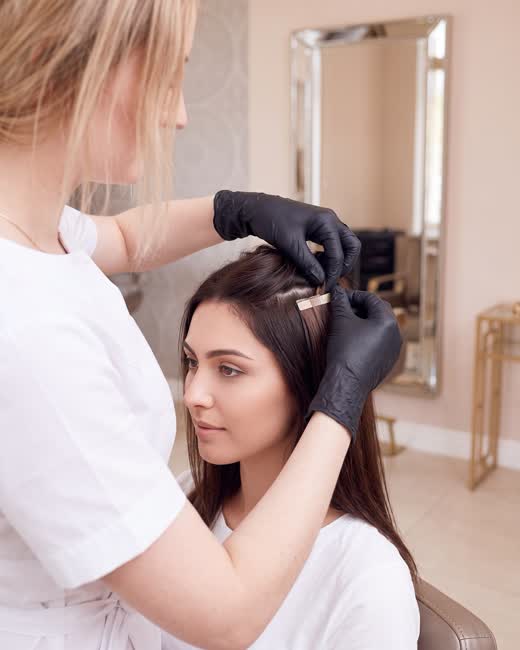
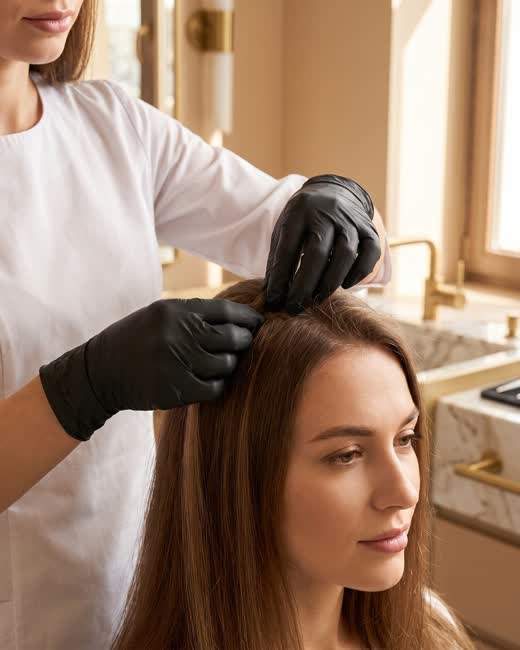
A treatment room at J'adore
SCALP & HAIR
Hair grows from the follicle, and the follicle lives on what blood delivers to it — oxygen and nutrients. When the scalp is tight, poorly supplied with blood, "cold" to the touch, follicles work at half capacity: hair becomes thinner, regrows more slowly, falls out more easily. Scalp carboxytherapy uses micro-injections of medical carbon dioxide (CO₂) to stimulate local microcirculation and improve tissue oxygenation — creating better working conditions for follicles.
It's not a miracle injection "for baldness", but support for scalp condition, which works best as a series and after prior diagnosis. At J'adore Instytut, the treatment is performed by a trichologist or experienced cosmetologist. Below you'll find everything worth knowing before your first visit.
series of treatments + maintenance
How it works
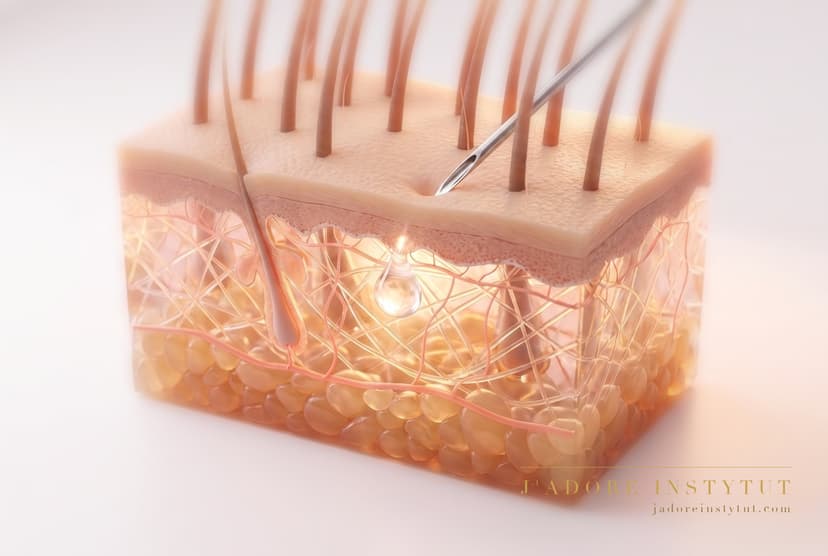
Carboxytherapy uses micro-injections of medical carbon dioxide (CO₂) delivered with a very fine needle just under the scalp. The body responds to the local "excess" of CO₂ as though the tissue needed more oxygen — and directs it there. This is the so-called Bohr effect: in response to carbon dioxide, blood releases oxygen to tissue more readily right where the gas was administered.
The effect is local and natural: small blood vessels dilate, microcirculation improves, and the scalp becomes better oxygenated and nourished. This in turn creates better working conditions for hair follicles — the gas itself doesn't "feed" the hair, but it improves the environment in which that hair grows. That's why the method makes sense where the problem is reduced scalp blood flow, not advanced, scarring hair loss.
Ideal for
What this treatment won't do: it won't regrow hair where the follicle has already disappeared, and it won't stop hormonal or autoimmune hair loss without treating the underlying cause. That's why we start with diagnosis, not a treatment "in the dark".
Women's and men's scalp
In women, hair loss is most often diffuse — the parting thins, hair becomes thinner across the whole scalp, density drops "evenly". It can be linked to hormones, the postpartum period, diet or stress. Scalp carboxytherapy in women then supports microcirculation across a larger area and is often part of a broader course of treatment.
What we work with
In men, thinning more often follows an androgenic pattern — temples recede, the crown thins. In the early stage, when follicles are still working, oxygenation and stimulated microcirculation can support them. This is scalp carboxytherapy in men as part of early action, not as a substitute for treating androgenic hair loss.
What we work with
Fun fact: carbon dioxide, the gas we usually "breathe out", acts in carboxytherapy as an alarm signal for tissue — telling it "I need more oxygen". The body responds by directing blood flow there. It's an old physiological trick (the Bohr effect) put to use in cosmetology.
Diagnosis first
Hair loss is a symptom, not a diagnosis. The same "fewer hairs on the brush" can mean several different things — and each requires a different approach. That's why, with us, scalp carboxytherapy starts with a consultation including trichoscopy, not the first injection.
If hair is falling out suddenly, dramatically, in clumps, if bald patches, itching, pain, flaking or inflammation appear — this isn't the moment for a cosmetic "oxygenation" treatment. First consult a dermatologist or trichologist to establish the cause. Carboxytherapy supports, but it doesn't treat hair loss and doesn't replace diagnostics.
SCALP & HAIR
This is a short visit with no general anaesthesia and no time away from daily life. The feeling of pressure under the scalp during administration is typical and passes quickly.
Contraindications
Some contraindications are permanent, others temporary — in the latter case, we simply postpone the treatment until the situation passes. This is a treatment that breaks the skin (needle), so some points matter especially here.
From the trichologist's chair
The most commonly overlooked issue is herpes and blood-thinning medication. "It's just on my lip, and the treatment's on my head" — the virus is still active, and it's better to postpone by a few days. And anticoagulant medication should always be disclosed, even if it seems "minor" — it affects the safety of the injections.
This isn't a complete list — we'll go through your medication, health conditions, scalp state and previous treatments individually during a consultation with trichoscopy.

What to expect
Most important: this is a game played over a series, following the hair cycle. Microcirculation improves immediately, but real changes in hair quality and density build up over weeks, because hair grows slowly and has its own rhythm. A single treatment "proves nothing" — consistency is what counts.
The most common disappointment comes from expectations: someone comes once and asks a week later "why hasn't new hair grown?". Carboxytherapy doesn't "add" hair — it improves the conditions in which the follicle works. We assess results across the full series, looking at trichoscopy, not after one visit.
Portfolio
A record of the work in our salons — the place where we publish treatment frames and, after photo sessions, results.
A record of results — in preparation. We publish photographs of our clients only with their consent.
After the treatment
This is a treatment involving micro-injections, so for the first 24 hours we treat the scalp gently — the aim is not to irritate fresh punctures or increase redness. The rules are simple:
Skip washing your hair and rubbing your scalp on the first day. After that, go back to a gentle, mild shampoo — no harsh SLS, no hot water.
Intense exertion and heavy sweating of the scalp in the first 24 hours encourage irritation of fresh punctures. Gentle movement is fine.
High temperature, steam and chlorinated water irritate and dilate blood vessels. Sauna, hammam, swimming pool — best after 1–2 days.
Freshly treated scalp and an exposed parting are sensitive — in full sun, wear a head covering or apply SPF to exposed areas. A fresh scalp tan is a reason to postpone the treatment.
Schedule colouring, chemical straightening and strong scalp cosmetics for a few days later, not right after the injections. Gentle combing — fine straight away.
The best results come from sticking to the course plan and gentle daily scalp care. Results are determined by regularity, not a single "intensive" visit.
Scalp carboxytherapy
These are three different trichology tools that don't rule each other out — in fact, they're often combined. Each works a little differently — the choice and order are decided by the trichologist after diagnosis:
oxygenates and stimulates microcirculation
doesn't "add" hair and doesn't deliver nutrients to the skin
delivers ingredients deep into the skin
doesn't focus solely on oxygenation — a different mechanism
stimulates regeneration using your own blood
requires a blood draw and its own protocol; not the same as gas oxygenation
Combine with
Scalp carboxytherapy works best as part of a plan, not a standalone treatment. The trichologist decides on combinations, order and intervals during consultation, but the general logic stays consistent:
The question "carboxytherapy or mesotherapy?" is like "water or fertiliser for a plant" — it's not a competition, it's two different things. Carboxytherapy improves blood flow (conditions), mesotherapy delivers ingredients (fuel). They often work best together in one well-planned schedule.
Variants and technology
Under the heading "scalp carboxytherapy" hides several versions of the same method and several ways of running it. You don't choose "an option off the shelf" — the trichologist selects it based on scalp condition, the stage of thinning, and the treatment goal.
Pure carbon dioxide delivered by micro-injections — it's what triggers the Bohr effect and stimulates microcirculation.
Dla kogoScalp with reduced blood flow, early thinning.
A cycle of regular sessions spread over time — it's the series, not a single visit, that builds results in quality and density.
Dla kogoGenuine support for hair condition; the standard approach.
CO₂ as part of a broader treatment (mesotherapy, PRP, LED) — oxygenation supports the other methods.
Dla kogoMore complex thinning that requires several tools at once.
Fact: Where do differences between salons come from? From the practitioner's experience, the quality of diagnosis before the series, and how sensibly the treatment is woven into the overall plan. The gas itself is "simple" — the difference comes from the hand performing it, the trichoscopy and the consistency, not the treatment name alone.
Price list
Checking free hours…
From the magazine
Editorial pieces on how this treatment works in practice — what happens during the session, how to prepare, where the limits are and what the first days after look like.
See also
The result lastsresult built through a series, maintained afterwardsJ’adore Instytut
Information. Scalp carboxytherapy is a trichological and cosmetology treatment that supports scalp and hair condition; it is not a treatment for baldness or a medical procedure, and it does not replace dermatological or endocrinological diagnostics. If hair loss is severe or sudden, consult a dermatologist or trichologist. This text is for information only. Indications and contraindications are assessed by a trichologist or experienced cosmetologist during consultation, including trichoscopy.
Home care
Cosmetics matched to what your skin needs after a treatment — so the clinic effect lasts longer.
 hair lossDSD de LuxeVasogrotene GF Activator 011 50mlView in the shop(opens in a new tab)
 scalpSesdermaSEBOVALIS Medicinal Shampoo 200 mlView in the shop(opens in a new tab)
 hair lossDermoMedicaGrowth Hair Serum 60mlView in the shop(opens in a new tab)
 scalpestGenBalancing ShampooView in the shop(opens in a new tab)
 hair lossDSD de LuxeCrexepil Lotion Forte 3.4.1 100mlView in the shop(opens in a new tab)
 scalpKV-13.2 Oily Dandruff Lotion 100ml – Anti-Dandruff BalmView in the shop(opens in a new tab)
 hair lossDermoMedicaGrowth Factor Scalp Mask 200mlView in the shop(opens in a new tab)
 hair lossMesoesteticTricology ShampooView in the shop(opens in a new tab)