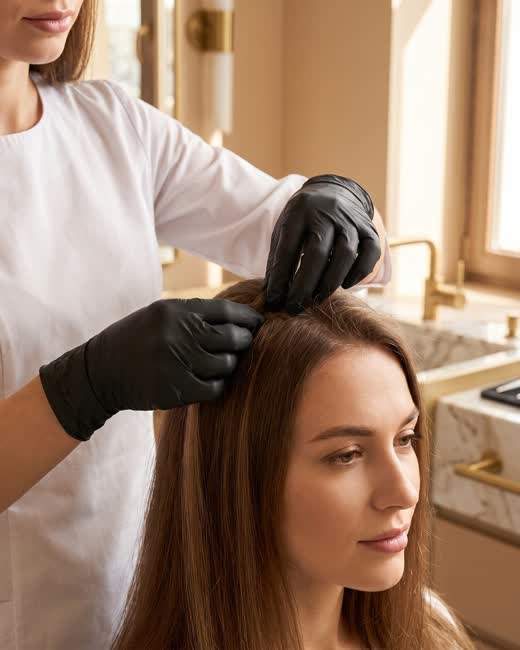
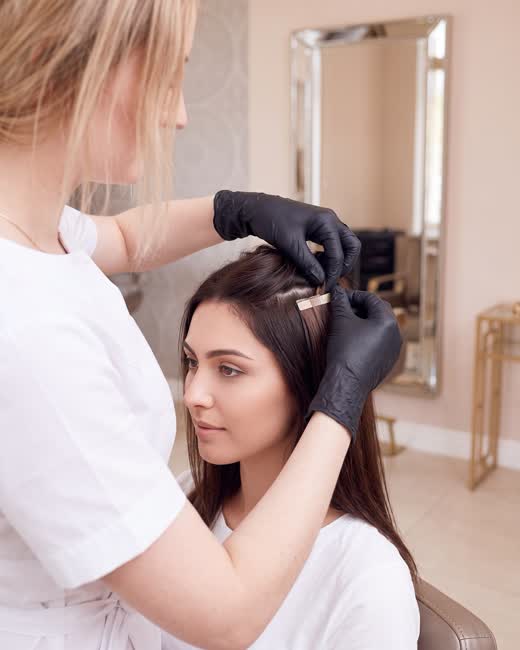
A treatment room at J'adore
SCALP & HAIR
Your hair is falling out, thinning, weaker, growing poorly — and the mirror won't tell you why. Very often the answer doesn't lie on the scalp itself, but deeper: in deficiencies or excesses of elements that the body deposits in growing hair. Hair mineral analysis is a laboratory test that reads your individual "mineral map" from a collected strand — it shows, among other things, your iron, zinc and copper balance, elements closely linked to hair condition.
This is diagnostics, not therapy: the test itself won't stop hair loss, but it gives you a concrete starting point — dietary and supplementation recommendations, plus guidance on whether a scalp treatment is also worth considering. Below you'll find everything worth knowing before you decide on the test.
1 sample collection → report + discussion of recommendations
How it works
Hair grows slowly, and throughout that time it "records" in its structure what circulates in your body — including elements: the ones you need (like iron, zinc and copper) and the ones you'd rather have less of. By taking a small strand of hair close to the scalp, the laboratory reads its content and builds your individual mineral map.
Why hair specifically? Because it works like a "recorder with a longer memory" than a single blood sample. Blood shows your state here and now; hair averages out what's been happening in your body over recent weeks. For a problem that builds up over months — like chronic hair loss — that longer view can be very valuable.
An important distinction: this is a diagnostic test, not a treatment. We don't promise that collecting a sample alone will rebuild anything. Its value lies in turning "I don't know why my hair is falling out" into a concrete list: what to supplement, what to improve in your diet, what to investigate further.
SCALP & HAIR
The mechanism of this test follows directly from how hair is formed. In the hair follicle, cells divide, fill with keratin and die — and whatever is circulating in the blood at that moment becomes built into the forming shaft. Finished hair is a dead structure: once elements are deposited, they don't leave it or return to the bloodstream. That's why a strand cut close to the scalp is a record of recent weeks and months of growth — the further from the scalp, the older that part of the story.
In the laboratory, the sample is washed, mineralised and measured using spectrometric methods — this produces the mineral map in your report. And here we need to be honest: the test shows the content of elements deposited in the hair cortex, an averaged, indirect picture from recent months. It doesn't tell you how much iron is in your blood today, and it doesn't replace blood tests or medical assessment — it's a complementary picture, an additional perspective alongside trichoscopy and consultation. It has the most value when read together with these other elements, not in isolation.
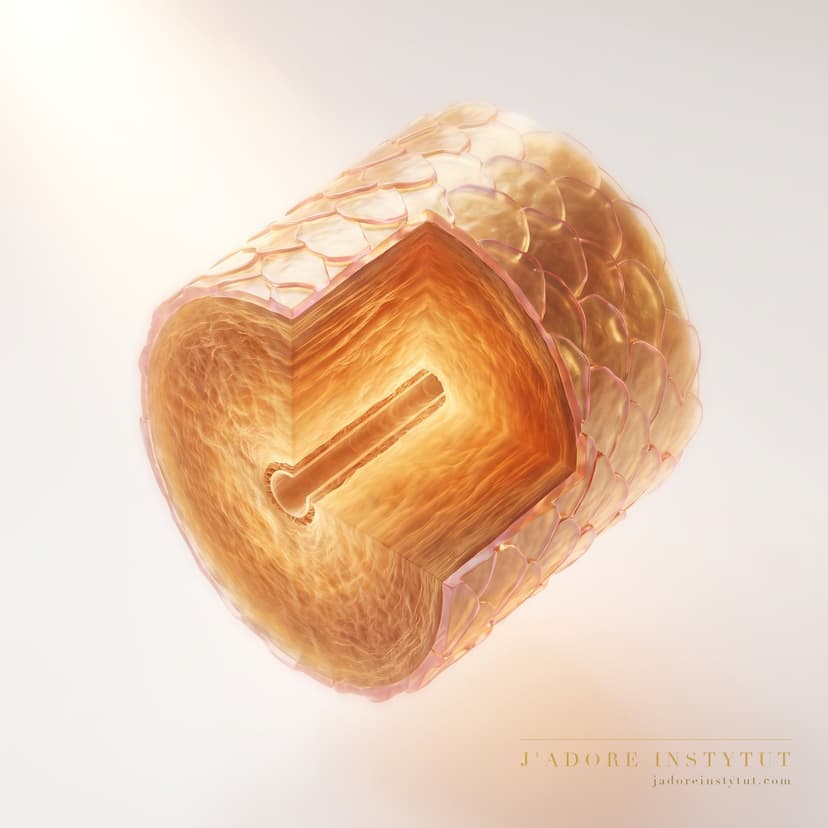
Did you know? A hair shaft has three layers — the outer cuticle made of overlapping scales, the cortex beneath it, which makes up most of its mass, and the medulla at the very centre. Most elements are deposited in the cortex — which is why analysis requires a hair strand, not a scalp swab.
Ideal for
Analysis for women and men
Hair mineral analysis in women most often revolves around iron metabolism. Monthly blood loss, pregnancy and the postpartum period, plant-based diets — all of these genuinely deplete iron stores, and low ferritin levels are one of the most common "silent" causes of hair loss and thinning in women.
What we work with
Hair mineral analysis in men more often draws attention to zinc — an element heavily "drawn upon" during intense training, stress and an irregular diet. Zinc supports the hair follicle and the condition of the scalp, and its deficiency is often underestimated.
What we work with
Did you know? Hair grows so slowly that the section close to the scalp "remembers" your body's recent weeks — that's why analysis is done on a strand taken right at the root, not from the ends. The ends are already an "archive" from many months ago.
What the analysis WON'T do
For the test to be worthwhile, you need to know its limits. Mineral analysis is a compass, not a cure — it points in a direction, but you cover the distance through diet, supplementation and sometimes treatment.
If hair falls out suddenly, in handfuls, distinct patches/bald spots of alopecia appear, accompanied by itching, pain, inflammation or changes on the scalp — do not stop at elemental analysis. This is a signal to first consult a dermatologist or trichologist. Hair testing can be part of the diagnostic process, but on its own it is not enough in such a situation.
Contraindications
Taking a hair strand is safe and has practically no contraindications. "Contraindications" here refer more to situations where analysis shouldn't be the only step — in those cases, we first refer you to the appropriate diagnostics.
This isn't a complete list — we'll go through your history, medication, diet and previous tests individually during your consultation, to determine the right order of steps.
How the test works
In terms of comfort, this is one of the easiest tests you can do: non-invasive, no needles, no pain. The whole "action" at the salon is a short visit — most of the process happens afterwards, in the laboratory and during the results discussion.

Sample collection
a short salon visit: the trichologist takes a small strand of hair close to the scalp — painlessly, with no needles

Laboratory analysis
the sample goes to the laboratory, which measures element content and prepares the result

Report — mineral map
you receive an individual report on your iron, zinc and copper balance, along with any excesses

Discussion and plan
the trichologist explains the result in plain language and puts together concrete recommendations: diet, supplementation, next steps
From the trichologist's chair
Most of the value isn't in the result itself, but in its discussion. A raw table of elements without context can be alarming or misleading. That's why we don't just hand you "a sheet of numbers and good luck" — we sit down, explain what it really means for your hair, and what to do about it.
Portfolio
A record of the work in our salons — the place where we publish treatment frames and, after photo sessions, results.
A record of results — in preparation. We publish photographs of our clients only with their consent.
I have my result
The report is the start of a plan, not its end. Depending on what the mineral map shows, the path forward varies — from simple dietary changes to adding a scalp treatment or a medical consultation.
The first and cheapest step. Based on your result, we strengthen your diet in what's missing (like iron and zinc sources) and address habits that "drain" elements — this benefits your hair and your whole body.
We choose supplements to match your specific deficiencies, not "because it's for hair". Less is more: without a result, it's easy to end up with an excess of one element that blocks absorption of another.
The mineral map is worth pairing with a picture of the scalp and follicles. Only analysis "from within" plus trichoscopy "from the outside" gives a full diagnosis.
If the picture justifies it, we add a scalp-stimulating treatment (such as mesotherapy) to the internal work. This is the trichologist's decision after analysis and trichoscopy.
If the results suggest a systemic problem (thyroid, hormones, anaemia), we do not stop at a supplement — we refer you to a doctor. This is not a failure of the test, but proof that it has done its job.
Hair grows slowly, so you won't see improvement in a week. After a few months of following the recommendations, it's worth returning to assess the change and, if needed, repeat the test.
Hair mineral analysis
Hair diagnostics isn't "one test instead of all the others". The three most common approaches show different things and complement each other best — a good trichologist reads them together:
a mineral map with a longer memory
doesn't show the "here and now" state like blood, doesn't assess follicles on the scalp
the body's state here and now
this test is ordered and interpreted by a doctor; it shows a moment, not a longer trend
a picture of the scalp and follicles
won't tell you anything about elements "inside" — this is an external assessment
Combine with
Mineral analysis works best as part of a plan, not a one-off shot. First, a full diagnosis; then internal work (diet, supplementation); and if needed, scalp treatment support. The order and intervals are decided by the trichologist during consultation, but the logic stays constant:
The most common question: "why would I need a hair test if I can just get a blood test?" Because these are two different time windows. Blood is a snapshot from one day; hair analysis is a longer recording. With a problem that's been building for months, both pictures together say more than either one alone.
Products included
Analysis isn't about "one magic element" — it's about the balance between them, because an excess of one can block the absorption of another. Below are the key parts of the picture, and what supports your body once we know the result.
Key for a follicle in its growth phase. Low levels are one of the most common "silent" causes of hair loss, especially in women.
Dla kogoWomen, plant-based diets, the period after pregnancy and breastfeeding, telogen hair "shedding".
Supports the hair follicle and scalp condition. Deficiency is easy to develop under stress, intensive training and an irregular diet.
Dla kogoMen, athletes, people under prolonged stress, cases of seborrhoea and weakened hair.
Works together with, among others, iron, and influences pigment and hair structure. What matters is the ratio, not just a single value.
Dla kogoA fuller picture when individual results "don't add up" into a coherent whole.
Chosen to match your specific deficiencies — not "a hair set from an advert". Diet first, then a supplement where it's genuinely needed.
Dla kogoAny result showing a real deficiency; the goal: correct the shortfall without creating an excess.
Fact: Why not supplement "just in case"? Because elements work as a system — an excess of one can hinder absorption of another, and "more is better" can actually be harmful. Supplementation only makes sense once a result shows what's truly missing.
Price list
Checking free hours…
From the magazine
Editorial pieces on how this treatment works in practice — what happens during the session, how to prepare, where the limits are and what the first days after look like.
See also
The result laststhe result is a "snapshot" of your body from recent weeks; recommendations work for as long as you follow themJ’adore Instytut
Information. Hair mineral analysis is a trichology and cosmetology test supporting the assessment of scalp and hair condition; it is not a treatment for hair loss or a medical procedure and does not replace dermatological or endocrinological diagnostics, nor blood tests. In cases of severe or sudden hair loss, consult a dermatologist or trichologist. The text above is for informational purposes. Indications, contraindications and result interpretation are determined by a trichologist or experienced cosmetologist during a consultation with trichoscopy.
Home care
Cosmetics matched to what your skin needs after a treatment — so the clinic effect lasts longer.
 hair lossDSD de LuxeVasogrotene GF Activator 011 50mlView in the shop(opens in a new tab)
 scalpSesdermaSEBOVALIS Medicinal Shampoo 200 mlView in the shop(opens in a new tab)
 hair lossDermoMedicaGrowth Hair Serum 60mlView in the shop(opens in a new tab)
 scalpestGenBalancing ShampooView in the shop(opens in a new tab)
 hair lossDSD de LuxeCrexepil Lotion Forte 3.4.1 100mlView in the shop(opens in a new tab)
 scalpKV-13.2 Oily Dandruff Lotion 100ml – Anti-Dandruff BalmView in the shop(opens in a new tab)
 hair lossDermoMedicaGrowth Factor Scalp Mask 200mlView in the shop(opens in a new tab)
 hair lossMesoesteticTricology ShampooView in the shop(opens in a new tab)