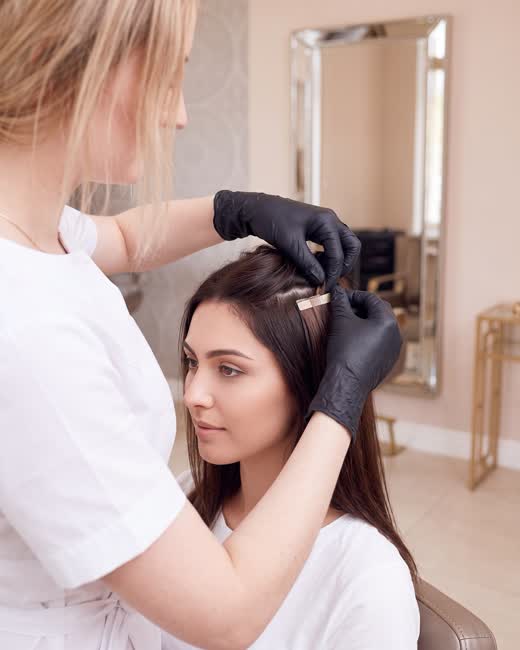
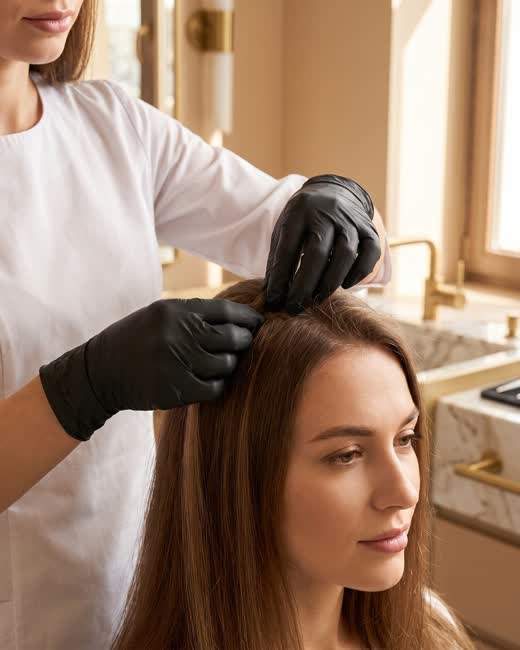
A treatment room at J'adore
SCALP & HAIR
Your hair gets thinner, weaker, lies flat and sheds more than it used to — and yet another conditioner rinsed off in the shower changes little. That's because most home care works on the fibre of the hair, while the problem usually starts deeper: in the scalp and follicles, which are hard to reach through an intact skin barrier.
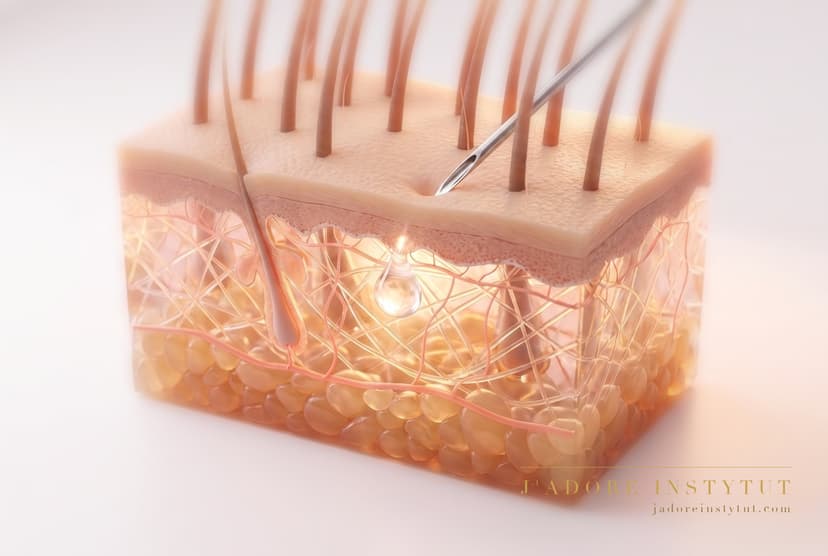
Intensive hair regeneration with microneedling is a trichology-cosmetology treatment in which controlled scalp micro-punctures (Dermapen or fractional microneedling RF) create a network of micro-channels — and only through these do regenerative, strengthening ampoules reach the layer where they actually work. The micro-injuries themselves aren't random either: they stimulate scalp renewal and improve blood flow, essentially "feeding" the follicle from within. An important distinction from the start: this is not Olaplex-style regeneration. Olaplex and similar treatments repair damaged hair fibre from the outside, without disturbing the skin — here we work with a needle at scalp level. At J'adore Instytut, the treatment is performed by a trichologist or experienced cosmetologist, ideally after a consultation with trichoscopy. Below you'll find everything worth knowing before your first visit.
usually a series of sessions every few weeks, after prior diagnosis
How it works
Your scalp has its own protective barrier — and that's a good thing, since it protects you every day. The problem is that this same barrier blocks most ingredients in ampoules and conditioners from reaching deeper layers. Microneedling solves this mechanically: fine needles create a network of microscopic channels in the scalp, through which regenerative, strengthening ingredients reach much deeper than anything applied "on top."
The second mechanism matters just as much. These controlled micro-injuries signal to the skin "repair me" — they trigger natural renewal processes and improve blood flow. A better-supplied follicle is a better-nourished, better-oxygenated follicle — one with a greater chance of retaining and strengthening hair. Hence the treatment has two goals at once: scalp regeneration and support for growth of weakened, thinning hair.
This is not Olaplex or "Botox for hair." Those treatments repair damaged hair fibre from the outside and don't disturb the skin. Here we work with a needle at scalp and follicle level — a different treatment with a different goal. If you're looking to repair damaged, over-dried length after colouring, the right choice is OLAPLEX regeneration, not this treatment.
Ideal for
This treatment supports — it works best after diagnosis and as a series, and it does not reverse advanced hair loss with a single session. If your hair is falling out suddenly or in clumps, we first look for the cause: a sensible first step is a trichology consultation with trichoscopy.
Women's and men's needs
In women, thinning most often shows along the parting and at the crown, while the hairline stays intact. Common underlying causes include hair loss after childbirth, stress, diet, or hormonal factors — which is why scalp microneedling for women makes sense mainly as part of a plan, not instead of diagnostics. The goal is a denser look and improved scalp condition.
What we work with
In men, thinning usually starts at the temples and crown and more often has an androgenic basis (AGA). Scalp microneedling for men can be a real support at the early to moderate stage — while follicles are still alive. The later it's addressed, the more the treatment becomes part of a broader plan rather than a stand-alone solution. This is where an honest trichoscopy assessment matters most.
What we work with
Fun fact: the same logic of "controlled micro-injury = a signal for renewal," which smooths scars and pores on the face (microneedling mesotherapy), serves a different purpose on the scalp — waking follicles and delivering ingredients more effectively. Similar tool, entirely different goal.
Safety
With a needle-based scalp treatment, a few things determine both effectiveness and safety — and they're worth asking about at any salon:
Without trichoscopy, we work blind. A trichologist assesses whether follicles are alive, what type of shedding you have, and whether you need a dermatological or endocrinological consultation first. A treatment without diagnosis often wastes both time and money.
At J'adore, the treatment is carried out by a trichologist or experienced cosmetologist, using sterile, single-use needles. They choose the technique (Dermapen or fractional microneedling RF) and the ampoules suited to your scalp.
The skin is punctured, so single-use needle cartridges and a sterile field are an absolute standard. You have every right to ask about this — a good salon will answer without hesitation.
A red flag: a "hair treatment" without diagnosis · If someone offers a series of scalp microneedling sessions without trichoscopy and without asking about the cause of hair loss, that's a warning sign. Sudden or intense hair loss can be a symptom (thyroid issues, deficiencies, anaemia, medication) rather than a purely cosmetic problem. In that case, we look for the cause with a dermatologist or trichologist first — the treatment is only a later step. A needle can't replace a diagnosis.
Contraindications
Some contraindications are permanent, others temporary — in the latter case, we simply postpone the treatment until the situation passes. Because the scalp is punctured, we take a cautious approach.
From the trichologist's chair
The most commonly forgotten issue is herpes — "it's only on my lips, and the treatment is on my scalp" doesn't remove the need for caution; an active virus is a risk. And second: sudden hair loss in clumps isn't a situation for jumping straight into a series of treatments — it's a signal to look for the cause with a dermatologist or trichologist first.
This isn't a complete list — we'll go through your medications, scalp conditions and previous treatments individually during your consultation with trichoscopy.

What to expect
The whole visit takes around an hour — no bandages, no stepping away from your day. Your scalp may be slightly red and sensitive afterwards, but it usually settles quickly.
I most often say one thing: this isn't a sprint, it's a plan. A single session improves scalp condition, but real strengthening and growth support come from a series combined with care between visits. Hair grows slowly — we assess results after weeks, not days.
Portfolio
A record of the work in our salons — the place where we publish treatment frames and, after photo sessions, results.
A record of results — in preparation. We publish photographs of our clients only with their consent.
What to expect
Most important: this is a treatment that builds results over time. Right after your visit, the scalp feels "stimulated," but real change in hair quality and density comes with the series and the following growth cycles.
Honestly: the treatment supports and can noticeably improve hair and scalp condition, but it doesn't reverse advanced hair loss and doesn't replace treatment when shedding has a medical cause. It works best where follicles are still alive, and we give them better conditions.
Microneedling and your daily routine
Your scalp has been punctured, so for the first few days, we protect it so the micro-channels can close calmly and the ingredients can do their work. The rule is simple: less irritation, less heat, more gentleness.
On the first day, we skip washing to avoid irritating the fresh micro-channels. After that, use a gentle, mild shampoo without harsh detergents — following your trichologist's guidance.
We put off intense exercise and heavy scalp sweating for 1–2 days — sweat and friction can irritate freshly punctured skin.
High temperatures, chlorine, and shared water carry a risk of irritation and infection until the skin closes up. Save the sauna, hammam and pool for a few days later.
Freshly punctured, exposed skin (the parting, thinning areas) is sensitive to the sun. Cover it for a few days and use SPF protection.
We put off hairspray, styling paste, dry shampoo and harsh styling products for the first few days — we don't rub them into freshly punctured skin.
We don't combine colouring or strong chemical treatments with microneedling back-to-back — your trichologist sets the interval to avoid irritating the scalp.
Intensive hair regeneration with microneedling
With hair, it's easy to confuse three quite different things. The first two work on the scalp and follicle, the third only on the fibre — and this is exactly the distinction that gets lost most often:
wakes the follicle + opens a path for ingredients
doesn't repair damaged hair length and doesn't reverse advanced hair loss
nourishes the follicle with a blend
this is a different delivery method to a micro-channel network — your trichologist decides which to use
repairs hair from the outside
doesn't work on the scalp, follicles or hair loss — a different problem altogether
Combine with
Scalp microneedling rarely works alone — it fits best into a trichology plan. Your trichologist decides the order and intervals during consultation, but the general logic stays the same: diagnosis and calming the scalp first, then stimulation, then maintenance.
The technique of microneedling itself is two familiar tools applied in a new way: Dermapen (microneedling mesotherapy, known from facial treatments) and fractional microneedling RF (microneedles with radiofrequency, known from body treatments) — here directed at the scalp. Hair regeneration is often paired with needle mesotherapy for the scalp and PRP for the scalp.
What I hear most often: "I want regeneration because my hair is falling out." Those are two different matters. Hair loss and thinning → work on the scalp (microneedling, mesotherapy, diagnosing the cause). Damaged, dry length after colouring → fibre repair (Olaplex). We start with trichoscopy — it tells us which path to take.
Variants and technologies
"Scalp microneedling" isn't one single treatment, but several related paths to the same goal. You don't choose them "off the shelf" — your trichologist selects them based on scalp condition, type of hair loss, and your history.
A pen with vibrating needles creates a dense network of micro-channels, through which we deliver ampoules — the classic form of microneedling.
Dla kogoGrowth support and better absorption of ingredients into the scalp.
Combines puncturing with radiofrequency thermal energy, adding an extra stimulus for scalp renewal.
Dla kogoFor when we want a stronger regenerative signal for the scalp.
Nourishing and strengthening ingredients chosen for the problem — these are what travel deep through the fresh channels.
Dla kogoWhichever variant of the treatment — these are what carry the regenerative and supportive effect.
Fact: What this is NOT: it's not fibre repair like Olaplex, nor "Botox for hair" — those work on the hair from the outside, without a needle. Here, the whole value comes from combining scalp microneedling with ingredients delivered deep beneath the surface. Choosing the variant and ampoules is your trichologist's decision, not a matter of the label.
Price list
Scalp microneedling — Dermapen
with regenerative, strengthening ampoules
Choose the area and the salon — book online straight away.
Warsaw, Żelazna 59
Prefer to call? Żelazna 573 569 431 · Mińska 732 228 806 · Karmelicka 732 228 846
From the magazine
Editorial pieces on how this treatment works in practice — what happens during the session, how to prepare, where the limits are and what the first days after look like.
See also
The result lastsresults build up over a series and need maintenanceJ’adore Instytut
Notice. Intensive hair regeneration with microneedling is a trichology-cosmetology treatment that supports scalp and hair condition; it is not a treatment for hair loss, nor is it a medical procedure, and it does not replace dermatological or endocrinological diagnostics. For intense or sudden hair loss, consult a dermatologist or trichologist. This text is provided for informational purposes. Indications and contraindications are assessed by a trichologist or experienced cosmetologist during a consultation with trichoscopy.
Home care
Cosmetics matched to what your skin needs after a treatment — so the clinic effect lasts longer.
 hair lossDSD de LuxeVasogrotene GF Activator 011 50mlView in the shop(opens in a new tab)
 scalpSesdermaSEBOVALIS Medicinal Shampoo 200 mlView in the shop(opens in a new tab)
 hair lossDermoMedicaGrowth Hair Serum 60mlView in the shop(opens in a new tab)
 scalpestGenBalancing ShampooView in the shop(opens in a new tab)
 hair lossDSD de LuxeCrexepil Lotion Forte 3.4.1 100mlView in the shop(opens in a new tab)
 scalpKV-13.2 Oily Dandruff Lotion 100ml – Anti-Dandruff BalmView in the shop(opens in a new tab)
 hair lossDermoMedicaGrowth Factor Scalp Mask 200mlView in the shop(opens in a new tab)
 hair lossMesoesteticTricology ShampooView in the shop(opens in a new tab)