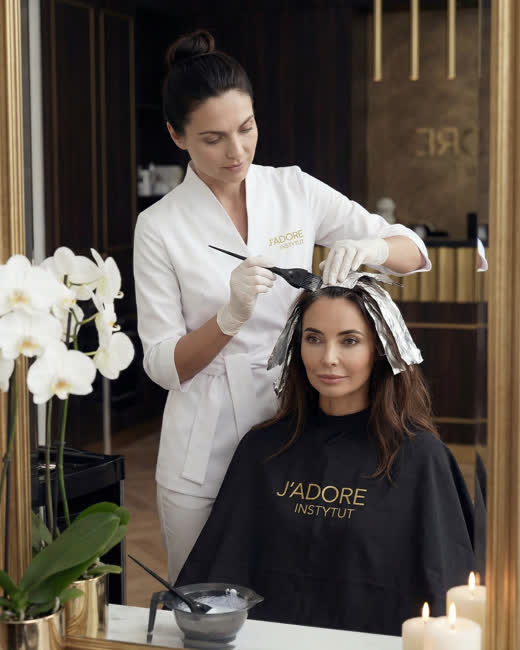
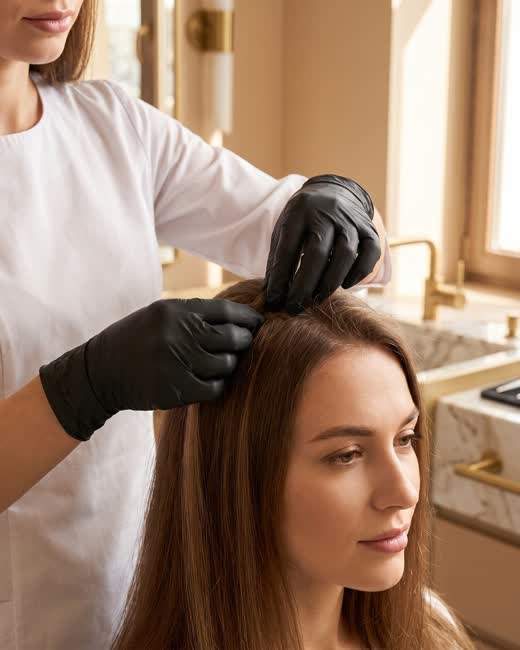
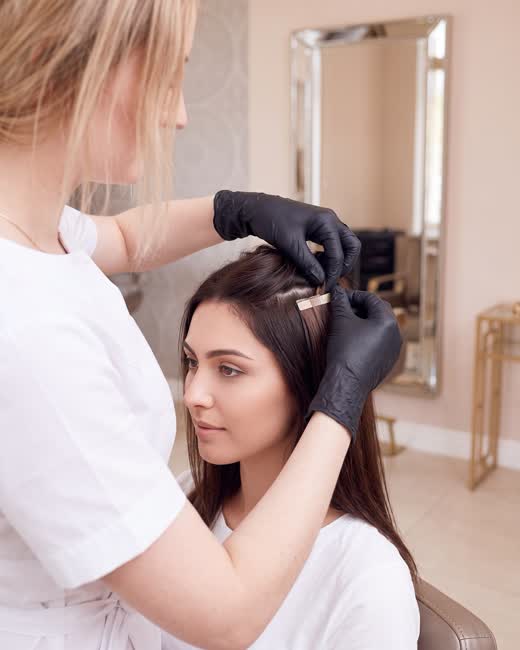
A treatment room at J'adore
SCALP & HAIR
Hair left on the brush and in the drain. A parting that keeps getting wider.
A scalp that feels tight, itchy or irritated after stronger treatments. LED scalp therapy isn't a "miracle cure for hair loss" — and we don't pretend it is. It's gentle light that stimulates the scalp to work at follicle level: it improves microcirculation, supports follicle metabolism, calms inflammation and speeds up recovery after more intensive trichology treatments. It's the same photobiomodulation technology you know from LED facial therapy — here directed at the scalp and hair condition. At J'adore Instytut this is a trichology and cosmetology treatment. It's pain-free, doesn't break the skin and requires no recovery at all. Below you'll find an honest account of what LED delivers, what it's not worth expecting from it — and why it works best as part of a larger plan.
best as a series, done regularly — often used to reinforce mesotherapy or carboxytherapy
How it works
LED scalp therapy is photobiomodulation — exposing the scalp to light emitted by LED diodes, in the red and infrared range. Scalp cells absorb this light and respond to it: they stimulate mitochondria to produce energy, trigger repair processes and improve local blood flow. Better-perfused, better-oxygenated skin means a better environment for the hair follicle — and follicle condition determines hair condition.
This isn't a "trendy internet gadget". Red and infrared light have been studied for decades — first for tissue healing, then for skin and hair condition. The key thing to remember: LED doesn't puncture the skin, delivers no substances and doesn't exfoliate — it works gently, "from inside the cell". That's why it's one of the safest treatments in a trichology salon. It's also why its effect builds up gradually, session by session, rather than overnight.
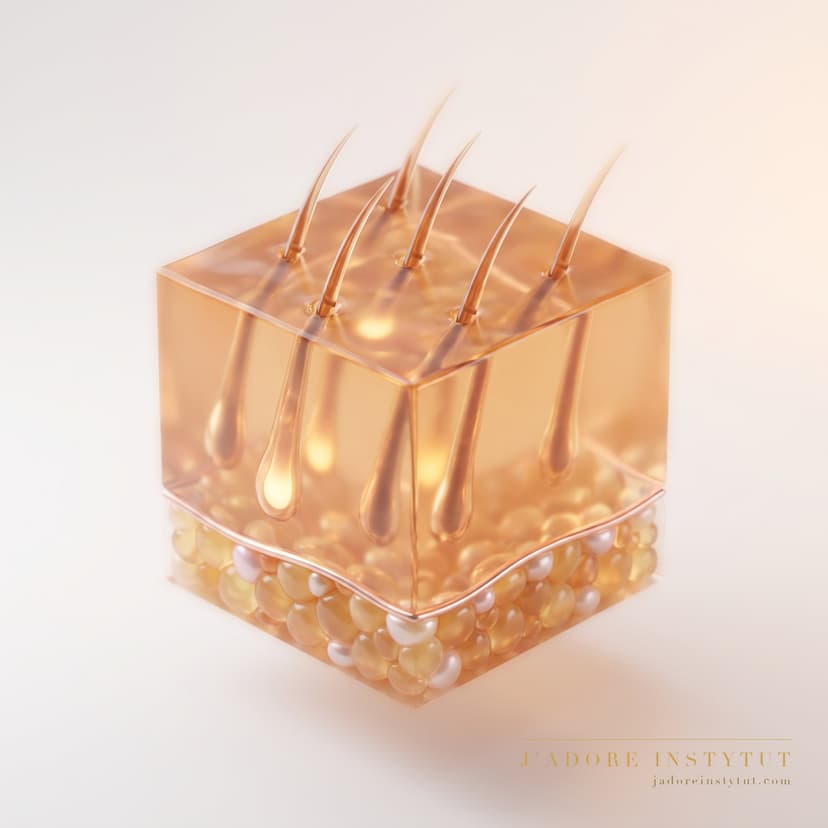
Good to know: the same red and infrared light that helps facial skin produce collagen works on the scalp by boosting microcirculation and nourishing the follicles. The mechanism is the same — a cell "fed" light at the right wavelength simply works more efficiently. That's why LED for the face and LED for the scalp are close cousins of the same technology.
SCALP & HAIR
The most common misunderstanding: "LED will stop hair loss." That's not how it works — and we say so honestly. LED supports the condition of the scalp and follicles, creating better conditions for hair, but it won't reverse advanced hair loss or replace a diagnosis of the cause. What it does deliver, realistically, is several specific things:
That's why we usually treat LED as a booster and finishing touch to a larger trichology plan — less often as a stand-alone treatment. A trichologist decides, after diagnosis, whether and how to build it into your series.
Ideal for
What LED won't do: it won't reverse advanced hair loss, won't replace treatment of the underlying cause (hormonal, nutritional) and won't deliver regrowth "on demand". It's condition support — strongest when combined with diagnosis and a series.
Women's and men's needs
In women, hair loss is most often linked to diffuse thinning — a wider parting and reduced density, often after childbirth, during menopause, or after severe stress or illness (telogen effluvium). This is a sensitive subject, so we approach it calmly and without judgement. LED scalp therapy for women most often comes in as a gentle booster within a series — it supports microcirculation and skin condition, combines well with mesotherapy, and calms the scalp after stronger treatments.
What we work with
In men, the most common issue is male pattern baldness — a receding hairline and thinning at the crown, progressing over time and genetically determined. Honesty matters especially here: LED won't reverse genetic hair loss, but as LED scalp therapy for men it can genuinely support follicle condition where hair is still active — best alongside mesotherapy or carboxytherapy. It's a discreet treatment with no marks, ideal for a lunch break.
What we work with
Diagnosis first
Hair loss is a symptom, not a diagnosis — and the same symptom can have entirely different causes: hormonal, nutritional (iron, ferritin, vitamin D), telogen loss after stress or illness, or genetic male/female pattern baldness. Each of these causes needs a different approach, and some can't be solved by a salon treatment alone.
That's why, with us, LED is never a "starting treatment". First comes a consultation with trichoscopy — a trichologist examines the scalp and follicles under magnification, takes a history and assesses what's really happening. Only with that information do we build a plan, in which LED may act as a booster.
If hair starts falling out suddenly, in handfuls, or in patches, or is accompanied by other symptoms (fatigue, hormonal changes, thyroid issues) — this is a sign that dermatological or endocrinological diagnostics are needed first, not a cosmetic treatment. LED or any other salon treatment won't replace treating the cause. An honest trichologist will refer you to a doctor in this situation — and that's what we do.
SCALP & HAIR · Scalp LED therapy
Contraindications
LED for the scalp has few contraindications, and some of them are temporary — in those cases we simply postpone the treatment until the situation resolves. A trichologist makes the final assessment at consultation.
From the trichologist's chair
The thing people most often overlook: the cause of the hair loss. Clients often want to "get straight under the lamp", but sudden, severe hair loss is a signal to look into the cause first — including with a doctor. LED is support, not diagnosis. It's better to start with trichoscopy and, if needed, tests, rather than start with a treatment "blind".
This isn't a complete list — we'll go through your medication, health conditions, scalp condition and treatment history individually at your consultation. Pregnancy and breastfeeding: LED therapy emits no UV and doesn't break the skin, and is widely considered safe — even so, tell your specialist, and we'll adjust our approach.

What to expect
The key point: LED works cumulatively and supportively. A single session brings comfort, a calmer scalp and better wellbeing — but this isn't "regrowth after one go". Real support for hair and scalp condition builds up over a regular series, and works strongest when LED accompanies mesotherapy or carboxytherapy. And once again, honestly: LED does not reverse advanced hair loss.
Sometimes, after the first session, I hear: "and nothing's grown". That's entirely natural — light doesn't "grow" hair in a day, it gradually improves the conditions the follicle works in. Hair grows slowly, on its own cycle, so trichology results are assessed over months, not days. That's why we set realistic expectations and a plan for a series from the start, not for a single visit.
Second important point: LED doesn't damage the scalp, so there's no "rebound" after stopping. We simply maintain the condition we've built up with regular sessions and the right home care — as part of the overall plan.
Portfolio
A record of the work in our salons — the place where we publish treatment frames and, after photo sessions, results.
A record of results — in preparation. We publish photographs of our clients only with their consent.
LED therapy and your lifestyle
This treatment comes with minimal restrictions — LED doesn't break the skin and doesn't make the scalp sun-sensitive. Even so, a few simple rules help you get the most out of a series, especially when LED accompanies other trichology treatments.
After the session there are no marks or redness on the scalp — cap, helmet, meetings or a return to work, no break needed. Come to the session with a clean scalp and no heavy styling product — cosmetics limit how well light penetrates.
LED doesn't make the scalp sun-sensitive (unlike peels or lasers). Even so, it's worth protecting the scalp and hair from strong sun and high heat — that's standard hair-care practice.
You can train before and after the treatment — LED requires no recovery and doesn't react to increased circulation. If LED was combined with mesotherapy, follow the recommendations for that treatment.
After LED alone, sauna and pool are fine straight away. Exception: when LED was a finishing touch after mesotherapy or carboxytherapy — then the recommendations for that treatment apply (usually a short break).
You wash your scalp as usual, with a suitable shampoo. After LED alone, styling is unrestricted; after combining it with a needle-based treatment, wait as advised by your trichologist.
If you're taking photosensitising medication or using prescription products on your scalp, flag this before the session — we'll adjust the protocol or reschedule until after a consultation.
Scalp LED therapy
Trichology treatments are sometimes confused, or treated as interchangeable. They're different tools with different strengths — and they usually complement, not replace, one another. In short: LED creates a better environment, while stronger treatments deliver "fuel" or stimulate the scalp more intensely.
gently stimulates and soothes with light
delivers no nutrients, doesn't puncture the skin, doesn't reverse advanced hair loss on its own
delivers ingredients deep into the skin
involves needling — LED won't replace it, but reinforces and soothes after it
strongly boosts microcirculation
a stronger stimulus than LED — gentle light complements it, not the other way round
Combine with
LED is the most versatile "complement" in a trichology salon — it reinforces the effects of stronger treatments and speeds up scalp recovery. The order and intervals are decided by a trichologist at consultation, but the underlying logic is consistent: LED usually comes in at the end, to calm the scalp and support what the earlier treatments have done.
The simplest way to put it: if the scalp needs deep nourishment, that's mesotherapy. If it needs a strong boost to circulation, that's carboxytherapy. And LED is gentle support and calming — invaluable as part of a series and as a finishing touch after a stronger treatment, because it improves comfort and shortens recovery. That's why I rarely recommend LED alone — it works best as part of a team.
Variants and technology
Behind the term "LED for the scalp" lies phototherapy using red and infrared light — in the salon we work with professional equipment, suited to the scalp and follicle. You don't pick a variant "off the shelf" — a trichologist or experienced cosmetologist selects it based on your issue, scalp condition and treatment history.
Stimulates scalp cells to work and improves microcirculation — a better-perfused, oxygenated follicle means a better environment for hair.
Dla kogoSupport for hair loss and thinning, improved scalp condition.
Reaches deeper, supports tissue regeneration and calms scalp inflammation.
Dla kogoRecovery after stronger treatments, an irritated and reactive scalp.
Delivers the right dose of light in a controlled way — unlike low-power home devices.
Dla kogoReal support for scalp condition as part of a series, under a specialist's supervision.
Reinforces and rounds off other treatments — mesotherapy, carboxytherapy, microneedling — shortening recovery time.
Dla kogoA full trichology plan, not a single visit.
Fact: Why the differences? Red and infrared light reach different depths and trigger slightly different processes in the cell — which is why the choice and structure of a series depend on the issue, not on "stronger light". We most often run LED as a regular part of a plan, rather than as a stand-alone treatment.
Price list
Checking free hours…
From the magazine
Editorial pieces on how this treatment works in practice — what happens during the session, how to prepare, where the limits are and what the first days after look like.
See also
The result lastscumulative effect — builds up over a series and, with maintenance, lasts for weeksJ’adore Instytut
Note. LED scalp therapy is a trichology and cosmetology treatment that supports scalp and hair condition; it is not a treatment for hair loss and not a medical treatment, and it does not replace dermatological or endocrinological diagnostics. If you experience severe or sudden hair loss, consult a dermatologist or trichologist. This text is for information purposes only. Indications and contraindications are determined by a trichologist or experienced cosmetologist during a consultation with trichoscopy.
Home care
Cosmetics matched to what your skin needs after a treatment — so the clinic effect lasts longer.
 hair lossDSD de LuxeVasogrotene GF Activator 011 50mlView in the shop(opens in a new tab)
 scalpSesdermaSEBOVALIS Medicinal Shampoo 200 mlView in the shop(opens in a new tab)
 hair lossDermoMedicaGrowth Hair Serum 60mlView in the shop(opens in a new tab)
 scalpestGenBalancing ShampooView in the shop(opens in a new tab)
 hair lossDSD de LuxeCrexepil Lotion Forte 3.4.1 100mlView in the shop(opens in a new tab)
 scalpKV-13.2 Oily Dandruff Lotion 100ml – Anti-Dandruff BalmView in the shop(opens in a new tab)
 hair lossDermoMedicaGrowth Factor Scalp Mask 200mlView in the shop(opens in a new tab)
 hair lossMesoesteticTricology ShampooView in the shop(opens in a new tab)