WarszawaŻelazna 59WarszawaMińska 29AKrakówKarmelicka 45Warszawa · Kraków

Careers

ENPL

Warsaw · KrakowSkin Clinic & Med Spa

PLEN
Hyperhidrosis treatment — treatment at J'adore InstytutA treatment room at J'adore

AESTHETIC MEDICINE

Less sweat, locally
“for months”

Wet patches on your shirt that you can't hide. Sweaty palms that make you avoid shaking hands.

Shoes where your feet keep slipping. Excessive sweating (hyperhidrosis) isn't about hygiene or "weakness" — it's overactive sweat glands, and it can genuinely limit your work, your relationships and how you choose your clothes. Botulinum toxin injected shallowly into the skin temporarily blocks the nerve signal that stimulates sweat glands in the treated area — sweating there is markedly reduced for months. It works only where it's injected; it doesn't change how your body cools itself overall. At J'adore Instytut, the treatment is performed by an aesthetic medicine doctor. Below you'll find everything worth knowing before your first visit — including the most common worry: "will sweating just move somewhere else?"

  • Wet patches on clothing
  • Sweaty hands
  • Excessive foot sweating
  • Situational sweating
  • Professional and social comfort

A single treatment, repeated periodically

Book an appointment
Duration
Around fifteen minutes (after the patch test)
Result
Usually 6–9 months (longer than Botox for wrinkles)
Recovery
None
Sessions
A single treatment, repeated periodically
Performed by
Aesthetic medicine doctor

How it works

How it works

Beneath the skin are sweat glands that release sweat in response to a nerve signal (a chemical messenger called acetylcholine). In hyperhidrosis, this mechanism is overactive. Botulinum toxin injected shallowly into the skin temporarily blocks this signal in the treated area — the gland stops receiving the instruction to "secrete", and sweating there is markedly reduced.

The mechanism is targeted and local — the toxin only works where it's injected, and it doesn't affect how the body regulates temperature overall. This method has been used in medicine for decades, with a well-understood and predictable profile. It's a medical treatment, not a cosmetic one — and we approach it that way.

Three layers of skin in cross-section: the epidermis at the surface, the dermis with its sweat glands beneath it, and deepest of all the subcutaneous tissue. A grid of very shallow injections spreads the formula through the dermis, at the level of the sweat glands. The doctor sets the spacing of the points and the dose during the consultation.
  1. Epidermisthe layer the fine needle passes through
  2. Dermis with glandsthe level botulinum toxin works at
  3. Subcutaneous tissuedeeper than this delivery reaches

Ideal for

Ideal for

  1. Wet patches on clothingthey appear regardless of temperature or stress, and antiperspirants (even strong pharmacy ones with aluminium chloride) have stopped being enough.
  2. Sweaty handsthey make work, study, handling documents or shaking hands difficult.
  3. Excessive foot sweatingdiscomfort, odour and slipping inside shoes.
  4. Situational sweatingbefore a presentation, meeting, exam or important event.
  5. Professional and social comfortwhen sweating undermines confidence at work and in social contact.
  6. The most commonly treated areas are underarms, hands and feet. The doctor determines zones and doses after discussion and assessment of severity. If sweating is generalised or started suddenly, the doctor may first suggest ruling out a systemic cause.

The myth of "sweat moving elsewhere"

Why it isn't true

This is by far the most common concern patients bring to consultation: "if I stop sweating here, it'll just move somewhere else — and that must be harmful." It's a myth — and worth clearing up.

  1. The blockage applies only to the treated area(e.g. the underarms). The toxin doesn't circulate through the body and doesn't "redirect" sweat elsewhere.
  2. You have several million sweat glandsspread across your body — switching off sweating in one small area doesn't disrupt thermoregulation, because the rest of the body handles heat release without issue.
  3. Sometimes patients subjectively "notice" sweat more in another area — this is usually not because it's been redirected, but because the dominant problem (e.g. wet underarms) has stopped drawing attention. This is a harmless phenomenon and doesn't need treatment.

Interesting fact: the same toxin that smooths the forehead and eases bruxism also "quietens" sweat glands — because it does the same thing everywhere: it temporarily blocks the nerve signal to an overactive muscle or gland. Aesthetics and hyperhidrosis treatment are two different applications of the same principle.

Women's and men's needs

What differs

For her

Sweating that plans your day for you

For many women, hyperhidrosis treatment means above all getting back freedom and confidence — the ability to wear light, silk or fitted clothes without worrying about stains, and calm in situations where thoughts of sweating used to dominate.

The areas we support

  1. Underarms — no more stains on blouses and dresses;
  2. Hands — peace of mind during meetings, greetings and events (weddings, photoshoots);
  3. Situational sweating — before an important speech or exam;
  4. Everyday comfort — without hiding your hands or avoiding contact.
For him

The dryness expected of you — and something no one should have to think about

In men, sweating areas (especially the underarms) tend to be larger, so higher doses of toxin are usually needed. There's often a clear professional dimension — this is classic hyperhidrosis treatment for men. The mechanism and effectiveness are identical to women's treatment; mainly the dose size differs.

The areas we support

  1. Underarms — a dry shirt under a suit, no stains at meetings;
  2. Hands — a confident, dry handshake at greetings;
  3. Working under pressure — comfort during presentations and negotiations;
  4. Feet — no more discomfort in shoes after a full day.

Safety

What really determines the result

For hyperhidrosis treatment, the result and its safety depend on three things worth asking about at any salon:

  1. Who performs the treatment

    Botulinum toxin is a medicinal product — at J'adore it's administered only by an aesthetic medicine doctor, not a cosmetologist. The doctor assesses your suitability, chooses the product, determines the zones (often after an iodine-starch test) and sets a dose that's safe for that specific area.

  2. Whether the product is genuine

    We work only with original, certified products from authorised distributors, stored at the required temperature (cold chain). Toxin that's poorly stored or of unknown origin means an unpredictable result and real risk.

  3. What dose, and where

    In hyperhidrosis treatment, especially of the underarms, we treat a larger surface than for wrinkles — the doctor determines the dose and injection points individually, which is why consultation is essential.

A red flag: suspiciously cheap hyperhidrosis treatment · A bargain price is the most common warning sign — with a medicinal product, origin and storage matter as much as technique. You have the right to ask about the product name, expiry date and who's performing the treatment. With a method this effective, it's not worth cutting corners on product quality or the practitioner's experience.

Contraindications

When to postpone the treatment

Some contraindications are permanent, and some are temporary — in that case, we simply postpone the treatment until the situation passes.

We don't perform it
  • Pregnancy and breastfeeding
  • Active cold sores (Herpes)even in a different location from the injection site (e.g. on the lip or near the nose), not just in the treated area. The treatment can trigger it — we postpone until it's fully healed.
  • Neuromuscular conditionsmyasthenia gravis, myasthenic syndromes and related conditions; the toxin affects neuromuscular transmission.
  • Allergy or a previous reactionto botulinum toxin or to albumin (a protein present in the products).
  • Active infection or inflammationin the treatment area, unhealed wounds, or recent significant skin irritation.
  • Fever and general infectionwe wait until you've recovered.
  • Clotting disorders and anticoagulant medicationrequire the doctor's assessment.
  • Certain medications(including aminoglycoside antibiotics) that may enhance the toxin's effect — be sure to tell your doctor.

From the doctor's chair

The most commonly overlooked thing: cold sores. Patients think "I only have one on my lip, and we're treating the underarms — that shouldn't matter." It does matter — an active virus is a risk, wherever it appears. It's better to postpone by a few days.

This isn't a complete list — we'll go through your medications, conditions and previous treatments individually at consultation. The doctor makes the final decision on your suitability.

The visit

What to expect during your visit

  1. Hyperhidrosis treatment — treatment at J'adore Instytut — Medical consultation

    Medical consultation

    the doctor assesses the severity of your sweating and the zones involved, takes a medical history (conditions, medications, pregnancy, allergies, cold sores) and sets a plan, ruling out contraindications.

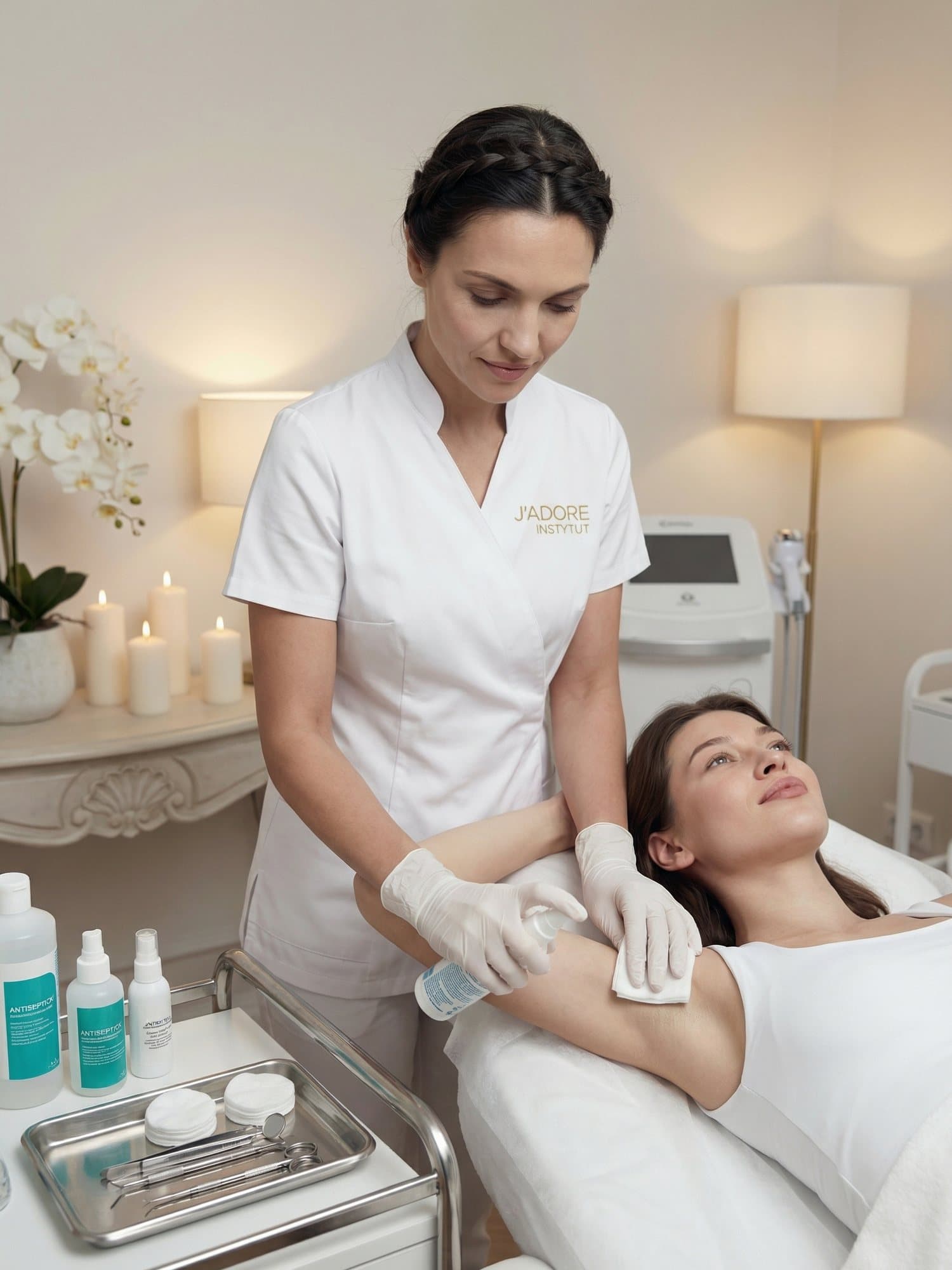
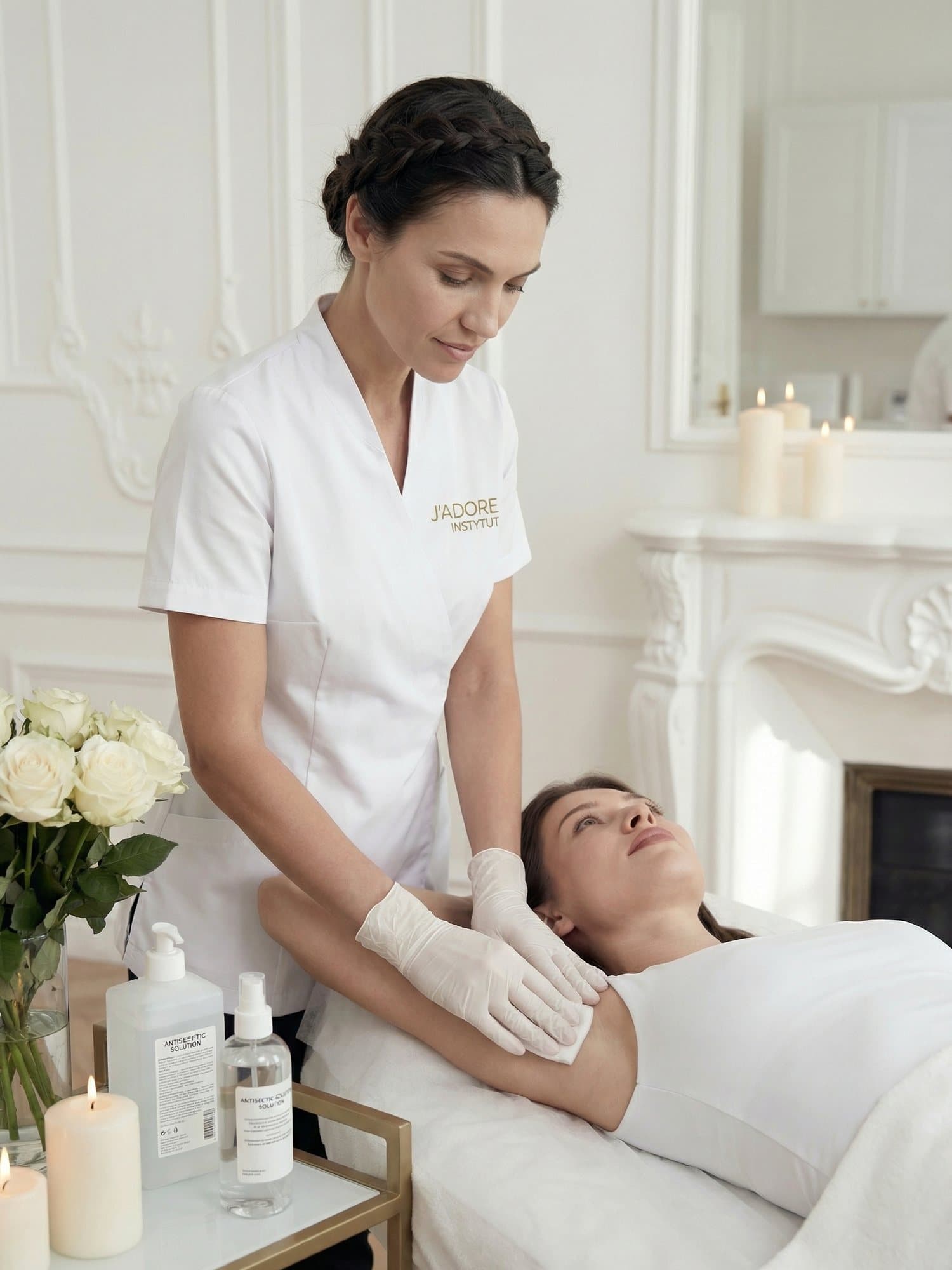
  2. Hyperhidrosis treatment — treatment at J'adore Instytut — Iodine-starch test (Minor's test) — for underarms

    Iodine-starch test (Minor's test) — for underarms

    the skin is covered with iodine solution, then starch once dry; a dark colour appears in the areas of most active sweating. This way the injection is targeted, not done by eye.

  3. Hyperhidrosis treatment — treatment at J'adore Instytut — Anaesthesia

    Anaesthesia

    for hands and feet (considerably more sensitive), numbing cream is used, sometimes along with additional comfort measures; underarms usually don't need anaesthesia.

  4. Hyperhidrosis treatment — treatment at J'adore Instytut — Micro-injections

    Micro-injections

    the toxin is delivered through a series of small, shallow injections evenly across the area. The whole process takes around fifteen minutes.

  5. Hyperhidrosis treatment — treatment at J'adore Instytut — Guidance and leaving

    Guidance and leaving

    no bandages or recovery time; you go back to your normal activities.

What to expect

No surprises

Most importantly: you won't see the result immediately. Sweating reduces gradually — the first changes usually appear after a few days, with the full result around the second week. Many patients describe it as "forgetting about the problem" for months.

  1. Faza 1.The first few daysSweating starts to gradually reduce; injection marks fade
  2. Faza 2.Around the second weekFull effect — "forgetting about the problem", a dry area
  3. Faza 3.A few monthsStable effect — comfort without daily thoughts about sweating
  4. Faza 4.After a few monthsSweating gradually returns — time to think about a repeat session
Some patients write after two or three days saying "I'm still sweating". This is completely normal — the toxin needs time to quieten the glands. We assess the full result only around the second week, not before.
From the doctor's chair

Portfolio

Frames from the institute

A record of the work in our salons — the place where we publish treatment frames and, after photo sessions, results.

01Zabieg w trakcie — nagranie z gabinetuOur own work · J’adore Instytut
01 / 01

A record of results — in preparation. We publish photographs of our clients only with their consent.

What's normal right after the treatment

  • Minor injection marks and slight redness in the area;
  • Occasionally a small bruise — more common on hands and feet, where the skin is more delicate;
  • A feeling of slight tenderness in the area for the first few hours — this passes quickly.

The effect on hyperhidrosis usually lasts longer than Botox for wrinkles — often around 6–9 months, and even longer for some patients. This is because we're working with a different type of nerve ending than we do for expression lines. Sweating returns gradually — and that's when the treatment is repeated.

Hyperhidrosis and your lifestyle

What you can do, and when

The treatment doesn't require stepping out of your life, but a few simple rules improve comfort and the quality of the result. There's one guiding principle — for the first 24 hours, we want to avoid overly stimulating circulation in the treated area or irritating it.

  1. Shaving and hair removal of the underarms

    A day or two before

    Shave your underarms a day or two before the treatment, not just before — freshly shaved skin can be irritated. Come to Minor's test with smooth but non-irritated underarms.

  2. Deodorant and antiperspirant

    Skip it on treatment day

    On the day of the treatment, skip antiperspirant (especially if an iodine-starch test is planned). You can go back to it after a few to several hours.

  3. Gym and exertion

    Wait around 24 hours

    Hold off on intense exertion for around 24 hours — sharply increased circulation can encourage bruising and discomfort in the freshly treated area.

  4. Sauna and hot baths

    One to two days' break

    High temperatures dilate blood vessels and increase swelling. Sauna, hammam, hot baths — best left for one to two days.

  5. Massaging the treated area

    Don't massage for the first 24 hours

    Don't massage or rub the treated area for the first 24 hours, so the toxin stays exactly where it was injected.

  6. Alcohol

    Skip it on treatment day

    Alcohol dilates blood vessels and increases the risk of bruising — best avoided on the day of the treatment.

Hyperhidrosis treatment

Frequently asked questions

  1. QuestionIf I stop sweating under my arms, will I sweat somewhere else instead? Is that harmful?
    AnswerNot in any meaningful way — and it isn't harmful. The body regulates temperature using millions of sweat glands; the blockage applies only to the treated area, and whole-body thermoregulation works normally. This is the most common myth about this treatment.
  2. QuestionIs it safe?
    AnswerYes — this method has been used in medicine for decades, administered locally, with effects limited to the treated area and reversible over time. It's performed by a doctor after assessment, using an original product.
  3. QuestionWill the treatment "cut off" the body's ability to cool itself?
    AnswerNo. We only switch off sweating in one small area. The remaining millions of glands across the body release heat freely — thermoregulation stays intact.
Have another question?Ask at your consultation

Price list

Treatment options

Hyperhidrosis treatment — underarms

The most common zone, often with Minor's test

Booking

Choose your treatment and book it

Choose the area and the salon — book online straight away.

Area
Hyperhidrosis treatment — underarmsSee price listYou'll confirm the exact amount at the salon — online booking works as usual.
Salon

Warsaw, Żelazna 59

Prefer to call? Żelazna 573 569 431 · Mińska 732 228 806 · Karmelicka 732 228 846

Start with a consultation

The result lastsUsually 6–9 months (longer than Botox for wrinkles)J’adore Instytut

Medical information. Botulinum toxin type A is a medicinal product; treatment for excessive sweating is medical in nature and is performed only by a doctor. This text is for informational purposes and does not constitute advertising of a medicinal product or medical advice. Indications, product and dose selection, and contraindications are decided by the doctor during an individual consultation.