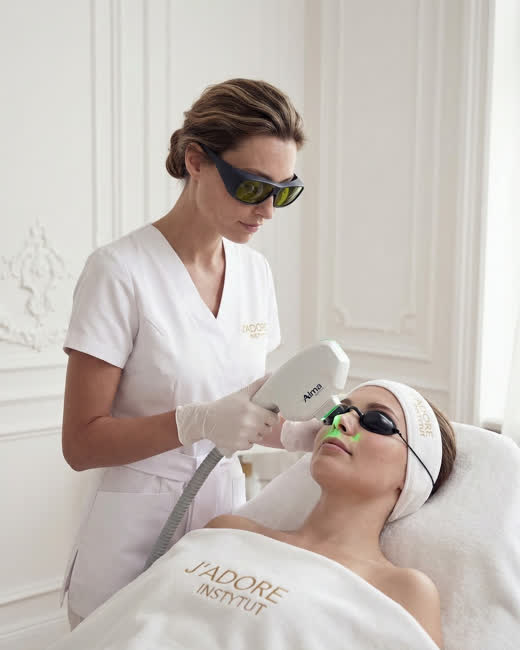
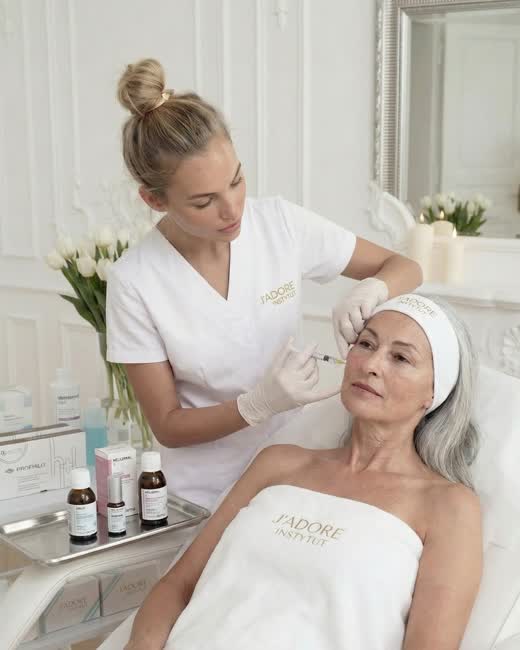
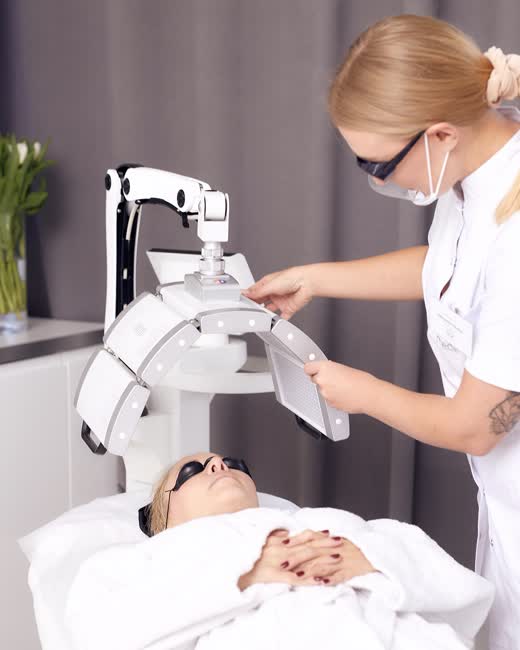
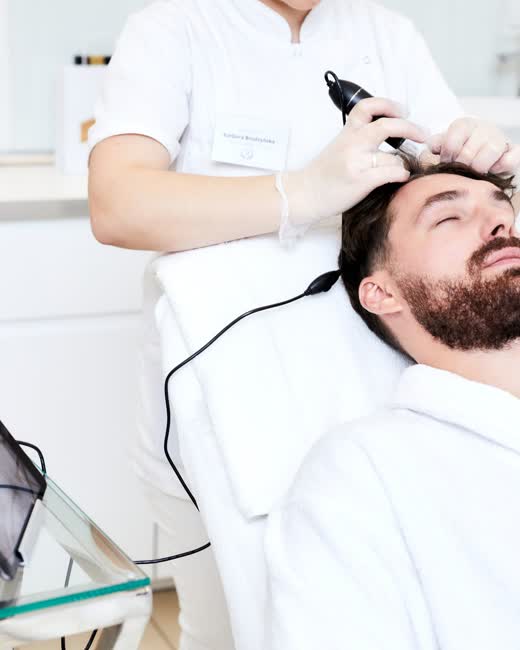
A treatment room at J'adore
FACIAL COSMETOLOGY
Acne is not a "phase" you wait out, and it's not about "not washing your face properly." It's an inflammatory skin condition with a specific microbiology — clogged pores, excess sebum and the bacterium Cutibacterium acnes, which drives red papules and pustules. A single treatment can refresh the skin for a moment, but acne responds to a plan, not a one-off action.
That's why our acne treatment at J'adore Instytut is an 8-week combined programme: first we calm active lesions (salicylic peels, cleansing, blue LED, HydraFacial), then in the second phase we address what acne leaves behind — hyperpigmentation (PIH) and scarring. The treatment is led by an experienced cosmetologist. This is cosmetology that complements, not replaces, dermatology — with inflammatory or hormonal acne, we say so directly. Below is everything worth knowing before your first visit.
8-week programme: series usually 4–6 sessions every 1–2 weeks
How it works
Acne develops when three things come together: excess sebum, keratinised skin cells blocking the pore opening, and the bacterium *Cutibacterium acnes (formerly Propionibacterium acnes), which multiplies in this environment. A blocked pore becomes a blackhead, and once inflammation joins in — a red papule or pustule. That's why an effective treatment doesn't target one point — it addresses all these mechanisms at once*.
Hence the word "combined." Salicylic peel cleanses pores from within and regulates oil production, blue LED calms the bacteria without medication, manual extraction removes existing blackheads, and HydraFacial gently exfoliates and unblocks pore openings. This is a cosmetology programme — not a medical treatment — and we approach it accordingly: no antibiotics, no hormones, using physical and chemical methods.
Ideal for
Female zone and male zone
In women, acne after age 25 often has a hormonal background and favours specific locations — chin, jawline, around the mouth — with flare-ups at a particular phase of the cycle. Skin can also be more sensitive, so we choose gentler concentrations and a slower pace. This is a classic acne treatment for women.
What we work with
In men, acne can be more intense — higher androgen levels drive oil production, skin is thicker, and there's another factor: shaving, which mechanically spreads bacteria across the beard line. Hence frequent "chin and jawline acne." This is a typical acne treatment for men.
What we work with
Fact: blue LED light "treats" acne without any medication — the bacterium C. acnes produces natural pigments (porphyrins), which under light around 415–420 nm release reactive oxygen and damage the bacteria themselves. Skin stays intact, and bacteria numbers drop.
Safety
With an acne treatment, results and safety depend on three things worth asking about at any salon:
A good programme starts with an assessment of acne type and severity — at J'adore this is done by an experienced cosmetologist, who knows when lesions exceed the salon's scope and a dermatologist should be involved. "One treatment for everything" is a warning sign.
Acne responds to a series and the right sequence (calming lesions first, then addressing scars). A promise of "clear skin after one treatment" isn't credible.
We use trusted, professional peel and serum lines and a medical LED lamp, and we tailor concentrations and pace to your skin — not "off the internet." Acids used in too aggressive a schedule can worsen acne.
Red flag: "a miracle acne treatment" in one visit and suspiciously cheap · Acne is a chronic condition — no single, bargain-priced treatment will "cure it once and for all." Watch out for promises of instant results, aggressive peels administered by someone without a cosmetology qualification, and "miracle" products with no name or listed ingredients. You have the right to ask who's running the treatment, what the series plan is, and which products are used. A good salon will answer without hesitation — and may sometimes advise against a treatment, referring you to a dermatologist first.
FACIAL COSMETOLOGY
Contraindications
Some contraindications are permanent, others temporary — in that case, we simply postpone the treatment until the situation passes. This is a non-invasive treatment (no needles in the active phase), so skin and barrier condition are what matter most.
From the cosmetologist's chair
The most often forgotten thing: cold sores. Clients think, "I only have it on my lips, and we're peeling the cheeks — that shouldn't matter." It does matter — an active virus is a risk during exfoliation, regardless of where it appears. Better to postpone by a few days.
This isn't a complete list — we'll go through your medications, skin conditions and previous treatments individually at your consultation.

What to expect
Most important: skin won't clear up after one visit. Acne calms gradually — you'll usually notice fewer new breakouts after 2–3 sessions (a few weeks), with clear improvement only after the full programme. Working on scars and hyperpigmentation takes the longest, because it's skin remodelling.
The thing I hear most often after the first treatment: "I think it's got worse." That's usually purging — lesions that were already forming under the skin come out faster. It doesn't mean the treatment isn't working; quite the opposite. We stick to the plan and assess results after the series, not after one visit.
After the programme, skin usually doesn't return to its starting point — provided you keep up home care and periodic visits. Acne is a chronic condition: we work towards remission and control, not a one-off "switch-off" of the problem.
Portfolio
A record of the work in our salons — the place where we publish treatment frames and, after photo sessions, results.
A record of results — in preparation. We publish photographs of our clients only with their consent.
The acne treatment and your lifestyle
With acne, most depends on what you do between visits. There's one rule — during the treatment, exfoliated skin is more sensitive to sun and irritation, so we pay particular attention to a few habits.
This is key: after peels, skin picks up hyperpigmentation more easily, and UV sets PIH in place. Mattifying SPF 50+ every morning throughout the programme (and afterwards), and we drop tanning beds altogether. "Tanning treats acne" is one of the most persistent myths.
After a salicylic peel or cleansing, give your skin a few hours to breathe. Day to day, choose non-comedogenic products — a heavy, pore-clogging foundation keeps lesions going on its own.
After a stronger peel, skip the sauna and pool for a day or two: heat increases redness, and chlorinated water irritates freshly exfoliated skin.
During the programme, don't add your own acids or coarse exfoliating scrubs — this is the quickest route to a dehydrated barrier and, paradoxically, worse acne. We agree everything with your cosmetologist.
Retinol is a great ingredient for acne, but only at the right moment and low concentration. We introduce it in stages during the reduction phase — too early and too strong, and it can irritate.
The hardest habit: don't pick at lesions yourself. It's the main cause of scarring and bacterial spread. We handle blackhead extraction in the salon, after softening the skin first.
Acne programme
In the acne treatment, several methods sound similar but do different things and often work together. The simplest way to think of them is as stages of one plan:
removes what's already clogging pores
doesn't calm bacteria or deep inflammation on its own — this is mechanical cleaning
regulates from within
won't mechanically remove a large blackhead "here and now" — that's what extraction is for
gentle support and calming
on their own, these won't resolve advanced inflammatory acne — they work as a set
Combine with
The acne treatment is by nature a set of methods. The cosmetologist decides on order and spacing at consultation, but the programme's logic stays constant — inflammation first, then marks:
I often hear: "let's just do Dermapen for scars while I'm here." I explain a simple rule: first put out the fire, then renovate. Microneedling on active, inflamed acne can spread bacteria and worsen the condition. That's why scars enter the plan only once the skin has calmed.
Products and methods
Under the heading "acne treatment" sit several tools, each with a different job — peels, devices and serums. You don't choose them "off the shelf" — your cosmetologist selects them based on your acne type, the programme phase, and your skin's sensitivity.
Salicylic acid is lipophilic — it penetrates pores, cleanses them, and works as an antibacterial and sebum-regulating agent. Mandelac (with mandelic acid) is gentler, good for more sensitive skin.
Dla kogoActive phase: inflammatory and comedonal acne, excess oil.
A peel with exfoliating, brightening and biostimulating action; helps even out tone and brighten post-acne hyperpigmentation.
Dla kogoReduction phase: PIH and improved texture.
Vortex technology: simultaneous hydro-abrasion, extraction of impurities from pores and serum infusion. Gentle exfoliation without micro-trauma — safe for sensitive skin too.
Dla kogoUnblocking pores and refreshing oily/combination skin during the programme.
Blue light (approx. 415–450 nm) destroys the acne bacterium by activating porphyrins and calms inflammation; red light (approx. 630–660 nm) stimulates regeneration and collagen. Painless, with no downtime.
Dla kogoBlue in the active phase, red in the regeneration and scar phase.
Dermapen microneedles the skin, triggering collagen remodelling in scars; EstGen (bioengineered colostrum) calms inflammation and speeds up healing. Used once active acne has calmed.
Dla kogoAtrophic scar phase (rolling, boxcar) and adult acne.
Fact: Where do the differences between variants come from? From the programme phase and skin type. We approach a teenager with active acne differently from a woman with adult chin acne, and differently again from a man with chin acne and excess oil. What matters is the right protocol and consistency, not a single "magic" product.
Price list
Checking free hours…
From the magazine
Editorial pieces on how this treatment works in practice — what happens during the session, how to prepare, where the limits are and what the first days after look like.
See also
The result lastsresults maintained with home care + follow-up sessionsJ’adore Instytut
Information. This text is for informational purposes and does not replace a consultation. The acne treatment is a cosmetology treatment — the choice of treatments, length of series and contraindications are decided by a cosmetologist/specialist during an individual consultation. Cosmetology complements, but does not replace, dermatological treatment; for inflammatory or hormonal acne we recommend parallel dermatologist care.
Home care
Cosmetics matched to what your skin needs after a treatment — so the clinic effect lasts longer.
 acne and blemishesDermoMedicaAnti-Blemish Nanoneedling Patches 9 pcs.View in the shop(opens in a new tab)
 oily skinSkeyndorExpert Cleanse Pro – Mattifying Foam GelView in the shop(opens in a new tab)
 sun protectionCell Fusion CAquatica Sunscreen 100 SPF 50+/PA++++View in the shop(opens in a new tab)
 acne and blemishesMesoesteticGrascontrol Detox PowderView in the shop(opens in a new tab)
 oily skinMedik8Natural Clay Mask™View in the shop(opens in a new tab)
 sun protectionDermaQuestSunArmor SPF50 30 mlView in the shop(opens in a new tab)
 acne and blemishesPeel MissionUPWASHING ACNE SKIN ACID GEL 250mlView in the shop(opens in a new tab)
 acne and blemishesDiego Dalla PalmaSmart Pure Exfoliating Mask stick 30 gView in the shop(opens in a new tab)