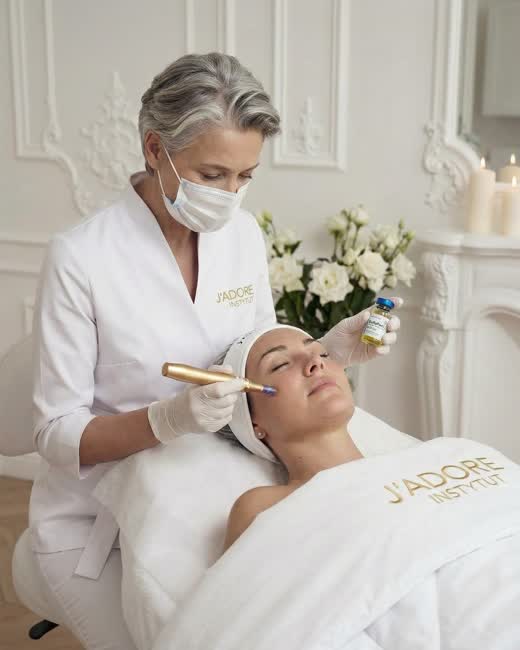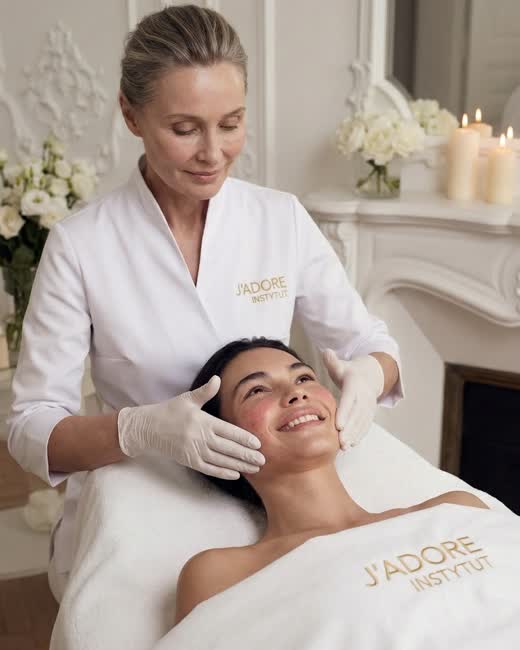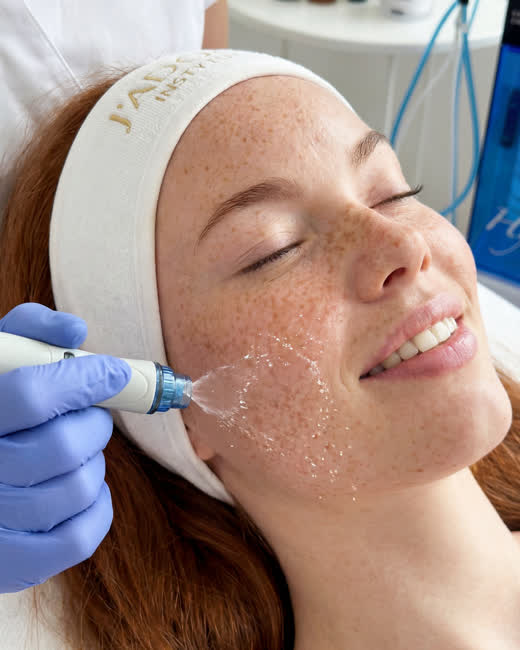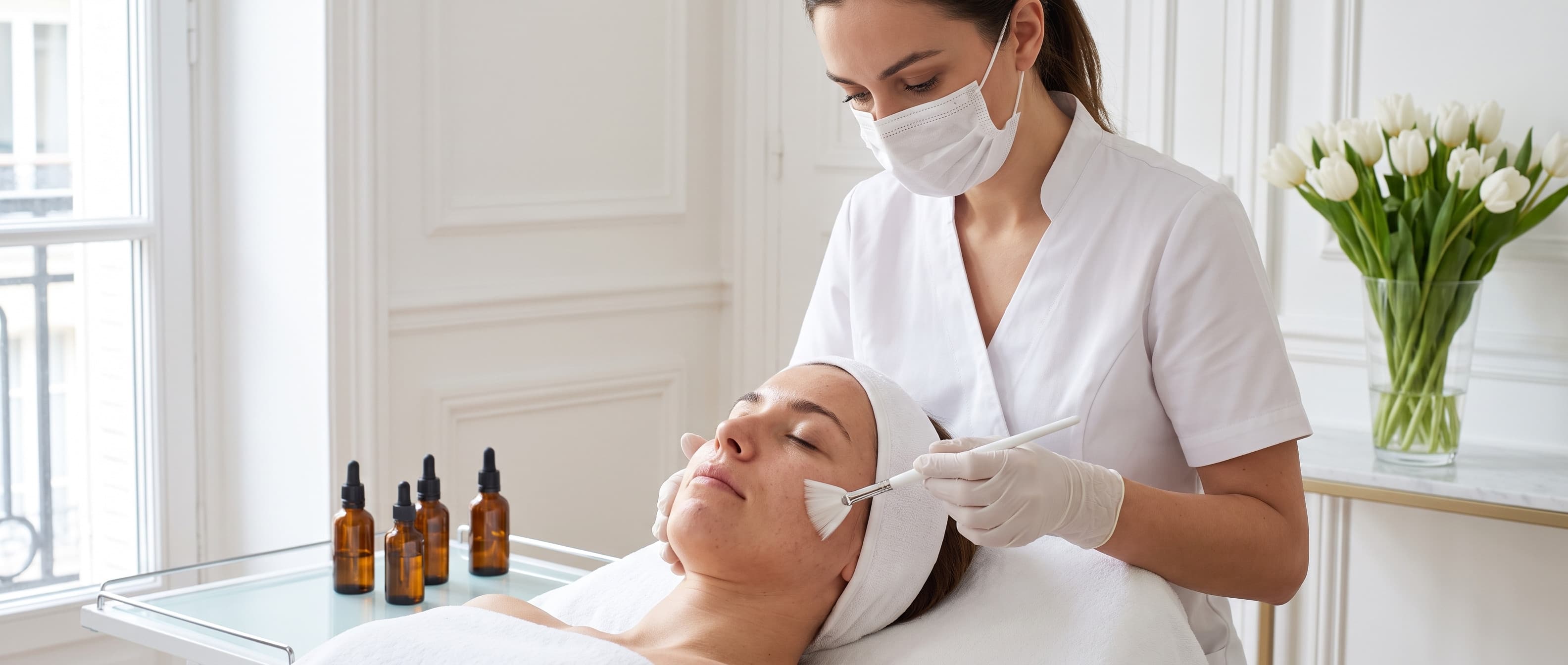
 A treatment room at J'adore
MEDICAL PEELS
Skin that feels tight after washing. A dull, “tired-looking” complexion.
Dry, flaky patches and slight unevenness in skin tone. At the same time, there may be concern that “the acid will be too strong”, that your face will become red or start peeling in flakes. This is exactly the type of skin lactic acid peel (Lactipeel) was created for. Lactic acid is the largest AHA molecule in the entire group. It penetrates the skin most slowly and superficially. This makes it the gentlest and best-tolerated AHA acid. It is recommended as a “first peel” and for dry, sensitive and irritation-prone skin. It also has a quality other acids do not have: it is hygroscopic. It naturally binds water in the epidermis, so it not only exfoliates but also hydrates. The result is smoother, firmer and brighter skin, without the price of stinging and a week indoors. This is a superficial AHA peel. In our salons, it is performed by an experienced cosmetologist. Below, you will find everything worth knowing before your first visit: whether it works at all, whether it stings, whether and for how many days your skin will peel, when results become visible, how many treatments are needed in a series, and why SPF after a peel is not optional.
best as a series of 4–6 treatments every 1–2 weeks, followed by seasonal maintenance
How it works
A lactic acid peel is a superficial peel with lactic acid — one of the AHA (alpha-hydroxy) acids. Lactic acid has the largest molecule in the entire AHA group, so it penetrates the skin more slowly and superficially than, for example, glycolic acid. This may sound like a disadvantage, but it is its greatest benefit. It is the gentlest and best-tolerated acid. It works in a controlled way, without aggressively “dissolving” the epidermis. This is why it is suitable as a “first peel” and for dry and sensitive skin.
The mechanism is simple: lactic acid loosens the bonds between dead cells in the stratum corneum, allowing the epidermis to renew itself. Skin becomes smoother and skin tone more even. But lactic acid does something else that other acids cannot — it is hygroscopic, meaning it binds water in the skin. It is a natural component of our NMF, the epidermis’s moisturising factor. It therefore not only exfoliates but also hydrates. Rather than drying the skin, it improves hydration levels. This is why lactic acid peel is sometimes called a “hydrating peel”.
In the salon, lactic acid peel belongs to the category of peels for dry, dehydrated, dull and sensitive skin, rather than strong “maximum-strength” peels. It is often the first step in using acids, part of a hydrating protocol, or a safe choice for people concerned about exfoliation. Your cosmetologist will decide during consultation whether lactic acid peel alone is sufficient or whether it may be worth moving to a stronger peel over time.
Ideal for
Lactic acid peel is a gentle and hydrating peel, not a “strong treatment for everything”. For deeper wrinkles, visible acne scars or advanced melasma, your cosmetologist will select a stronger peel or another protocol. Lactic acid peel may then be part of skin preparation rather than the main tool.
Women’s zone and men’s zone
Lactic peel for women is most often the answer to dryness, dehydration and loss of radiance — skin that feels tight in winter and from air conditioning, dull skin after summer, or a “first peel” without the risk of redness. We often combine it with hydrating treatments and skincare because the goal is the same: firm, smooth and radiant skin, not skin that has been “stripped”.
What we work with
Lactic peel for men is a good, gentle start to professional skincare — without redness or downtime. Men’s skin can be thicker and oily, yet dehydrated at the same time (shaving, soaps, no moisturiser). Lactic acid gently exfoliates and hydrates, improving texture and tone. By the evening after your appointment, there is no trace of the treatment — you can return to work or a meeting.
What we work with
Did you know: lactic acid is not “laboratory chemistry” in a negative sense — it is a natural component of our own skin (part of NMF, the natural moisturising factor) and has been known to humankind for millennia: Cleopatra’s sour milk baths were simply a prehistoric lactic peel. This explains its dual action — it exfoliates like an acid, while hydrating like a component the skin “knows”.
Safety
Lactic peel is one of the safest chemical peels, but “safe” does not mean “unaffected by who performs it and how”. Several factors determine the result and safety. They are worth asking about in every salon:
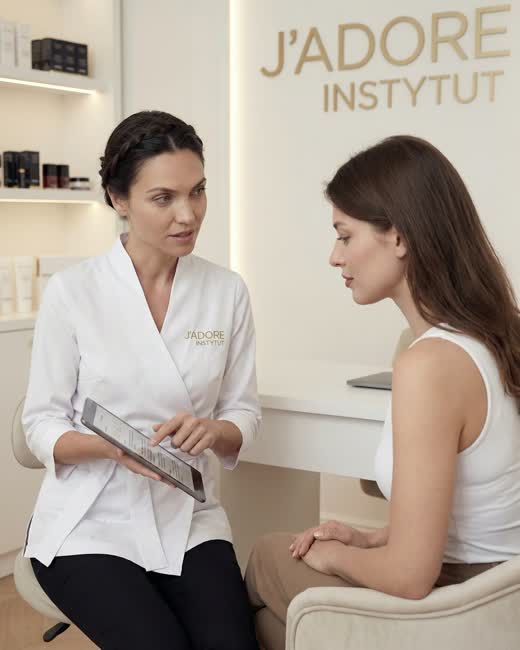
Every peel begins with a consultation and skin assessment. The cosmetologist checks your skin phototype, skin condition, medication and previous treatments. Based on this, they select the strength and application time. A peel offered “straight away”, without discussing your skin, is a warning sign.
We use peels from legal professional distribution, with a known concentration and pH. An acid of unknown origin, or a “home” product of unknown strength, can produce unpredictable results and carries a real risk of irritation or hyperpigmentation.
With acids, less often means better. The aim is controlled exfoliation and hydration, not maximum irritation. The cosmetologist adjusts the concentration and application time to suit your skin.
Freshly exfoliated skin is more sensitive to the sun. Without daily SPF 50+ after a peel, hyperpigmentation can easily occur instead of brightening. Protection is therefore part of the treatment, not an extra.
Red flags when it comes to peels ·
MEDICAL PEELS
Contraindications
A lactic peel is gentle, but it is still a chemical peel. Some contraindications are permanent, while others are temporary. In these cases, we simply postpone the treatment until the situation has passed.
From the cosmetologist’s salon
The most commonly overlooked issue is cold sores. People think: “I only get them on my lips, and the peel is for the whole face — so it probably does not matter.” It does matter. A chemical peel can spread and intensify the virus. With an active lesion, we postpone treatment. With frequent recurrences, we plan prophylaxis. The second issue is isotretinoin (for example, after acne treatment) — a full 6-month interval applies here, without exceptions.
This is not a complete list — we will discuss your medicines, skin conditions, skin phototype and previous treatments individually during consultation before the peel.

What to expect
Most importantly: a lactic acid peel does not usually cause visible skin peeling. It is a superficial peel. You will most often see slight redness on the same day, followed by subtle, fine exfoliation over the next few days. Sometimes it is not visible at all. Skin peeling off in “sheets” is associated with stronger, medium-depth peels, not a lactic acid peel.
The most common concern before a “first peel” is: “will all my skin peel off, and will I have to stay at home?”. With a lactic acid peel — almost certainly not. It is the gentlest of the AHA acids. Most clients leave without redness and return to their usual activities straight away. If slight peeling occurs — do not pick at it, as this is the simplest route to hyperpigmentation and irritation. Let it peel naturally.
You will usually see the result of hydration, smoothness and radiance straight away or after 1–2 days. Lasting even skin tone and improved skin condition require a course of treatments — usually 4–6 treatments every 1–2 weeks, followed by seasonal maintenance.
Portfolio
A record of the work in our salons — the place where we publish treatment frames and, after photo sessions, results.
A record of results — in preparation. We publish photographs of our clients only with their consent.
Lactic acid peel and your lifestyle
For several days after a peel, your skin is “freshly exposed” and more sensitive. The most common questions concern what happens afterwards: sun, make-up, sauna and skincare with acids. There is one rule — do not irritate your skin for a few days and protect it from UV without exception.
This is the most important rule with every peel. Freshly exfoliated skin is prone to hyperpigmentation. Without daily SPF 50+, dark spots can easily appear instead of brightening. Avoid intensive sun exposure. Peels are best performed outside the peak tanning season.
Sunbeds and intentional tanning are excluded during the course and immediately afterwards. They are a simple route to irritation and hyperpigmentation on freshly exfoliated skin.
Give your skin time to rest on the same day. It is best to apply make-up from the following day, on well-hydrated skin. After a mild peel, you can also go out with only cream and SPF.
High temperatures, chlorine and sweat irritate freshly exfoliated skin. Postpone saunas, swimming pools and hot baths for a few days after the treatment.
Stop using products with retinol, AHA/BHA and other strong active ingredients for a few days after the peel. This prevents irritation from building up. Focus on hydration and regeneration.
Intensive training and heavy sweating immediately after the treatment may worsen redness and irritation. Avoid strenuous exercise on the first day. Afterwards, there are no restrictions, with SPF outdoors.
If you are travelling somewhere sunny, schedule your final peel well in advance. Use SPF while you are there. We do not begin a course of peels immediately before intensive tanning.
Lactipeel — lactic acid
A “peel” is not one single thing. Peels differ in depth of action and purpose. A lactic peel sits at the gentlest end of this scale. Here is how it compares with two related options:
the gentlest option — hydrates and brightens
does not remove deep wrinkles or pronounced scars; insufficient for advanced melasma
gentle, but works more intensively on the skin
less “hydrating” than a lactic peel; may feel slightly more noticeable on the skin
targeted treatment for melasma / deep hyperpigmentation
this is not “instant radiance”; it requires commitment, home care and strict SPF use — selected individually
Combine with
A lactic peel works well alongside other treatments. On its own, it refreshes and hydrates. Combined with other treatments, it enhances hydration and radiance. The cosmetologist decides on the order and intervals during consultation, but the general approach remains the same:
The simplest rule when choosing: dry, sensitive skin, “first time” → lactic peel. Acne and hyperpigmentation tendency → mandelic peel. Persistent melasma → a separate depigmentation protocol. We often start gently with a lactic peel. This helps your skin become accustomed to acids. Only then — if needed — do we move to stronger options. This is not taking a step back. It is a safe sequence.
Lactic peels
A “lactic peel” is not one ready-made product from a shelf. It is lactic acid in different concentrations and formulations, offered by professional salon skincare brands. You do not choose the preparation yourself — the cosmetologist selects it according to your skin condition, skin phototype and goal (hydration alone versus gentle brightening). Below are the lines we work with:
Pure lactic acid (AHA), the gentlest superficial peel — hydrates and brightens.
Dla kogoDry, sensitive skin, a “first peel”; face, with neck/décolletage as an option.
Professional Spanish salon skincare; AHA peels, including lactic acid peels, with controlled concentration and pH, selected by a cosmetologist according to your skin condition.
Dla kogoDry/dehydrated skin, even skin tone and radiance — when a precisely selected superficial peel is needed.
Fact: Why do they differ? It comes down to acid concentration, pH and product form (gel, solution), as well as the brand and whether lactic acid is used alone or as part of a broader protocol. The lower the pH and the higher the concentration, the stronger the action. This makes selection by a cosmetologist even more important. For sensitive skin, we start with the gentlest variant and observe the response before increasing the intensity.
Price list
Checking free hours…
From the magazine
Editorial pieces on how this treatment works in practice — what happens during the session, how to prepare, where the limits are and what the first days after look like.
See also
The result lastshydration and radiance are usually visible straight away; even skin tone and improved skin condition develop and become established over a seriesJ’adore Instytut
The above text is for information purposes only and does not replace a consultation. A lactic acid peel (Lactipeel) is a beauty treatment — a superficial peel with lactic acid (AHA); the term “medical peel” refers to the class of preparation, not to the treatment being performed by a doctor. The peel type, its strength, the number of treatments in a series and contraindications are determined by a cosmetologist/specialist during an individual consultation, including after assessing your skin phototype and skin condition.
Home care
Cosmetics matched to what your skin needs after a treatment — so the clinic effect lasts longer.
 hydrationSesdermaMANDELAC Moisturizing CreamView in the shop(opens in a new tab)
 post-treatment regenerationCell Fusion CDermagenis pH Biome SerumView in the shop(opens in a new tab)
 sun protectionDermaQuestSunArmor SPF50 30 mlView in the shop(opens in a new tab)
 hydrationMedidermaHylanses Md Ha Advance Concentrate SerumView in the shop(opens in a new tab)
 post-treatment regenerationVagheggiEmozioni Plus — Anti-Stress Face Mask 75mlView in the shop(opens in a new tab)
 sun protectionSkeyndorProtective cream SPF 50+ – Age Photo DefenseView in the shop(opens in a new tab)
 hydrationMedik8Lipid-balance Cleansing Oil™View in the shop(opens in a new tab)
 hydrationSelvert ThermalThe Essential Care Daily Moisturising CreamView in the shop(opens in a new tab)