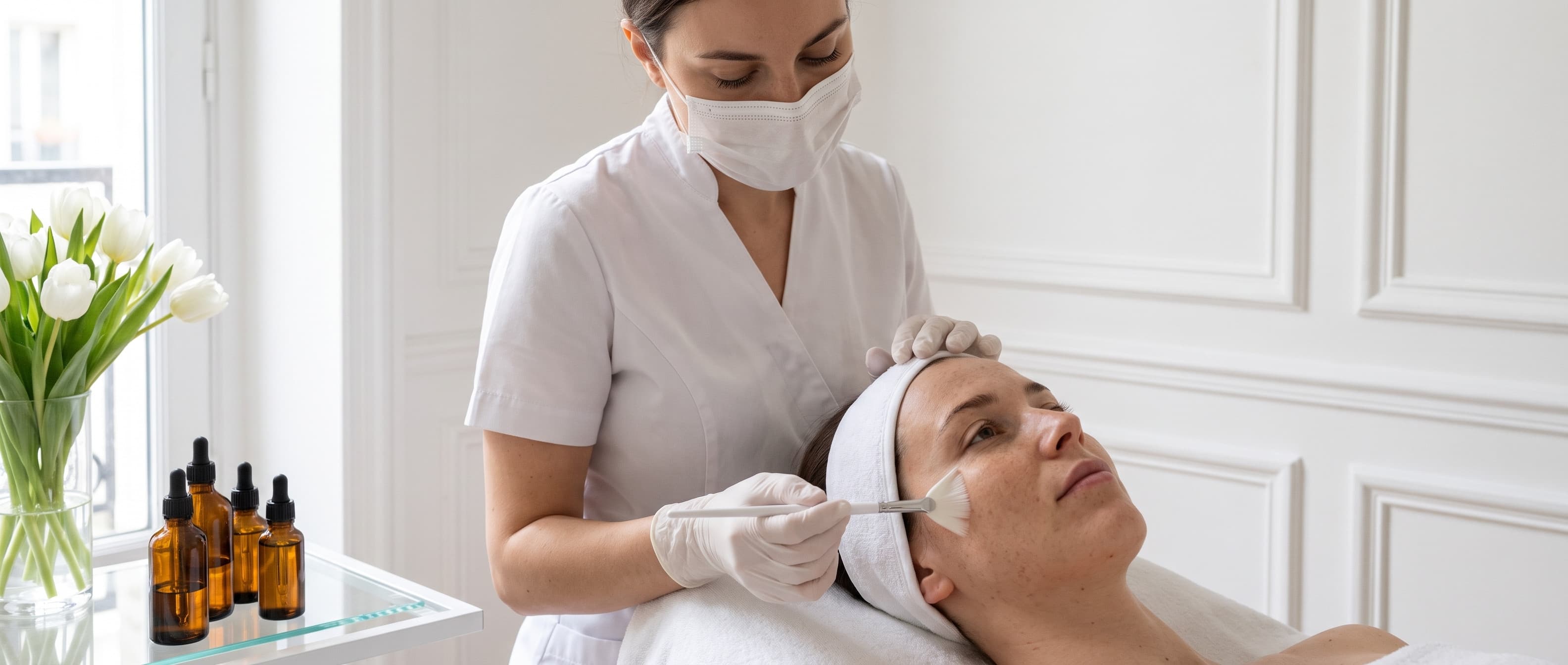
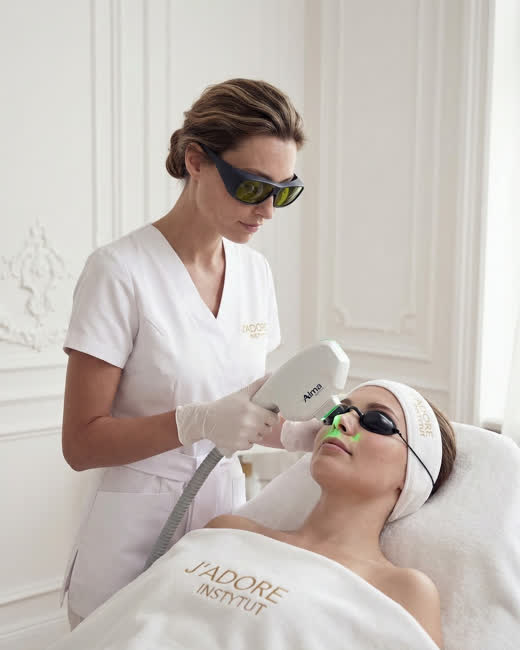
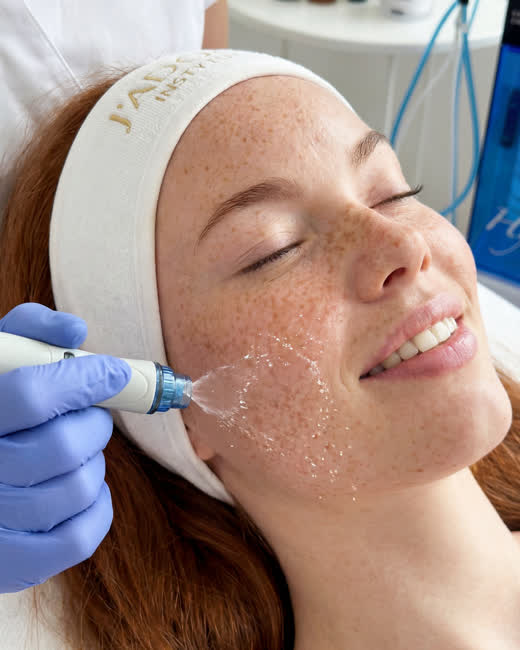
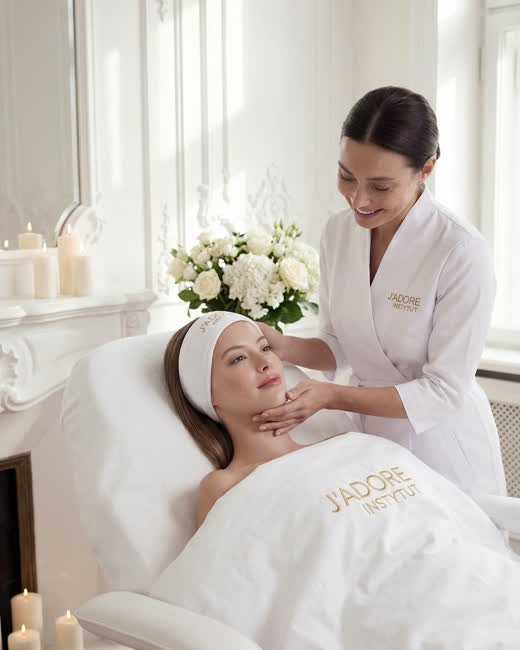
A treatment room at J'adore
MEDICAL PEELS
Persistent redness, broken capillaries on the cheeks and around the nose, skin that flushes at the slightest trigger — or recurring breakouts followed by hyperpigmentation. These are problems of reactive, vascular and acne-prone skin that an ordinary cream simply can't manage.
The Azelac peel is based on azelaic acid (Mediderma / Sesderma line) — one of the mildest, yet most "intelligent" acids: it works as an anti-inflammatory, strengthens vessel walls, regulates melanogenesis and sebum — hitting exactly the points that trouble skin with rosacea and broken capillaries. This is a superficial peel: it's not about aggressive exfoliation, but controlled calming and strengthening of the skin. At J'adore Instytut, the treatment is carried out by an experienced cosmetologist. Below you'll find everything worth knowing before your first visit: whether it really works, whether it stings, whether you'll flake and for how many days, when you'll see results, and why SPF isn't optional here.
series of 4–6 treatments every 1–2 weeks (a 10-session package is also available)
How it works
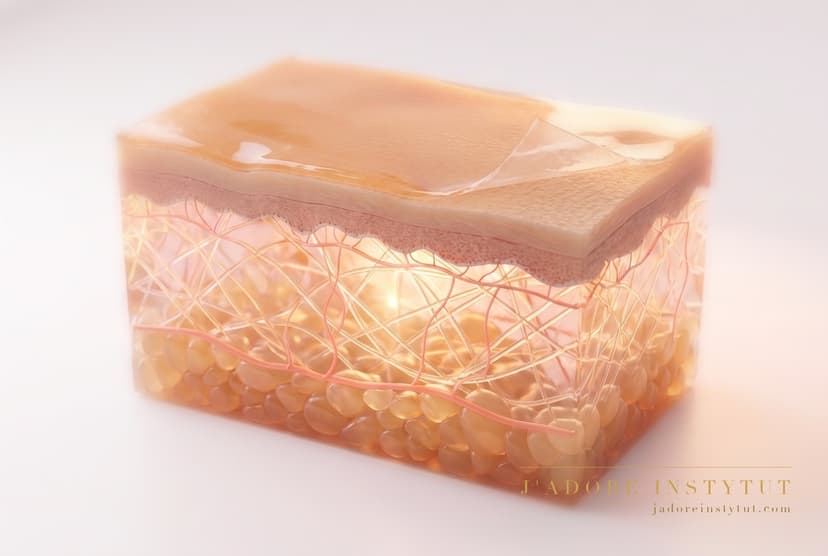
Azelac is a peel based on azelaic acid — a substance the skin already recognises naturally (it's derived, among other things, from grains). Unlike strong "exfoliation" acids, azelaic acid works on multiple fronts, and gently: it curbs inflammation, calms redness, strengthens the walls of small blood vessels, regulates sebum production and brightens hyperpigmentation by blocking excess melanin production.
This is a superficial peel — it works mainly on the epidermis, in a controlled and safe way. The goal isn't to make skin "peel off in flakes" — it's to calm it, even out its tone and strengthen it. That's why Azelac is one of the first choices for redness-prone, vascular and reactive skin that doesn't respond well to more aggressive treatments.
Ideal for
This is a "first-contact" peel for rosacea and broken capillaries — gentle but consistent. For more advanced concerns, a cosmetologist may combine it with other treatments (more on that below).
Women's concerns and men's concerns
The most common reason women choose the Azelac peel for women is rosacea and broken capillaries — redness, flushing, skin that flares up easily. The second is hyperpigmentation (post-inflammatory and hormonal) and uneven skin tone. Azelaic acid is ideal here, since it calms and brightens at the same time, while being well tolerated by sensitive skin.
What we work with
In the men's category, the Azelac peel for men most often targets oily, congested skin, with blackheads and acne scars, along with shaving-related hyperpigmentation and irritation (dark marks and breakouts along the beard line). Men rarely have an SPF habit, so sun-induced hyperpigmentation is common too. Azelac regulates sebum, works as an antibacterial and evens out skin tone — with zero downtime.
What we work with
Fun fact: azelaic acid does two things at once that usually require two different ingredients — it calms redness and flushing (like an "anti-rosacea" ingredient) and brightens hyperpigmentation (like a "pigment" ingredient). That's why it works so well where problems overlap: rosacea-prone skin that also hyperpigments after every breakout.
Safety
With peels, results and safety depend on a few things worth asking about at any salon:
The Azelac peel is performed by an experienced cosmetologist — after a skin analysis and consultation. The cosmetologist assesses skin phototype and reactivity, and chooses the strength and number of layers. A peel done "on the spot", without a skin assessment, is asking for irritation.
We use only genuine Mediderma/Sesderma products from legitimate sources. A peel of unknown origin means unpredictable pH and concentration — that's a risk, not a result.
There's no "one peel for everyone". The number of treatments and the intervals between them are set individually by your cosmetologist — a peel sold as a single "miracle" without a plan rarely delivers a lasting result on redness or hyperpigmentation.
Without sun protection after a peel, it's easy to develop post-inflammatory hyperpigmentation. A good salon finishes the treatment with SPF and gives you clear guidance in writing.
Red flag — when it's better to walk away ·
Contraindications
Some contraindications are permanent, others temporary — in which case we simply postpone the treatment until the situation resolves. We'll go through the full list at consultation.
From the cosmetologist's chair
The most commonly overlooked issue: cold sores. "It's just a small blister on my lip" — that's enough to postpone a peel. An active virus combined with controlled exfoliation risks spreading the lesion. Better to wait a few days, and for recurring cold sores, simply plan antiviral protection before the series.
This isn't a complete list — we'll discuss your medications, skin conditions, phototype and previous treatments individually at consultation.

Why the price is so "reasonable"
A superficial peel is often cheaper than more intensive salon treatments, and that's not a reason for suspicion — provided it comes with a genuine product, a consultation and a plan. Low price becomes a warning sign only when it's paired with no skin assessment, an unlabelled product, or a series sold "blind".
In other words: with Azelac, you're not paying for "heavy exfoliation" — you're paying for the right choice and safe management of the series. That's why a single treatment is affordable, while real change comes from consistency, not a one-off "big hit".
What to expect
Azelac is a peel I dose "for the skin", not "for the price list". For very reactive, rosacea-prone skin, I go easier on the first treatment — shorter exposure, fewer layers — to see how the skin responds. Only in later sessions can I work more intensively. This isn't a peel meant to deliver everything in one go.
Portfolio
A record of the work in our salons — the place where we publish treatment frames and, after photo sessions, results.
A record of results — in preparation. We publish photographs of our clients only with their consent.
What to expect
The key point: this is a gentle, superficial peel. Don't expect skin to dramatically "come off". You'll most often notice temporary redness and a feeling of tightness, and flaking tends to be mild, sometimes barely noticeable — small, dry flakes, not large sheets of skin.
Does it sting? You'll usually feel mild tingling, stinging or warmth during application — a normal reaction to the acid, controlled by your cosmetologist. Azelaic acid is one of the milder peels, so sensations are generally well tolerated, even on sensitive skin.
The effect doesn't appear "the next day". A refreshed skin tone can be visible after the first treatment, but real improvement in redness, broken capillaries and hyperpigmentation builds over a series and is maintained through home care and consistent SPF.
From the cosmetologist's chair
The most common disappointment after a first Azelac session is "but I barely flaked at all". And that's a good thing! With rosacea and broken capillaries, we don't want heavy exfoliation — we want calming. Judge the result after the series, by how much less your skin flares up — not by how much skin "came off".
Peels and your lifestyle
Most peel questions are about afterwards: sun, make-up, sauna, home acids, exercise. The rule is the same for all of it — skin regenerates over the first few days and is more sensitive to UV, so sun protection isn't a suggestion, it's a condition for results.
This is the most important rule with any peel. After treatment, avoid direct sun and sunbeds, and use SPF 50+ daily for at least a few weeks. Without it, you risk post-inflammatory hyperpigmentation — the opposite of what you're trying to achieve.
With a superficial peel, make-up can usually go on from the next day. On the day of the treatment, let your skin rest. Your cosmetologist will give you precise guidance depending on your skin's reaction.
High temperatures, chlorine and sweat irritate freshly exfoliated skin and worsen redness. Postpone the sauna, pool and hot baths for a few days after treatment.
Stop using strong AHA/BHA acids and retinol in your home routine until your cosmetologist tells you it's safe to reintroduce them. Applying them right after a peel is a quick route to irritation.
Intense exercise and heavy sweating right after treatment can sting and worsen redness. Give your skin 1–2 days of rest, then you're free to resume as normal.
Sunbeds are out. Travelling into full sun during a series of peels risks hyperpigmentation — mention your plans at consultation, and we'll schedule sessions so your skin isn't exposed at a sensitive moment.
Azelac — azelaic acid
"A peel for hyperpigmentation" isn't one single tool. Azelac, a stronger superficial peel and a depigmentation protocol each do something different, matched to the problem — and sometimes they complement each other:
calms and evens out
not an aggressive "resurfacing" treatment — won't remove deep scars or advanced melasma on its own
stronger exfoliation
can be too strong for very rosacea-prone, vascular skin — azelaic acid is a better fit then
targets stubborn pigment
this is a separate, intensive course — not a single refreshing peel
Combine with
Azelac works best as part of a plan, not on its own. The order and intervals are decided by your cosmetologist at consultation, but the general logic stays the same — first we calm and strengthen, then we finish the effect:
If skin mainly reddens and shows broken capillaries, I start with Azelac. If the issue is very oily skin with blackheads, I often reach for a salicylic or mandelic peel instead. And if it's stubborn melasma, a peel alone won't be enough — then we talk about a full depigmentation protocol. The choice isn't about "which peel is strongest" — it's about which one fits your problem.
Products and variants
The "azelaic peel" at J'adore is a specific product from the Mediderma/Sesderma line, though you'll find similar acids in a few other salon ranges. The client doesn't pick the product "off the shelf" — your cosmetologist chooses it based on the problem, skin reactivity and treatment area. The treatment area and series format also vary:
A classic azelaic peel: anti-inflammatory, regulating melanogenesis and sebum, and strengthening blood vessels. Gentle, well tolerated by sensitive skin.
Dla kogoRosacea, broken capillaries, redness, hyperpigmentation, reactive skin.
The same product, different treatment areas — from the face alone to face with neck and décolletage (where broken capillaries and hyperpigmentation also like to appear).
Dla kogoFor when the problem doesn't stop at the face — the neck and décolletage redden and hyperpigment too.
A convenient package of treatments for a full course — for persistent redness, rosacea and hyperpigmentation, where consistency counts.
Dla kogoFor those aiming for a real, longer-lasting change, ready to commit to the full series.
From the cosmetologist's chair
I often hear: "maybe go straight for something stronger than azelaic acid?" For skin that reddens and has broken capillaries, stronger peels can be a mistake — they irritate and worsen redness. I choose Azelac precisely because it's gentle: it lets us work consistently, without "punishing" the skin.
Fact: Where do differences in strength and sensation come from? From the number of layers applied, exposure time and how your skin responds — not from the product name on the label. Two azelaic peels using "the same product" can feel different because your cosmetologist doses them differently for your specific skin. It's about the right fit, not "stronger is better".
Price list
Checking free hours…
From the magazine
Editorial pieces on how this treatment works in practice — what happens during the session, how to prepare, where the limits are and what the first days after look like.
See also
The result lastscumulative effect — builds and is maintained with a series and home careJ’adore Instytut
Informational text. The description above is educational in nature and does not replace a consultation. The Azelac peel is a beauty treatment (the word "medical" in the category name refers to the class of product, not to the treatment being performed by a doctor). The choice of peel, its strength, the number of sessions in a series and any contraindications are determined by a cosmetologist/specialist during an individual consultation, following a skin analysis.
Home care
Cosmetics matched to what your skin needs after a treatment — so the clinic effect lasts longer.
 capillaries and rednessMedidermaRedness Control A&A Sensitive Cream 50mlView in the shop(opens in a new tab)
 sensitive skinCell Fusion CLow pH CleanserView in the shop(opens in a new tab)
 sun protectionDermaQuestSunArmor SPF50 30 mlView in the shop(opens in a new tab)
 capillaries and rednessPeel MissionAza Gel 30 gView in the shop(opens in a new tab)
 sensitive skinSesdermaSERENITY mask 50 mlView in the shop(opens in a new tab)
 sun protectionSkeyndorProtective cream SPF 50+ – Age Photo DefenseView in the shop(opens in a new tab)
 capillaries and rednessMedik8Calmwise™ SerumView in the shop(opens in a new tab)
 capillaries and rednessVagheggiEmozioni Plus Soothing Mist 100ml — Soothing concentrated mist/tonerView in the shop(opens in a new tab)