

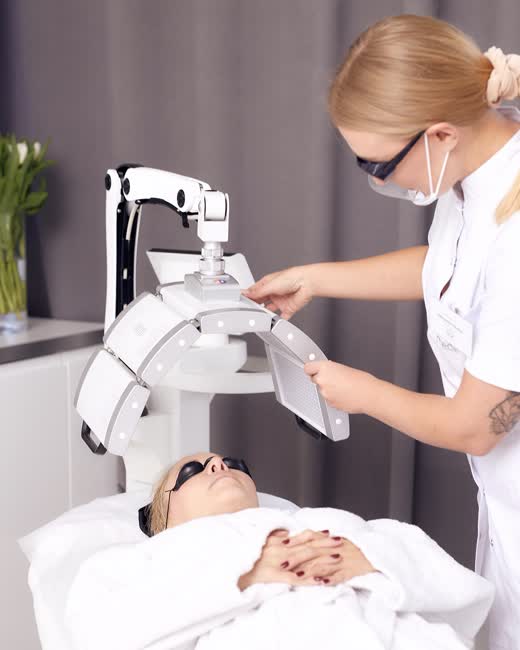
How does laser hair removal work?
The laser emits a beam of light absorbed by melanin — the pigment in the hair follicle. Thermal energy destroys the follicle without damaging the surrounding skin.
Key point: the laser only works on hairs in the growth phase (anagen). Only 20–30% of hairs are in this phase at any one time. That's why a series of 6–8 sessions every 4–8 weeks is needed.
Devices at J'ADORE INSTYTUT
Soprano ICE (Alma Lasers) — 810 nm diode
The most widely used device for laser hair removal. The SHR (Super Hair Removal) system delivers a series of rapid, lower-energy pulses that heat the follicle gradually and painlessly. It can also be used on tanned skin (though not on fresh tans).
Ideal for: phototypes I–VI. All body areas. Particularly recommended for darker skin or after sun exposure.
Sensation: mild warmth. One of the most comfortable treatments in the salon.
Soprano ICE Platinum (Aleje) — multi-beam
The Platinum version combines three wavelengths at once (755 nm Alexandrite + 810 nm diode + 1064 nm Nd:YAG). It reaches different follicle depths, making it even more effective on dark hair and fair skin.
Ideal for: a wide range of hair types. Available at our Aleje location.
Versus (lesthezone) — diode
A diode device for hair removal. An alternative to Soprano ICE, used for selected body areas.
ZYE YAG — HR (Hair Removal) handpiece
Nd:YAG 1064 nm — a handpiece exceptionally effective on very dark or thick skin (phototypes V–VI) and on tanned skin. The deepest-penetrating device in the J'ADORE range.
Most commonly treated body areas
Women
- Legs (full or 3/4), bikini (classic, deep, Brazilian), underarms
- Face: upper lip, chin, sides of the face
- Abdomen, arms, fingers
Men
- Back, chest, abdomen
- Neck, arms
- Underarms
- Legs (increasingly popular among athletes)
How many sessions are needed?
- Body area: Underarms — Number of sessions: 6–8 — Intervals: Every 4–5 weeksBody area: UnderarmsNumber of sessions: 6–8Intervals: Every 4–5 weeks
- Body area: Classic bikini — Number of sessions: 6–8 — Intervals: Every 4–6 weeksBody area: Classic bikiniNumber of sessions: 6–8Intervals: Every 4–6 weeks
- Body area: Brazilian bikini — Number of sessions: 7–9 — Intervals: Every 4–6 weeksBody area: Brazilian bikiniNumber of sessions: 7–9Intervals: Every 4–6 weeks
- Body area: Full legs — Number of sessions: 7–9 — Intervals: Every 5–8 weeksBody area: Full legsNumber of sessions: 7–9Intervals: Every 5–8 weeks
- Body area: Face (women) — Number of sessions: 7–10 — Intervals: Every 4–5 weeksBody area: Face (women)Number of sessions: 7–10Intervals: Every 4–5 weeks
- Body area: Back (men) — Number of sessions: 7–10 — Intervals: Every 5–8 weeksBody area: Back (men)Number of sessions: 7–10Intervals: Every 5–8 weeks
Preparation and aftercare
Before the treatment:
- Shave (do not wax or thread) 24–48 hours beforehand
- No active tan in the treatment area (at least 4 weeks without sun exposure)
- No self-tanning products in the treatment area
- No photosensitising medication (discuss this with your cosmetologist)
After the treatment:
- Mild redness for 24–48 hours is normal
- SPF 50+ for sun exposure for 2 weeks
- Do not wax or epilate between sessions — shaving only
Contraindications
- Open skin lesions or infections in the treatment area
- Pregnancy and breastfeeding (for hair removal on larger body areas)
- Significantly photosensitising medication (discuss this with your cosmetologist)
- Active tan or recent self-tanning
- Vitiligo or a tattoo in the treatment area (requires special care)
- Isotretinoin treatment — a 6-month break is required


