

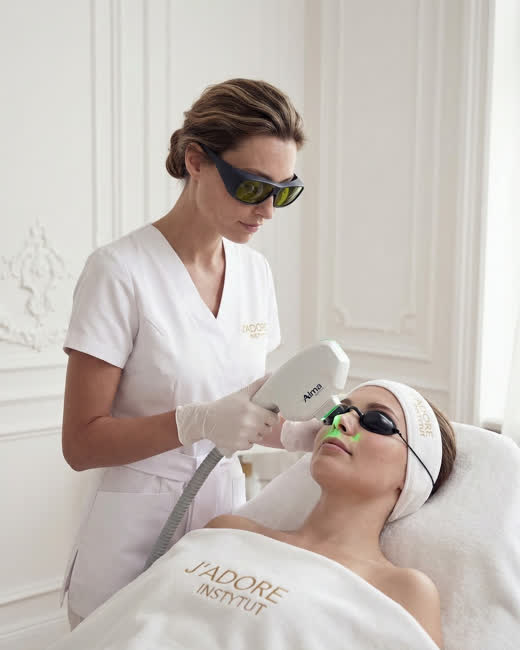
What you actually see in the mirror — and why it isn't "fat"
Let's start with the first misconception: cellulite isn't simply fat. Or rather — it isn't fat alone. If it were, it would disappear with any diet and only appear in people who are overweight. Yet we see it in slim, athletic, healthy-eating women — and often don't see it in men who carry real excess weight. This asymmetry tells us something important about what the real problem is.
Beneath the skin, in the subcutaneous tissue, fat cells sit within a network of connective tissue fibres — something like partitions or honeycomb cells. These partitions anchor the skin from below, connecting it to the deeper layers. And here's the key point: in women, this network is built differently than in men. The fibres run perpendicular to the skin — straight up, like vertical rods. In men, they run diagonally and cross over each other, forming a stiffer mesh.
There's one more factor at play: microcirculation. The areas where cellulite most often appears — thighs, buttocks, abdomen — naturally have weaker blood and lymph flow. When circulation is impaired, the tissue is less well nourished, fat cells enlarge, and the connective tissue partitions gradually lose elasticity and stiffen. The skin above — instead of lying flat — ripples and dips into the characteristic depressions.
Three layers of the problem — and why diet only touches one
To understand why diet alone isn't enough, it helps to see cellulite as a three-layered problem. Each layer needs a different approach — and diet has a real effect on only one of them.
- Layer 1 — PARTITION STRUCTURE (the framework). The vertical connective tissue fibres surrounding fat cells stiffen and shorten over time, pulling the skin downward. These are what create the visible dimpling on the surface. Diet alone won't loosen them — this is a mechanical, structural problem that needs energy capable of reaching deep into the tissue.
- Layer 2 — FAT CELLS (the content). This is where diet and physical activity make the most sense: as you reduce fat tissue, the cells shrink and press less on the partitions. The effect is limited, though — even if the cells shrink, the stiff partitions keep pulling the skin down. That's why weight loss can improve the appearance of cellulite, but rarely eliminates it.
- Layer 3 — MICROCIRCULATION (tissue nourishment). Poor blood and lymph circulation drives the whole cycle: the tissue is less well nourished, fat cells enlarge, local metabolism slows, and the partitions stiffen faster. Physical activity helps here — but the areas most prone to cellulite are often poorly perfused regardless of your overall activity level.
In other words: diet and physical activity are valuable, but they only work on one third of the problem. The rest — partition structure and deeper circulation — needs an approach that reaches the tissue where diet physically can't.
Grades of cellulite — and when it stops being "just a lifestyle issue"
Cellulite isn't uniform. Specialists distinguish between grades — from barely noticeable changes visible only under pressure, to deeper, structural tissue changes visible even when lying down. This scale has practical significance: the higher the grade, the smaller the impact of diet alone, and the greater the role of methods that work deeper.
- 01
Visible only under pressure
Skin looks smooth at rest. Unevenness appears only when you pinch the skin or apply pressure. Microcirculation is slightly impaired, but the partitions retain their elasticity. This is the stage where prevention — exercise, diet, massage — makes the most sense.
- 02
Visible when standing
Dimples and bumps are visible when standing, though not necessarily when lying down. The partitions begin to stiffen, and local circulation is noticeably weaker. Diet alone now brings limited results — the tissue needs external stimulation.
- 03
Visible in any position
Unevenness is visible both standing and lying down. The partitions are considerably stiffer, and you may notice tightness or increased skin sensitivity. At this stage, tissue changes are pronounced and need work on the structure — not just lifestyle changes.
- 04
Advanced changes
Deeper connective tissue changes, clear surface irregularity, and possible pain under pressure. Changes at the level of tissue microarchitecture are firmly established. A multi-pronged approach is recommended: both deep tissue stimulation and comprehensive contouring treatments.
What the myths say, and what science says
Cellulite has accumulated a layer of half-truths that both generate guilt and sell products. It's worth setting the record straight.
What actually works
has real grounding
- Reducing fat tissue (diet + activity) — reduces "pressure" on the partitions
- Physical activity — improves overall microcirculation
- Massage — provides short-term improvement in lymphatic drainage
- Avoiding alcohol and salt — reduces water retention and swelling
- Hydration — affects surface skin elasticity
- Treatments that work on tissue structure — can address partitions and circulation at depth
What WON'T solve the problem
myth or significant overestimation
- Anti-cellulite creams alone — don't reach the layer where the problem lies
- Dry brushing — temporary circulation boost, no effect on the partitions
- "Detoxing" — cellulite isn't caused by toxins
- Diet alone, without work on the structure — improves, rarely eliminates
- Exercises targeted at "burning cellulite" — fat can't be burned in a specific spot
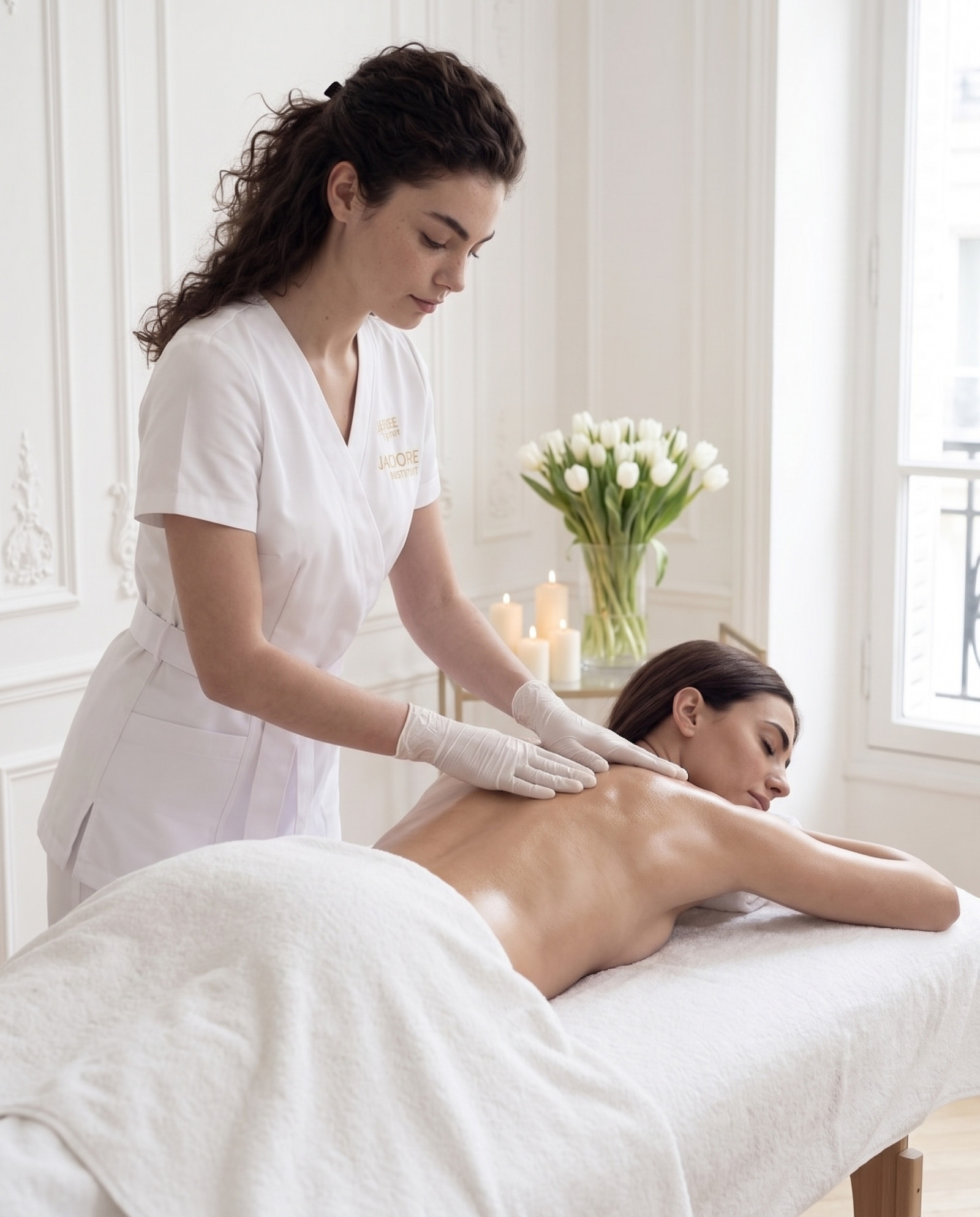
What it means to "work on the structure" — and why go deeper
Since the problem lies in stiffened partitions and impaired microcirculation, it makes sense to look for methods that can reach those areas. This is exactly what sets in-salon treatments apart from home care: tools that penetrate deep into the tissue can go beyond the limit that any cream can reach.
Different techniques achieve this in different ways — and it's worth understanding the logic behind each one, because that helps you assess what you actually need. Some focus on mechanically loosening the partitions — literally working on the connective tissue fibres pulling the skin down. Others rely on deep heat, which stimulates the tissue to remodel — the fibres soften, new collagen is produced, and circulation improves. Another group works primarily on flow — lymph and blood — improving tissue nourishment and speeding up the removal of excess fluid.
In practice, the best results come from combining several of these approaches at once — because cellulite is multi-layered, and one treatment rarely addresses all its causes at the same time. That's why, during a consultation, the conversation isn't about a single method but about what dominates for you: whether the problem lies more in the partition structure, in circulation, or in tissue volume — and only then do we select the right tools.
Treatments — how we choose them
Below are the methods we use to work on cellulite — grouped by what they primarily target. In practice, we select them individually, often combining several approaches, because cellulite rarely has a single cause. If you're not sure where to start, a consultation is a good starting point: it lets us assess which layer of the problem is most active for you.
Body contouring
Comprehensive work on subcutaneous tissue — combined methods targeting partition structure, circulation and volume.
Lymphatic drainage
Work on circulation and removing excess fluid — an ideal complement to structural treatments.
Endermology / mechanical massage
Mechanical loosening of adhesions and partitions, plus improved microcirculation — addresses the first layer of the problem.
Laser body treatments
Deep thermal stimulation of the tissue — supports partition remodelling and new collagen formation.
Shockwave therapy
Mechanical breakdown of hardened connective tissue areas — effective for established cellulite.


